


Theistic Evolution: The Teilhardian Heresy by Wolfgang Smith examines the intellectual and theological system of Pierre Teilhard de Chardin, the French Jesuit who proposed a fusion of evolutionary theory and Christian theology. Smith, a mathematician and physicist with a deep grounding in metaphysical philosophy, undertakes a precise dismantling of Teilhard’s evolutionary cosmology, exposing its scientific weaknesses and its radical reinterpretation of Christian doctrine.
The book traces how Teilhard’s vision of a “Christified evolution” functions as a new creed — an ideology that replaces divine creation with the self-unfolding of matter toward an Omega Point of collective consciousness.
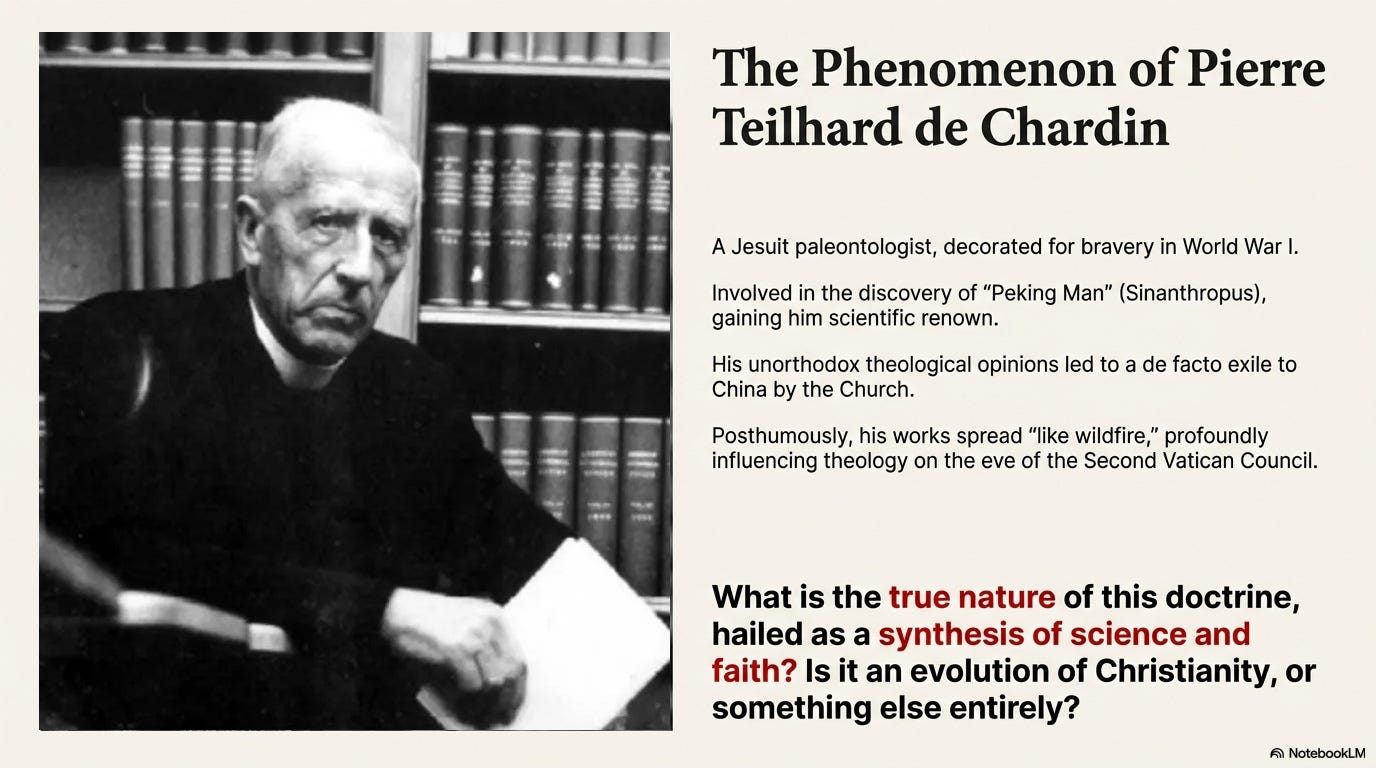
The Rise of a Modern Prophet
Pierre Teilhard de Chardin, born in 1881 in France and educated by the Jesuits, sought to reconcile Darwinian evolution with the faith of the Church. His work in paleontology and his participation in the discovery of “Peking Man” gave him credibility in scientific circles1. After years of suppression by the Jesuit hierarchy, his manuscripts circulated widely after his death in 1955, spreading rapidly through the Catholic world on the eve of the Second Vatican Council. His synthesis of cosmic evolution, mysticism, and human progress captivated both scientists and theologians. Smith opens the study by identifying this historical moment as a critical turning point when scientific modernism entered the theological bloodstream of Western Christianity.
Bots React Podcast (34:16)
Evolution as the Axis of Thought
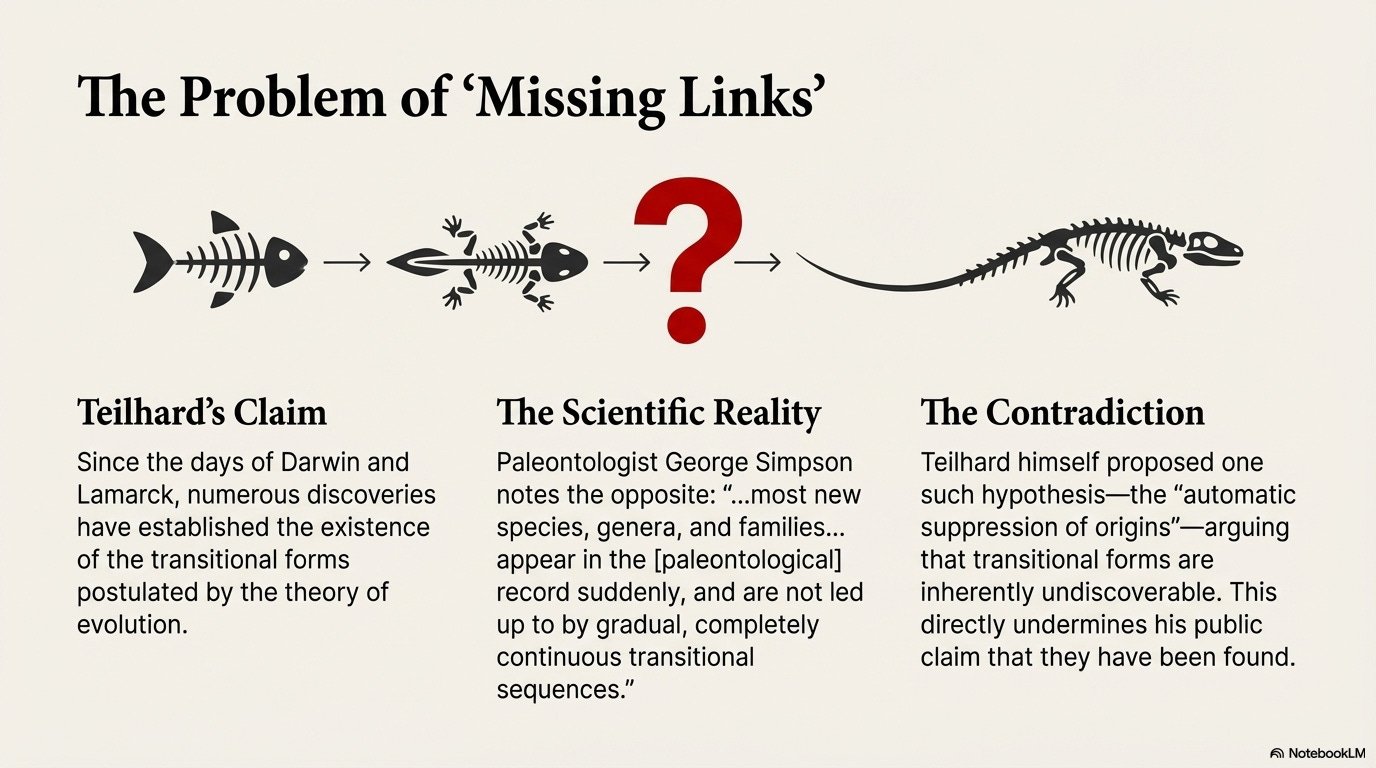
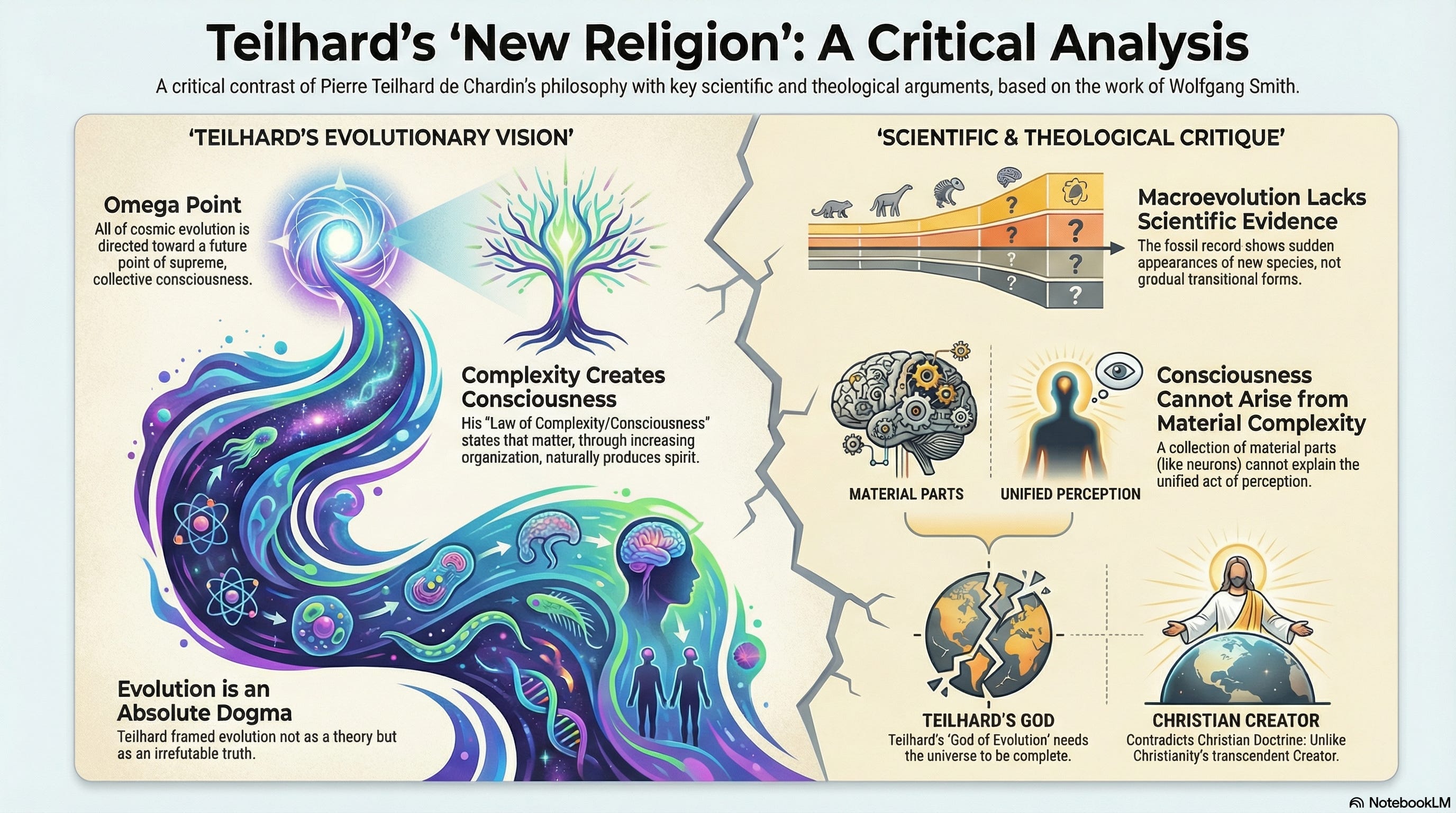
Smith begins by defining Teilhard’s central premise: evolution functions as the “general condition” of reality, the framework through which all phenomena must be interpreted. Teilhard calls it “a light illuminating all facts.” Smith subjects this declaration to rigorous analysis, examining the scientific legitimacy of macroevolutionary claims. He draws a strict distinction between microevolution — observable variations within species — and macroevolution, the unobserved transformation of one species into another. He demonstrates that the fossil record offers no continuous chain of transitional forms and that the supposed “missing links” have remained missing despite a century of excavation.
Citing biologists such as George Gaylord Simpson, Colin Patterson, and Douglas Dewar, Smith emphasizes that species appear in the geological record abruptly and fully formed. He argues that Teilhard’s statements about “numerous discoveries” confirming transitional forms are factually incorrect. He emphasizes the mathematical precision of biochemical data, especially in protein sequence studies, such as comparisons of cytochrome C, which reveal clear distinctions among major biological groups. A fish, reptile, and mammal differ by equivalent genetic distances, undermining the idea of gradual descent. These data, Smith asserts, make macroevolution untenable as a scientific hypothesis.
The Ideology of Evolution
Smith identifies a crucial philosophical shift: Teilhard treats evolution as an a priori truth rather than an empirical conclusion. Quoting The Phenomenon of Man, Smith highlights Teilhard’s claim that evolution has become a “dimensional condition which all hypotheses must satisfy.” This inversion — transforming theory into a metaphysical axiom — constitutes, in Smith’s view, the core of Teilhardism. Evolution ceases to describe change within nature and becomes the essence of being itself.
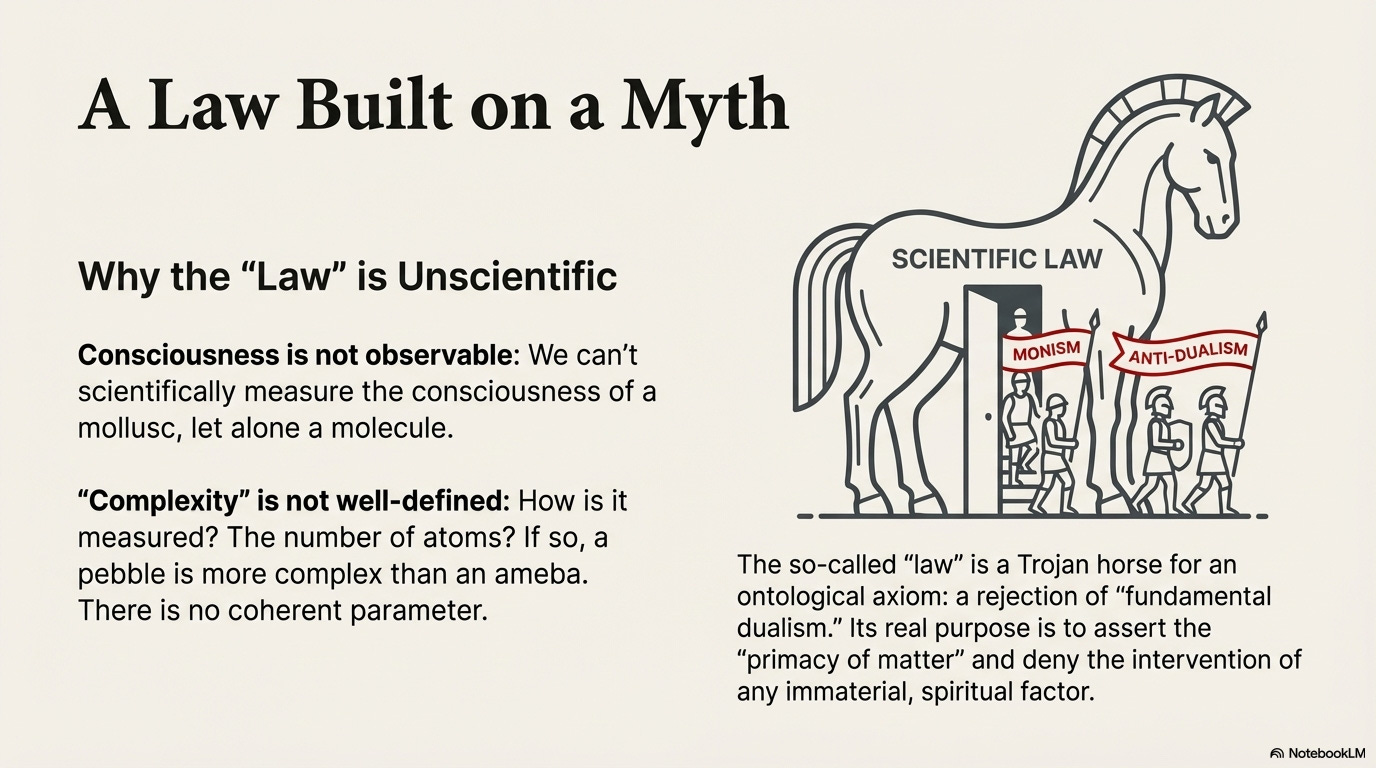
Smith traces this inversion to a pseudo-Kantian logic2. Teilhard asserts that because we perceive phenomena within space and time, the process of transformation must define reality. Smith refutes this, explaining that human perception does not dictate the structure of the cosmos. The assumption that every real event must be empirically observable, he argues, restricts metaphysics to the limits of sensory data. This confinement reduces the act of creation to a perceptual event rather than a transcendent cause.
The Collapse of the Stochastic Universe
Smith turns to modern physics to test Teilhard’s commitment to chance as the motor of evolution. Teilhard’s language of “happy accidents” and “directed groping” presumes that life unfolds through random variation guided by natural or “psychic selection.” Smith brings the anthropic principle into the discussion, citing physicists Paul Davies and Ludwig von Bertalanffy to demonstrate that the fundamental constants of the universe are finely tuned to permit human existence. The strength of electromagnetic forces, the gravitational constant, and the rate of cosmic expansion align within infinitesimal margins that sustain the conditions for life.
From this evidence, Smith concludes that the cosmos bears the imprint of design. He observes that modern physics, once committed to materialism, now points toward an intelligent principle governing the universe. Within this framework, the Darwinian appeal to statistical chance collapses. The same reasoning that recognizes precise tuning in cosmology must, by logical extension, affirm intentionality in biogenesis. For Smith, the order of life expresses continuity with divine causation rather than stochastic evolution.
Creation and Time
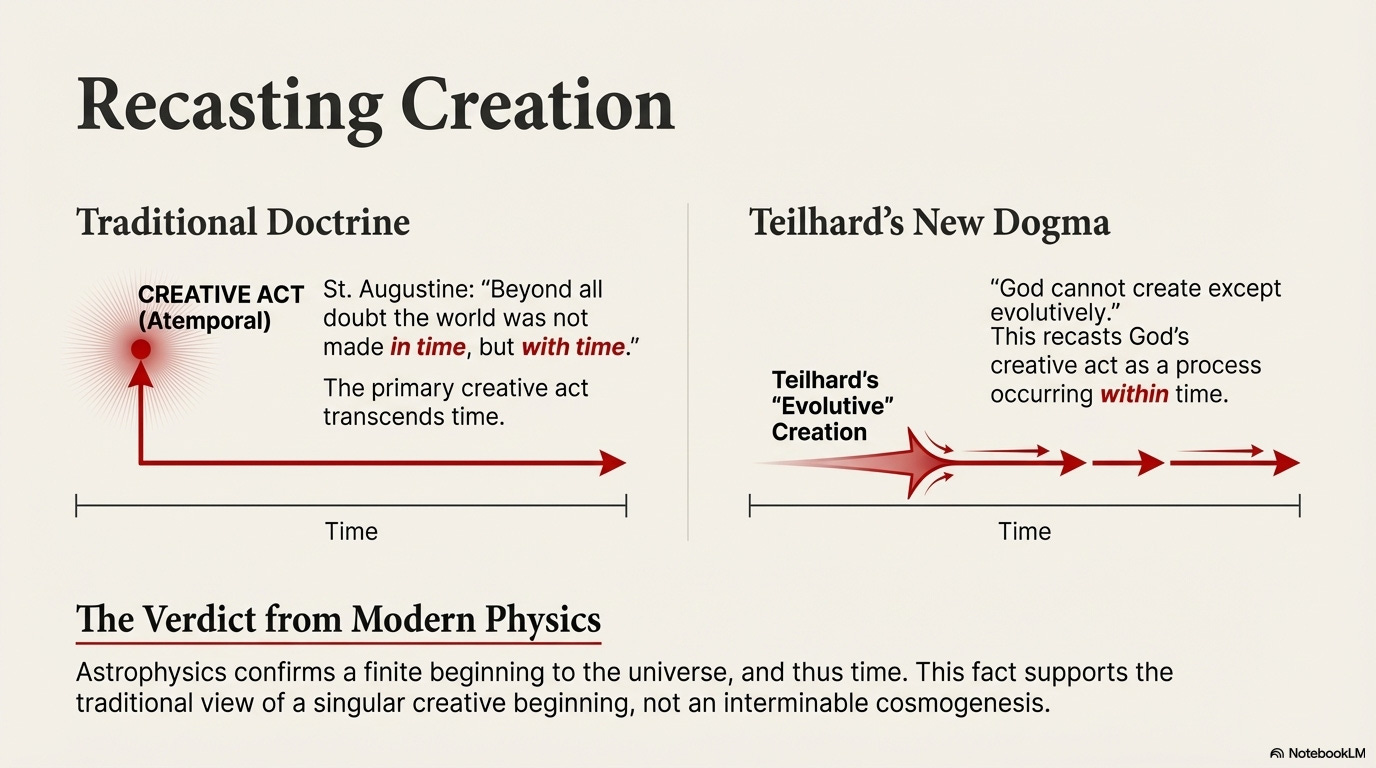
Smith proceeds to the theological consequences of Teilhard’s system. Teilhard declares, “God cannot create except evolutively.” Smith identifies this as a redefinition of the Creator. Drawing from St. Augustine, St. Thomas Aquinas, and the Book of Genesis, he establishes that creation occurs “with time, not in time.” Time, as part of creation, cannot contain the act that brings it into existence. Evolution, by contrast, presupposes temporal succession. A temporal process cannot, therefore, constitute the creative act itself.
Smith explains that Genesis presents two complementary accounts of creation. The first describes the sequence of formation—the six days of the hexaemeron. The second, in Genesis 2:4–5, reveals the eternal aspect: “He that liveth in eternity created all things at once.” This simultaneity defines creation as a timeless decree from which temporal processes unfold. Teilhard’s idea of a universe “unfolding interminably into the past” conflicts with both revelation and metaphysics. Smith cites contemporary astrophysics, which identifies a finite cosmic beginning roughly twenty billion years ago, to confirm the theological principle that time itself had a point of origin.
The Metaphysics of the Seed
Smith develops a profound metaphor drawn from patristic theology — the doctrine of rationes seminales, or seminal reasons. Every creature exists first as an intelligible seed within the creative act of God, then unfolds into temporal manifestation. The visible world expresses these archetypal realities through form and development. Evolution, understood in this metaphysical sense, refers to the unfolding of preexistent essences, not to random transformation. Teilhard’s denial of this inner hierarchy, Smith argues, uproots being from its metaphysical source. The result is a vision of life as self-generating matter without transcendent origin.
Transformism and the Mechanization of Life
Smith revisits Teilhard’s essays on transformism, in which Teilhard argues that the emergence of life can be explained by a continuous network of physical causes. Teilhard calls this faith in “one organic physical interaction of living beings” the mark of an evolutionist mind. Smith reads this as a declaration of material determinism. He identifies in it the residual influence of Newtonian physics — a belief in a seamless chain of cause and effect linking all natural phenomena. In this model, God no longer acts as transcendent Creator but as an internal force within the evolving cosmos.
Smith regards this absorption of divinity into physical process as the decisive break from orthodoxy. The Creator becomes the energy of evolution; Christ becomes the cosmic center of matter. Teilhard’s theological vocabulary preserves Christian terminology while inverting its metaphysical content. Terms such as “creation,” “redemption,” and “Christ” acquire naturalistic meanings that dissolve the distinction between God and the world.
The Omega Point and the New Religion
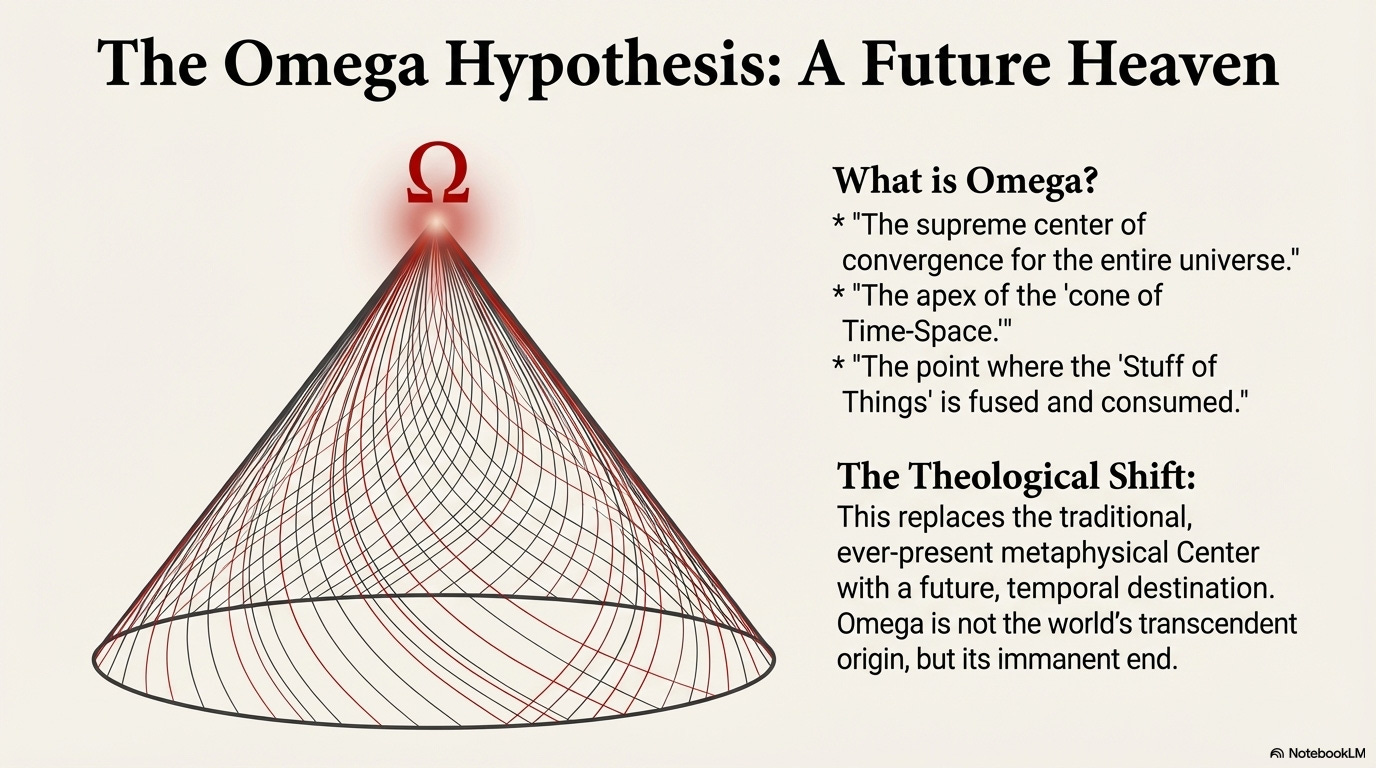
At the apex of Teilhard’s system stands the Omega Point, a final state of convergence where consciousness, matter, and divinity fuse into total unity. Smith analyzes this as a metaphysical reversal of Christian eschatology. The Omega Point represents not the transcendent return of creation to God but the self-deification of the cosmos. Salvation becomes evolutionary completion; grace becomes biological integration. Humanity evolves toward a collective organism — the noosphere — culminating in universal consciousness.

Smith interprets this vision as the foundation of a new religion. He calls it “the religion of evolution,” a faith that sanctifies progress and material development as divine acts. In this worldview, sin becomes resistance to evolution, and redemption becomes participation in cosmic growth. The historical Church, with its revealed doctrines and sacraments, yields to a planetary faith governed by science, technology, and social unification.
The Return of Gnosis
In the appendix, “Gnosticism Today,” Smith traces the spiritual ancestry of Teilhardism. He situates it within the ancient Gnostic impulse to seek salvation through inner enlightenment rather than divine grace. The Gnostic believes in ascent through knowledge, the transformation of the human into the divine by self-evolution. Teilhard’s emphasis on consciousness and self-transcendence mirrors this pattern. The Omega Point functions as a modernized Pleroma, the fullness of being attained through the elevation of the mind.
Smith argues that this revival of Gnosis under the guise of science carries immense cultural consequences. It reshapes ethics, politics, and theology by identifying moral progress with biological evolution. The sanctification of social evolution leads to collectivism, the subordination of the individual to the species, and the reinterpretation of salvation history as social development.
A Call to Intellectual Clarity
Smith writes from the standpoint of classical metaphysics. His critique of Teilhard de Chardin extends beyond doctrinal boundaries into the foundations of modern thought. He defends the distinction between the Creator and creation, form and matter, being and becoming. The book reasserts the metaphysical structure of Christian cosmology: creation as the timeless act of God, the world as the temporal unfolding of that act, and man as the image of the eternal within time.
He concludes that Teilhardism represents a synthesis of scientism and mysticism that seduces the modern mind by promising transcendence through evolution. Its language of progress conceals a displacement of divine revelation by human self-assertion. Smith calls for the recovery of authentic metaphysical vision, one that perceives the cosmos as transparent to transcendence rather than as an autonomous mechanism.
The Enduring Significance
Teilhardism and the New Religion is a precise analysis of the intellectual transformation that shaped twentieth-century theology. Wolfgang Smith brings to the task the technical acumen of a physicist and the contemplative insight of a metaphysician. His exposition of the “God of evolution” as an idol of modern consciousness exposes the spiritual cost of replacing divine creation with evolutionary myth. The book endures as both a critique of Teilhard de Chardin and a defense of the perennial Christian worldview that understands the cosmos as created, ordered, and sustained by the eternal Word.
Through careful reasoning and theological precision, Smith restores clarity to questions that shaped an age:
What is creation?
What is evolution?
What does it mean to say that God acts in the world?
The force of his arguments lies in their affirmation that the mystery of life cannot be reduced to physical process because existence itself begins in the timeless act of divine will. The book invites a return to that vision, where science serves truth, philosophy serves wisdom, and faith perceives creation as the revelation of eternal order.
The Piltdown Man and More Problems of Chardin’s Scientific Credulity
Pierre Teilhard de Chardin’s involvement in the Piltdown Man episode remains one of the more troubling and often overlooked chapters of his scientific life. Piltdown Man, announced in 1912 as the “missing link” between ape and human, was later exposed as a deliberate fraud—a human skull paired with an orangutan jaw, artificially aged to appear ancient. Teilhard, then a young Jesuit studying and working in England, was part of the small circle of researchers associated with Charles Dawson, the fossil’s discoverer.
He reportedly found one of the supposed fossils — a canine tooth — during a visit to the Piltdown site. His enthusiastic report of the find helped reinforce the discovery’s credibility. Although there is no conclusive evidence that Teilhard participated in fabricating the fossils, his presence at key moments, his close friendship with Dawson, and his later silence about the affair have raised persistent suspicions among historians.
When the hoax was exposed in the 1950s — long after Teilhard’s death — critics noted that he had never publicly expressed doubts, despite his later experience as a paleontologist who must have recognized inconsistencies. For some, this episode illustrates his readiness to accept evolutionary evidence that supported his broader theological vision of humanity’s cosmic ascent. Whether he was a naïve participant or a knowing accomplice remains uncertain, but the Piltdown story lingers as an uncomfortable reminder of how zeal for a unifying evolutionary narrative can sometimes eclipse scientific rigor.
Thanks to the generosity of my readers, all my articles are available for free access. Independent journalism, however, requires time and investment. If you found value in this article or any others, please consider sharing or even becoming a paid subscriber, who benefits by joining the conversation in the comments. I want you to know that your support is always gratefully received and will never be forgotten. Please buy me a coffee or as many as you wish.

The Duke Report - Where to Start
My articles on SubStack are all free to read/listen to. If you load the Substack app on your phone, Substack will read the articles to you. (Convenient if you are driving).
Foundational Articles
Podcast (Audio & Video Content)
Palmerston’s Zoo Episode 01 - Solving the Paradox of Current World History (9 Episodes)
Oligarchic Control from the Renaissance to the Information Age
SoundCloud Book Podcasts
I’ve taken almost 200 foundational books for understanding how the world really works and posted them as audio podcasts on SoundCloud. If you load the app on your phone, you can listen to the AI robots discuss the books on your journeys across America.
Duke Report Books
Over 600 foundational books by journalists and academics that never made the New York Times Bestseller list, but somehow tell a history we never learned in school. LINK

Peking Man research includes disputes over dating accuracy, stratigraphic assignment, population uniformity, hominin classification, tool attribution, burn-layer interpretation, fire-use evidence, reconstruction methods, comparative metrics, excavation documentation, publication control, political claims over origins, cultural-layer meaning, site-formation processes, and the unresolved disappearance of the original fossils during wartime transfer.
Pseudo-Kantian logic refers to a line of reasoning that imitates Immanuel Kant’s critical philosophy without actually adhering to its rigor or structure. In genuine Kantian thought, the human mind contributes the forms of experience—space, time, and the categories of understanding—through which phenomena become intelligible. These forms condition our knowledge but do not determine the objective structure of reality beyond experience.
When Wolfgang Smith calls Teilhard’s reasoning pseudo-Kantian, he means that Teilhard misappropriates this insight. Teilhard assumes that because humans perceive the world as a process in space and time, reality itself must be evolutionary—that is, unfolding developmentally. This turns a condition of human cognition into a property of being. In philosophical terms, Teilhard illegitimately transforms an epistemological condition (how we know) into an ontological claim (what exists).
The “pseudo” prefix thus signals that Teilhard uses the authority of Kant’s transcendental method to justify a metaphysical doctrine that Kant himself would have rejected. It grants necessity to evolution, not as an empirical hypothesis, but as an a priori law of thought—an unwarranted elevation of method into metaphysics.


