


Report from Iron Mountain by Leonard C. Lewin introduces a clandestine study commissioned in the early 1960s to evaluate the structural consequences of a permanent condition of peace for the United States and the global system it anchors. The study, conducted by a secret Special Study Group of fifteen men, examines the economic, political, and social functions of war and the systemic challenges peace would impose. Its findings claim that war, beyond defense or diplomacy, underpins the organization, stability, and continuity of modern society. The report’s reasoning unfolds through disciplined analyses of economics, psychology, governance, and technology, culminating in the conclusion that peace requires institutional substitutes for war’s stabilizing functions.
Bots React Podcast (56:24)
Formation of the Special Study Group
In August 1963, a university professor — identified only as John Doe — receives a call from Washington directing him to join a commission described as vital to national security. He accepts and joins fourteen other members at Iron Mountain, a fortified corporate facility near Hudson, New York. Participants include political theorists, sociologists, scientists, and industrial experts, all selected for their record of distinction across multiple fields. Among the anonymized list: Arthur Able, historian and theorist; Bernard Baker, professor of international law; Charles Cox, economist and biographer; Edward Ellis, sociologist; Frank Fox, anthropologist; George Green, psychologist; Harold Hill, psychiatrist; John Jones, literary critic; Martin Miller, chemist; Paul Peters, biochemist; Richard Roe, mathematician; Samuel Smith, physicist; Thomas Taylor, systems analyst; and William White, industrialist. The group meets monthly in locations across the United States, avoiding Washington to ensure independence from formal oversight.
Their assignment, conveyed through intermediaries, consists of two mandates: to forecast the transformations likely to arise if permanent peace emerges, and to recommend measures for managing those transformations. The group operates without public record, votes, or official titles. They develop their own protocols, emphasizing unanimity, open deliberation, and an absence of moral premises. The method privileges objectivity modeled after military planning. Each member investigates aspects of war’s systemic role, contributing findings to a shared analysis over two and a half years.
The Scope and Premise of Inquiry
The report defines peace as a total and enduring disarmament: the absence of organized military capability, war preparation, or the threat of sanctioned violence by the state. War encompasses not only active conflict but also the entire apparatus of readiness—the budgets, institutions, industries, and ideologies that sustain the capacity for combat. The authors insist that peace would transform every major structure of society, from production to governance. They frame their work around three principles: military-style detachment, suspension of preconceived moral judgments, and inclusion of all relevant fields of knowledge.
The analysis proceeds from a single value: the survival and stability of human society, with particular attention to American society as the world’s dominant system. The authors recognize that previous peace studies underestimated the complexity of transition by assuming that peace would automatically produce economic and moral benefits. They reject this assumption and treat stability, not moral idealism, as the decisive measure of policy success.
Economic Dependencies of the War System
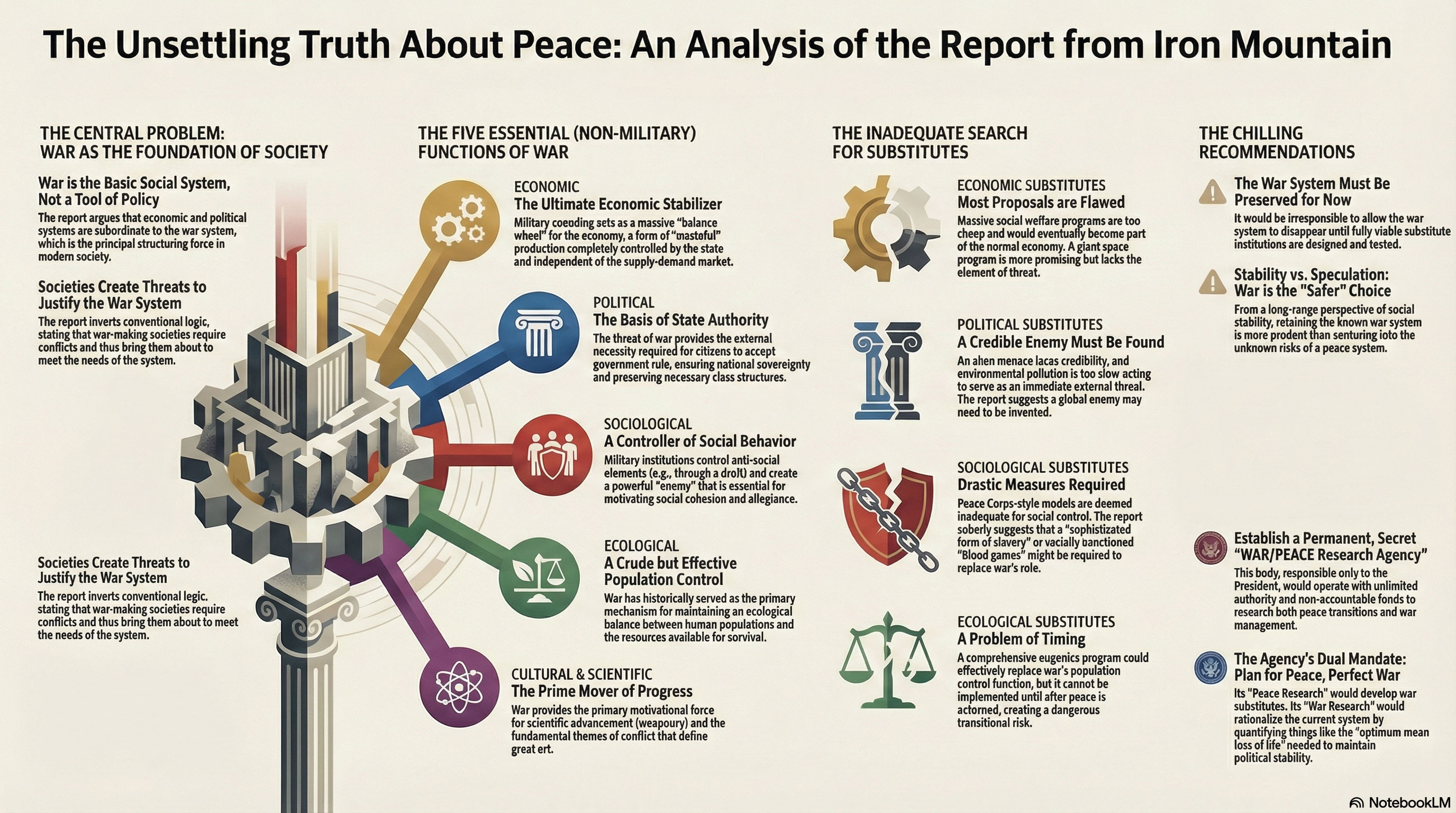
The report quantifies the global war economy at roughly ten percent of total world production. In the United States, military spending exceeds $60 billion annually during the study period. This expenditure drives employment, industrial demand, and technological innovation, functioning as a self-regulating sector immune to traditional market pressures. The authors argue that military spending stabilizes growth by absorbing surplus production and maintaining full employment through “controlled waste.”
The report observes that military industries — especially those producing nuclear weapons, missiles, and advanced systems — possess highly specialized skills and infrastructure that are difficult to convert to civilian use. Economic transition plans, such as the Ackley Committee’s proposal for a gradual conversion, ignore the magnitude of the disruption caused by disarmament. Localized retraining programs cannot address the structural interdependence of war industries with national production. Fiscal tools like tax cuts and credit expansion lack the capacity to replace the scale or control of military expenditures.
Some economists propose diverting war budgets to space exploration, environmental restoration, or large-scale public works. The report analyzes these as partial substitutes, acknowledging their potential to mobilize resources but identifying limits in duration, scope, and central control. Military spending, by contrast, engages continuous government command and delivers consistent long-term stability. The authors conclude that disarmament without equivalent replacements would generate economic collapse and political fragmentation.
War as the Primary Social System
The report defines war as the organizing principle of modern civilization. It governs hierarchy, legitimizes authority, and provides the structural framework within which economies, laws, and values function. War is not a derivative of politics; rather, political systems evolve to sustain war-readiness. The persistence of “national interest” conflicts reflects this systemic dependency. Threats serve as instruments to maintain social cohesion and to justify the concentration of power.
Within this model, the military establishment functions as an autonomous system that sets its own priorities and extends influence across civilian institutions. The group observes that the stability of societies depends on continuous mobilization — material or psychological — against external or internal adversaries. Without such mobilization, public motivation declines, and social order weakens. The report interprets this as a universal dynamic of state formation and persistence.
Nonmilitary Functions of War
The report identifies several essential roles war fulfills beyond defense. Economically, it directs production and employment toward state-controlled ends, creating predictable cycles of demand and expenditure. Psychologically, it unifies populations through shared purpose and sacrifice. Politically, it legitimizes authority by framing obedience as patriotism. Sociologically, it provides outlets for aggression and mechanisms for discipline through military service, law enforcement, and national mobilization.
The authors emphasize that war’s utility extends to culture and science. The pursuit of advanced weaponry drives technological innovation, while wartime propaganda fosters cohesion through national mythology. Even the organization of education, industry, and public welfare reflects the need to sustain readiness. The report describes war as the most effective stabilizer of social and economic equilibrium discovered in human history.
When examining alternatives, the group evaluates “nonmilitary surrogates.” These include space programs, environmental control initiatives, and large-scale infrastructural systems designed to replicate the mobilizing effects of war. The report also considers the potential of creating artificial threats — ecological catastrophes, extraterrestrial dangers, or engineered pandemics — to unify populations under centralized authority. The authors treat these proposals as experimental hypotheses rather than moral judgments, assessing them in terms of feasibility and potential for control.
Peace Games and Systems Simulation
The group develops a computational forecasting method known as “peace games.” Using early computer modeling, they simulate complex interactions among social variables to predict the consequences of disarmament. These simulations quantify indirect relationships between events that appear unrelated — such as the impact of a moon landing on foreign elections or the effect of changes in conscription on real estate markets. The method demonstrates that social systems respond to minute adjustments with measurable shifts in economic and political outcomes.
Peace games reveal that removing war spending destabilizes multiple subsystems simultaneously — labor markets, scientific research, international finance, and public morale. The group concludes that peace, without structured substitutes, produces instability more severe than wartime crises because it eliminates centralized mechanisms for coordination.
Proposals for Transition
The report proposes that any transition to peace must incorporate substitutes replicating war’s social, economic, and psychological functions. These substitutes must absorb labor and capital, sustain technological advancement, enforce discipline, and legitimize authority. The authors outline possibilities: a massive space program on par with the defense industry in budgetary scale; universal national service integrating military and civilian labor; and continuous global projects such as planetary engineering or resource colonization.

They suggest that environmental management could serve as a stabilizing enterprise, provided it remains under strict government coordination and can generate sustained expenditure. The group also examines controlled population programs, mandatory birth regulation, and the use of technology to monitor and manage social behavior. Each proposal derives from the assumption that authority must remain centralized to preserve societal equilibrium.
Political Control and Cultural Continuity
The report argues that the war system ensures predictability in governance by directing aggression outward. Peace would remove this channel, compelling governments to internalize control mechanisms. To prevent disorder, political systems would need to develop new means of unifying populations—possibly through ritualized service, regulated scarcity, or scientifically managed fear. The authors discuss the potential reintroduction of coercive structures, including surveillance, conscription, and social stratification, as instruments of continuity.
They note that traditional moral and religious institutions, weakened by modernization, cannot substitute for the cohesion war provides. The future stability of peace, therefore, depends on technological systems capable of simulating collective purpose. The report treats this requirement as a logistical and administrative challenge rather than an ethical dilemma.
Conclusions and Recommendations
The study concludes that permanent peace, while conceivable, remains undesirable under current social and economic conditions. The report asserts that war performs indispensable functions whose elimination would endanger civilization’s stability. Until effective substitutes arise, the continuation of the war system remains essential. The authors recommend controlled research into substitute institutions and sustained investment in improving military organization as a safeguard against systemic collapse.
The report advises that its contents remain restricted to policymakers, warning that public dissemination could provoke a crisis in confidence and disrupt social order. Its publication through Leonard C. Lewin’s arrangement defies this recommendation, transforming the confidential analysis into a public artifact of Cold War logic.
Legacy and Continuing Relevance
The book’s structure mirrors the report’s analytical rigor—divided into sections on economic disarmament, social systems, war functions, and proposed alternatives. Its tone maintains bureaucratic precision, using technical language drawn from military planning and systems theory. The study’s implications reach beyond its historical setting. It defines war as the integrative force of industrial civilization and peace as a transformative event requiring institutional innovation on a planetary scale.
The document concludes with a warning that the transition to peace demands premeditated design equal to the organization of war itself. The equilibrium of human society, according to the Special Study Group, depends on continuous coordination, large-scale mobilization, and the management of purpose. The report leaves a question unresolved: who will construct the structures of peace if the structures of war sustain the modern world?
Thanks to the generosity of my readers, all my articles are available for free access. Independent journalism, however, requires time and investment. If you found value in this article or any others, please consider sharing or even becoming a paid subscriber, who benefits by joining the conversation in the comments. I want you to know that your support is always gratefully received and will never be forgotten. Please buy me a coffee or as many as you wish.

The Duke Report - Where to Start
My articles on SubStack are all free to read/listen to. If you load the Substack app on your phone, Substack will read the articles to you. (Convenient if you are driving).
Foundational Articles
Podcast (Audio & Video Content)
Palmerston’s Zoo Episode 01 - Solving the Paradox of Current World History (9 Episodes)
Oligarchic Control from the Renaissance to the Information Age
SoundCloud Book Podcasts
I’ve taken almost 200 foundational books for understanding how the world really works and posted them as audio podcasts on SoundCloud. If you load the app on your phone, you can listen to the AI robots discuss the books on your journeys across America.
Duke Report Books
Over 600 foundational books by journalists and academics that never made the New York Times Bestseller list, but somehow tell a history we never learned in school. LINK


