



In this podcast, the hosts trace Peter Duke’s article, "The Poster Children of Technocracy," through a March 2, 2026, United Nations Security Council session chaired by Melania Trump and build a detailed account of how the episode illustrates how institutional language, humanitarian urgency, and digital infrastructure converge within a single argument.
Original Story:

The Source Stack
The episode grounds its discussion in three sources: the official transcript of the 10,113th Security Council meeting, Courtney Turner’s essay From Exit and Build to Tesla’s Wireless World Brain, and Peter Duke’s Substack post, which serves as the central lens. The hosts tell listeners exactly where the frame begins. They place Gaza and Ukraine inside the background of the discussion, name the United Nations as the institutional setting, and place Donald Trump and Melania Trump among the political figures who shape the atmosphere around the material. From the opening minutes, the conversation advances as a close reading of rhetoric, structure, and word choice.
The UN Session and its Stated Agenda
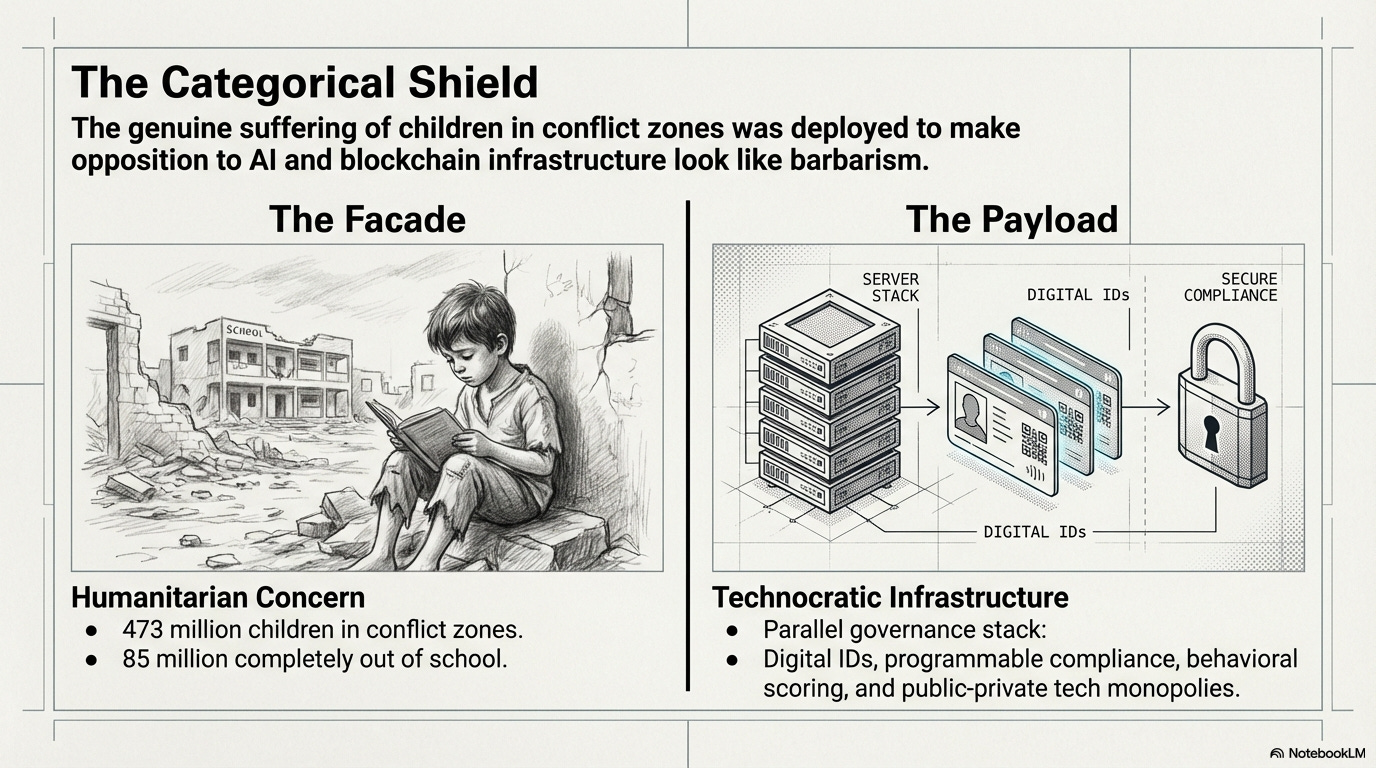
The program centers on a Security Council meeting titled Maintenance of International Peace and Security, Children, Technology, and Education in Conflict. ” Under-Secretary-General Rosemary DiCarlo opens that session with a dense set of figures that define the humanitarian stakes. She cites 473 million children who are living in or fleeing conflict zones, a 25 percent rise in grave violations against children from 2023 to 2024, a 35 percent increase in sexual violence against children, and 2,374 verified attacks on schools and hospitals in 2024. She then turns to education, stating that 85 million children are out of school and that there is a global shortage of 44 million teachers. Those numbers give the meeting its emotional force and establish the rationale for rapid action.
The Proposed Remedy
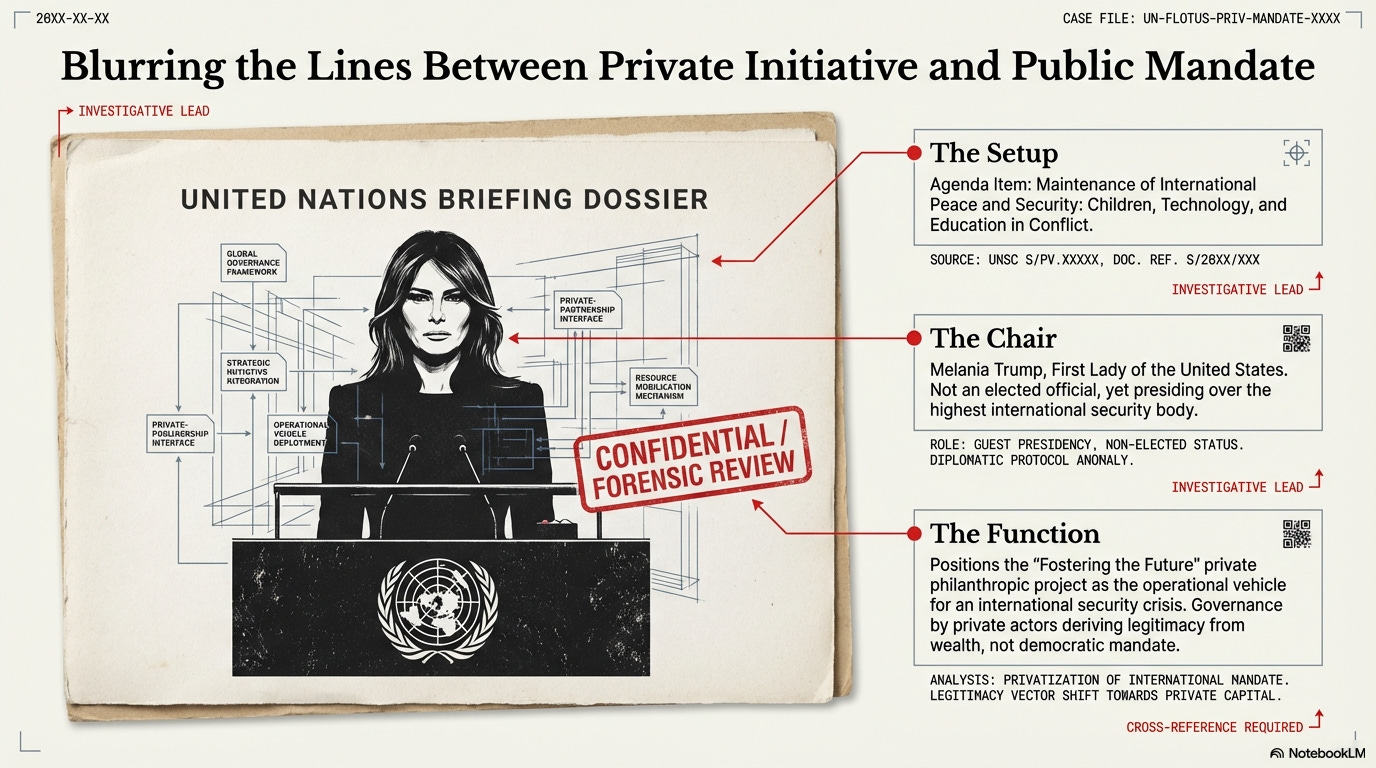
The Deep Dive hosts say the delegates move quickly from crisis metrics to a common solution. Fourteen national delegations, including France, Greece, Denmark, and China, endorse a program of artificial intelligence, expanded digital connectivity, and public-private partnerships to deliver remote education in conflict zones. Melania Trump highlights an initiative called Fostering the Future as part of that effort. The episode describes the pitch in concrete terms: if physical schools lie in rubble, digital schools can deliver lessons through tablets and networks; if teachers cannot reach children, AI tutors can scale instruction across camps, damaged cities, and unstable regions. That sequence gives the meeting its public-facing logic and defines the practical case for digital education.
Peter Duke’s Central Claim
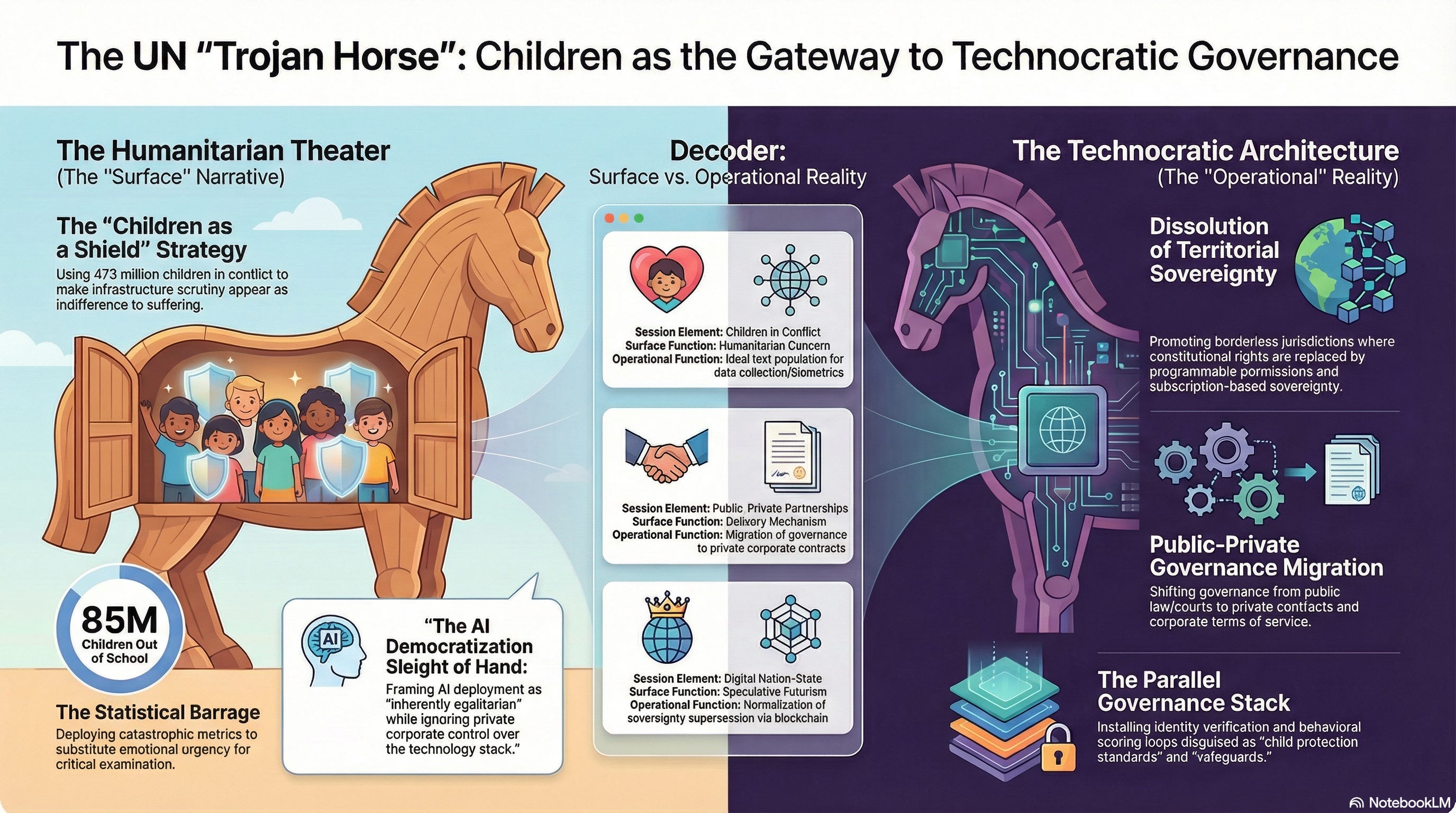
The hosts then turn to Peter Duke’s core thesis. Duke calls the meeting a carefully constructed Trojan horse, and the episode spends significant time defining the mechanism he says drives it. He uses the term epistemological warfare, or epiwar, to describe the intentional corruption of meaning through the capture of legitimating discourse. The hosts explain that term in simple language: Duke says institutions can secure compliance by shifting the meaning of the words that guide public judgment. Once that shift takes hold, the argument can move forward under familiar moral language even as the structure beneath that language changes.
Redefining Key Terms
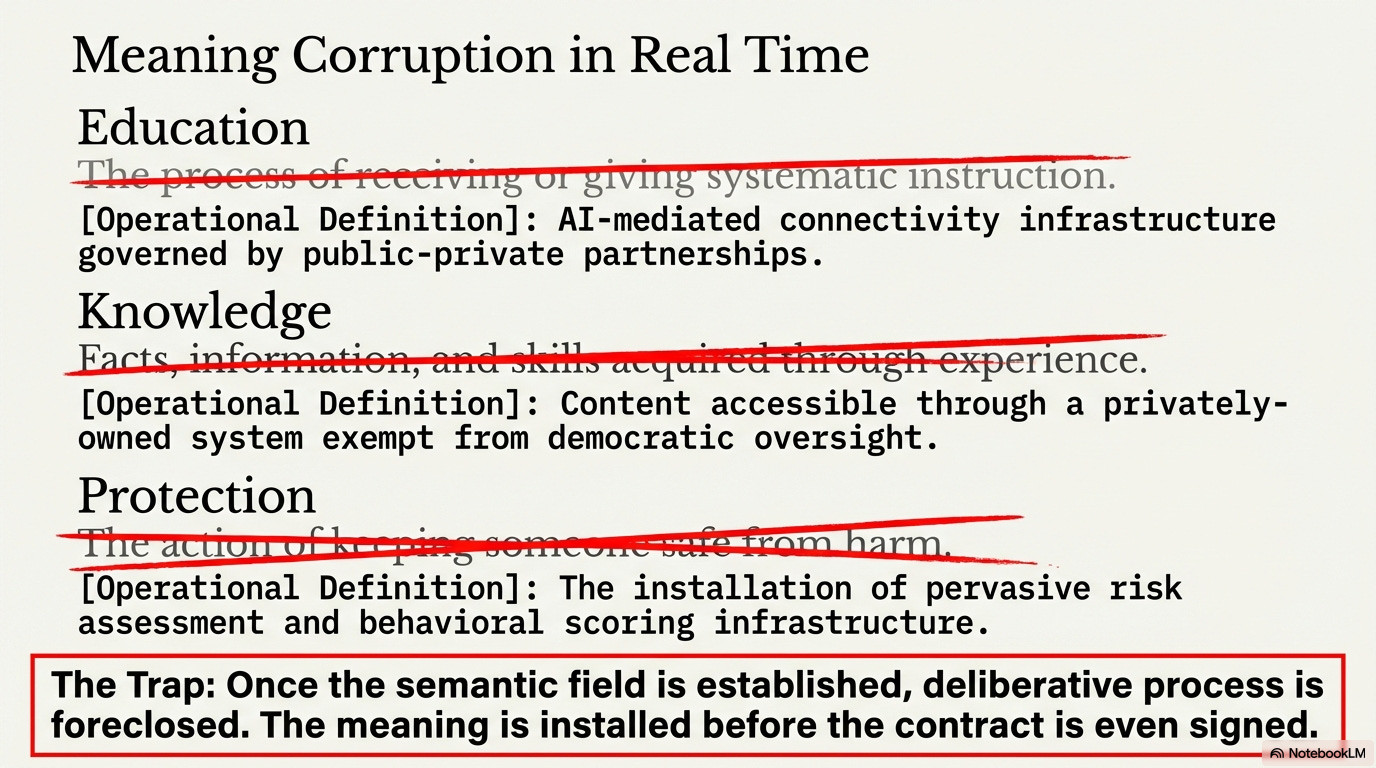
The episode makes Duke’s theory concrete by following his treatment of three words. First, it says the meeting functionally redefines education. In Duke’s reading, education becomes an AI-mediated connectivity infrastructure governed through public-private partnerships. The infrastructure itself carries the meaning. Second, the hosts say the meeting redefines protection. Duke argues that, in this context, protection means behavioral monitoring, data harvesting, and risk-assessment systems that track children in digital environments. Third, the episode examines the phrase democratizing AI. Duke says that phrase masks a transfer of authority to private firms that own the platforms, set the terms of service, curate the knowledge base, and collect user behavior. When the hosts ask who holds power inside such a system, they place Microsoft, BlackRock, and large tech firms in the center of that question.
A Recurring Rhetorical Pattern
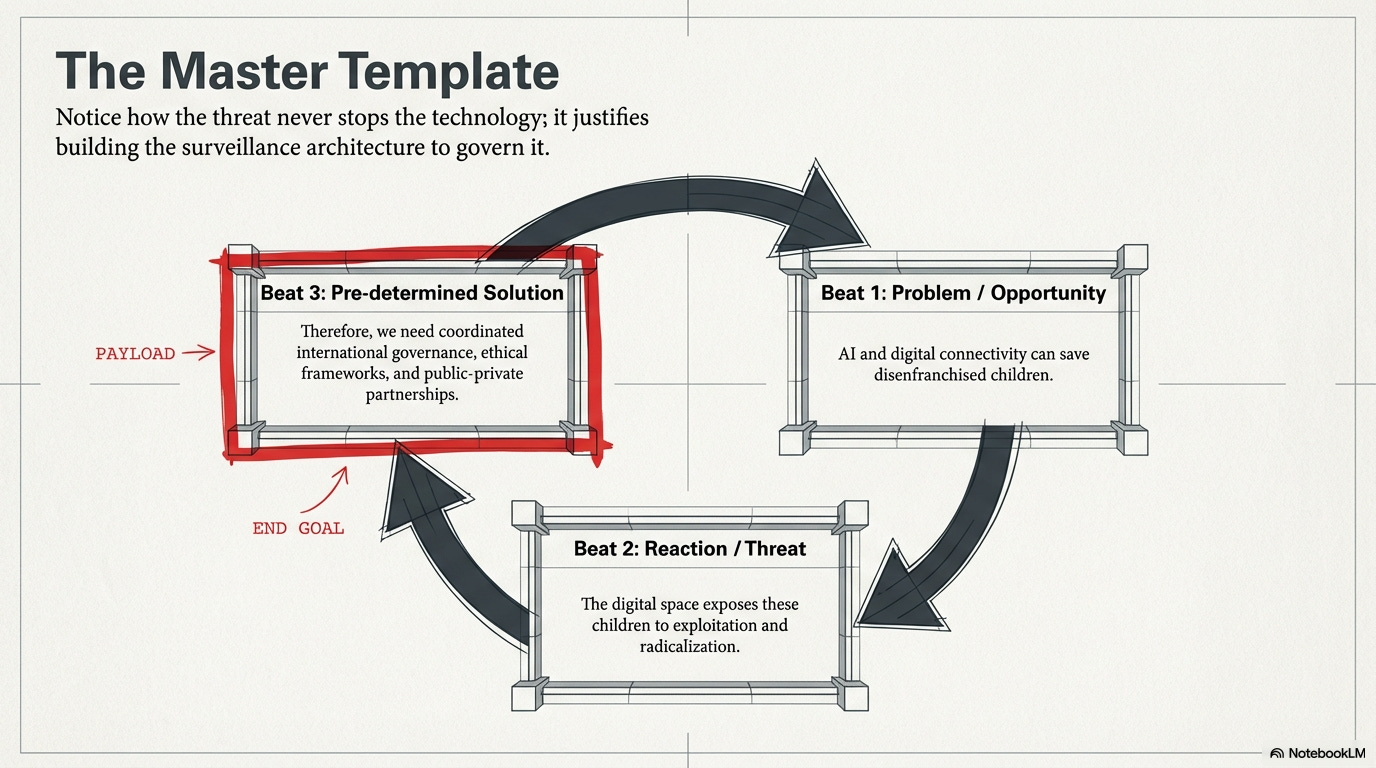
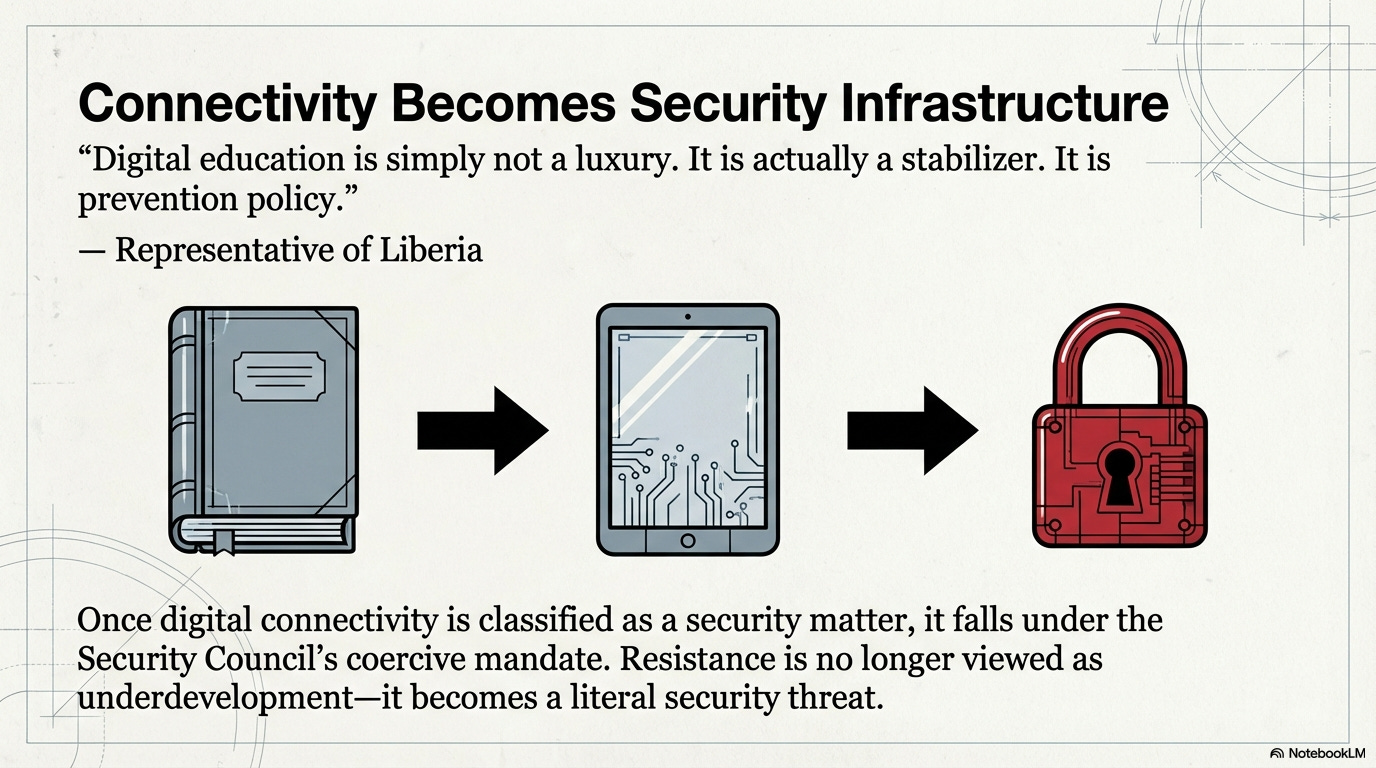
The hosts identify a three-part structure that Duke says appears across the speeches of fourteen delegations. First comes the opportunity frame: technology, AI, and digital connectivity appear as transformative tools for children in conflict zones. Then comes the threat acknowledgment: speakers name radicalization, trafficking, and exploitation as serious dangers inside digital spaces. The final move delivers the governance resolution: delegates call for coordinated international standards, ethical frameworks, and stronger systems to monitor and regulate the technology. The episode treats that sequence as the meeting's operating pattern. Why does that matter? Because the same language that names danger also expands the case for deeper oversight and more data collection.
Melania Trump, Network States, and the Parallel Governance Stack
The discussion reaches a turning point when the hosts quote Melania Trump asking, “Is a single digital nation state inevitable?” They pair that line with another phrase from her speech about technology becoming free and unrestricted by land borders. Through Courtney Turner’s essay, the episode links those statements to Exit and Build, a techno-libertarian current that promotes network states and startup societies. The host's name is Prospera in Honduras, a private charter city that uses digital dispute systems, DAOs, and blockchain-based smart contracts. They also name Praxis and its proposed California flagship city, Atlas, as a venture-backed project for AI and crypto innovators.
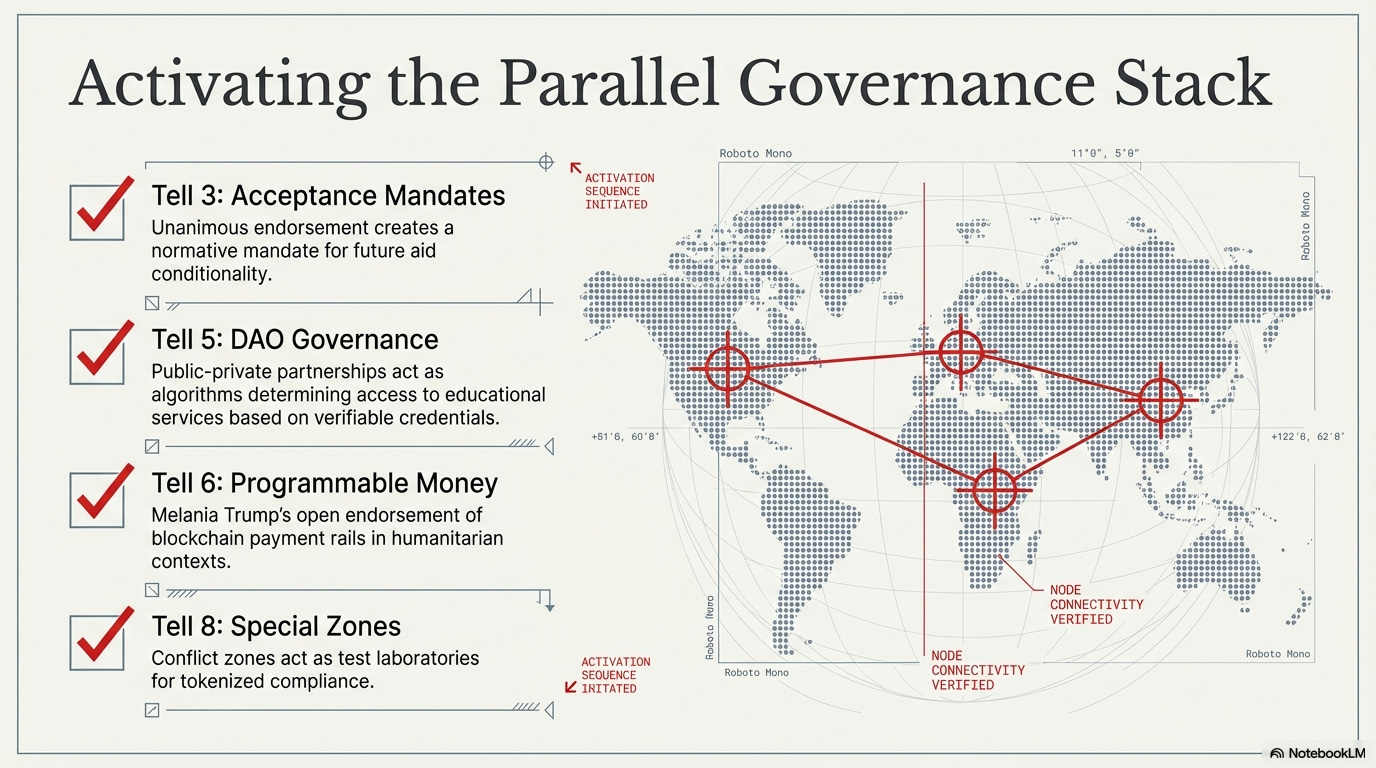
From there, the episode lays out what Turner calls the parallel governance stack: a digital wallet that holds identity, credentials, and assets; tokenized access that governs entry into services and spaces; ambient sensing that captures clicks, location pings, and biometric reads; and reputation scores that convert collected data into compliance rankings. The hosts present that architecture as the culmination of the argument they trace through the transcript. They close by returning to Duke’s question — why children, and why children in war zones? — and answer it through the three functions: the episode names: a categorical shield of sympathy, an ideal test population with little political leverage, and a security frame that elevates connectivity from educational policy into the language of international peace and security.
Thanks to the generosity of my readers, all my articles are available for free access. Independent journalism, however, requires time and investment. If you found value in this article or any others, please consider sharing or even becoming a paid subscriber, who benefits by joining the conversation in the comments. I want you to know that your support is always gratefully received and will never be forgotten. Please buy me a coffee or as many as you wish.

The Duke Report - Where to Start
My articles on SubStack are all free to read/listen to. If you load the Substack app on your phone, Substack will read the articles to you. (Convenient if you are driving).
Foundational Articles
Podcast (Audio & Video Content)
Palmerston’s Zoo Episode 01 - Solving the Paradox of Current World History (9 Episodes)
Oligarchic Control from the Renaissance to the Information Age
SoundCloud Book Podcasts
I’ve taken almost 200 foundational books for understanding how the world really works and posted them as audio podcasts on SoundCloud. If you load the app on your phone, you can listen to the AI robots discuss the books on your journeys across America.
Duke Report Books
Over 600 foundational books by journalists and academics that never made the New York Times Bestseller list, but somehow tell a history we never learned in school. LINK


