



An Epistemological Analysis of Melania Trump’s March 2, 2026 UN Presentation Within the Framework of Courtenay Turner’s “Exit & Build” Thesis.
The Duke Report™ | EpiWar™ Series
“Is a single digital nation-state inevitable? Perhaps this idea isn’t so far-fetched since digital currency and payment systems via blockchain, plus AI’s massive factual database is already revolutionizing media and financial markets.”
— Melania Trump, President, UN Security Council, March 2, 2026
Framing the Inquiry
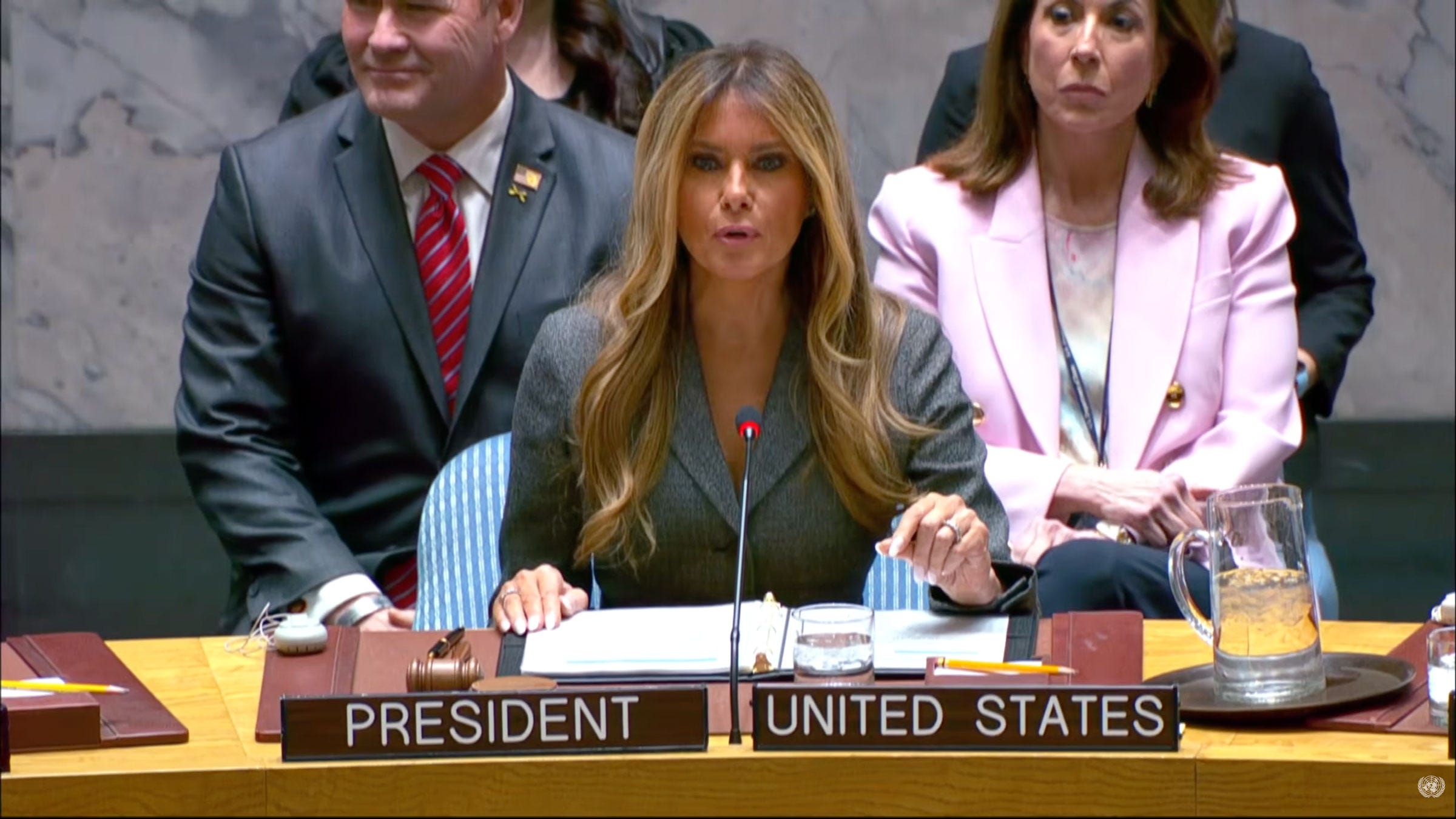
On March 2, 2026, Melania Trump chaired the 10,113th meeting of the United Nations Security Council under the agenda item “Maintenance of International Peace and Security: Children, Technology, and Education in Conflict.” Fourteen delegations followed an identical rhetorical template.
Melania, reading from what was clearly a prepared and polished script, presented as an exercise in humanitarian concern. However, if one considers Courtenay Turner’s March 1, 2026 Substack essay “From ‘Exit & Build’ to Tesla’s Wireless World Brain,” which appeared one day before the session, the meeting reveals itself as a sophisticated attempt at the deployment of what Turner calls the “parallel governance stack” — the architecture by which constitutional rights are progressively displaced by programmable permissions, and sovereignty is reconstituted as a revocable subscription within a tokenized, algorithmically enforced planetary system.

To start the cognitive assault and overwhelm the audience's defenses, their discernment (κρίσις) must be disabled, and the verbal barrage consisted of repetitive statistics with large numbers.1
Under-Secretary-General Rosemary DiCarlo opened with the master sequence. 473 million children are living in or fleeing conflict zones. Grave violations against children are up 25% from 2023 to 2024. Sexual violence against children is up 35%. 2,374 verified attacks on schools and hospitals in 2024 alone. 85 million children are entirely out of school. A global shortage of 44 million teachers in conflict settings.
These numbers were delivered in rapid succession, without pause for absorption, framed as evidence of a scale so catastrophic that any proposed solution becomes self-justifying. This is the emotional pre-commitment device: by the time the solution is presented, the listener has already been maneuvered into a position where rejection of the proposed remedy is indistinguishable from indifference to the suffering that preceded it. Dr. Robert Cialdini terms this “pre-suasion.”
The onslaught of numbers anchors the psychological warfare intent, functions as a statistical artillery barrage, and serves to manufacture urgency, compress the decision window, eliminate the cognitive space in which the terms of the proposed solution might be examined, and effectively eliminate the praus (reserved strength or πραΰς) required to discern truth.2
Not one speaker in fourteen asked: Does the proposed solution address the causes of any of these statistics? A question no delegate raised: whether the organizations positioned to deliver the proposed solutions have any documented relationship to the conditions that produced the crisis. The vast number of children in conflict zones is used to set up the problem frame, employing scale as a persuasion technique to frame urgency as a priority over measured discernment. The proposed solution — AI-mediated connectivity infrastructure governed by public-private partnerships — addresses none of the conditions that produce armed conflict, because, again, those conditions are manufactured by those presenting the solutions, or, better stated, by those they represent. It sets up a ‘market opportunity’ by fostering the perception that the solutions will alleviate suffering at scale.
The Master Template: Opportunity → Threat → Governance Solution
The rhetorical architecture of the session is built on a three-beat sequence that every speaker, without exception, deployed in the same order. This pattern inverted the standard problem-reaction-solution ‘Hegelian Dialectic’ into a more opportunistic variant, but the psychological mechanisms remain the same. Technology sales reps use the same technique, which they call FUD, or Fear, Uncertainty, and Doubt, where they introduce a potential disaster scenario as an incentive to buy a product that will avert the disaster.
Beat 1 — The Opportunity Frame: Technology, AI, and digital connectivity can save disenfranchised children, democratize education, and close the global knowledge divide.
Beat 2 — The Threat Acknowledgment: The digital space exposes children to exploitation, radicalization, trafficking, and recruitment by armed groups.
Beat 3 — The Governance Resolution: Therefore, we need coordinated international standards, ethical frameworks, and public-private partnerships to govern the deployment.
This is a Hegelian Problem-Reaction-Solution dialectic rendered as multilateral theater. The critical observation is that Beat 2 — the threat acknowledgment — never questions whether the technology itself should be deployed. It questions only whether it is being governed sufficiently. The resolution is always more governance architecture, never less technological dependency. The endpoint is predetermined: a legitimized international mandate for the coordinated build-out of the infrastructure Turner’s essay maps as the parallel governance stack — wallets, credentials, behavioral scoring, programmable compliance, and ambient sensing. This is operant conditioning at an international institutional scale, using what Dr. Robert Cialdini calls the ‘consistency principle,’ where people will mindlessly go along with the crowd, because ‘everyone is doing it.’ This mechanism is deliberately designed to eliminate discernment (κρίσις) and critical thinking (λόγος).

Nothing Attracts a Crowd, Like a Crowd
Under-Secretary-General Rosemary DiCarlo set the template in the opening briefing, immediately following by Melania Trump’s keynote. Thirteen national delegations then repeated the same structure with local variation, which, appropriately, ended up sounding like fourteen variations on an LLM-inspired theme. By the final speaker, the rhetorical environment had been so thoroughly saturated with the triad that any alternative framing would have required a delegate to reconstruct the entire epistemological ground of the meeting, in real time, against the social pressure of unanimous institutional agreement. This is what Turner means by “governance without representation”: the outcome is embedded in the process before deliberation begins.
The Ideological Payload: Melania Trump’s Keynote
The First Lady’s prepared statement is the keystone document of the session. It carries the greatest symbolic authority and, examined closely, the most explicit ideological payload. Several passages require forensic attention.
The Digital Nation-State Proposition
The most extraordinary passage in the entire session transcript reads:
“Is a single digital nation-state inevitable? Perhaps this idea isn’t so far-fetched since digital currency and payment systems via blockchain, plus AI’s massive factual database is already revolutionizing media and financial markets.”
A sitting First Lady, chairing a UN Security Council meeting, openly advanced the concept of a borderless digital nation-state with blockchain financial rails. In what might be described as a ‘Dog and Pony Show,’ no ambassador challenged it, nor was a procedural objection raised. In Turner’s framework, this is the “exit and build” thesis — the techno-libertarian proposition that new digital jurisdictions should supersede legacy constitutional states — being delivered not from the libertarian periphery but from the most symbolically legitimate international security forum on earth.
Turner documents how figures like Balaji Srinivasan argue for “a world of archipelagic ‘startup societies’ whose physical enclaves are coordinated through a digital capital” that “re-centralizes on a shared informational and organizational center.” What Melania Trump delivered was this thesis stripped of its libertarian packaging and reclothed in the language of children’s welfare.
The Sovereignty Dissolution Frame
The proposition is extended in the following passage:
“We are in the age of imagination, a period when technology can be free and unrestricted by land borders.”
“Free and unrestricted by land borders” is precisely the operational premise of the parallel governance stack. It is the description of a system in which tokens, wallets, DAOs, and smart contracts route around national jurisdiction — the architecture Turner identifies in Próspera (Honduras), Atlas/Praxis (California), and the UN-backed Artificial Intelligence World Society Cities initiative. In UN Security Council parlance, this phrase serves to conjure institutional legitimation for the dissolution of the territorial sovereignty that the UN Charter was designed to protect.
The AI Democratization Sleight of Hand
“AI is democratizing knowledge, which was once confined to university libraries... Let’s connect everyone to knowledge through AI.”
The word “democratizing” performs crucial ideological work. It deletes the unasked question of who controls the AI by framing deployment as inherently egalitarian. Turner’s framework identifies this as the central deception of the noosphere project: the humanitarian wrapper that naturalizes infrastructure dependency as liberation. Knowledge is not democratized when it flows through a system owned and governed by a private entity that sets the terms of access, curates the content, and retains the behavioral data generated by every query. That is totalitarianism, a company store with an end-user license agreement and a better interface.
The operational question — which Turner poses throughout her essay — is not whether AI can deliver knowledge but who controls the stack through which it is delivered, who owns the identity and behavioral data of the users, and what happens to access when compliance conditions are not met?
The Conflict-Ignorance-Peace Syllogism
“Conflict arises from ignorance, but knowledge creates understanding, replacing fear with peace and unity.”
This syllogism is foundational to the session's entire rhetorical structure. If conflict is caused by ignorance and ignorance is solved by AI-mediated connectivity, then resistance to connectivity infrastructure is, by logical implication, a choice in favor of conflict, a classic ‘double-bind.’ The argument is unfalsifiable within its own terms and functions to make opposition to the deployment agenda legible only as barbarism. This is the same mechanism Turner identifies in the “exit culture” dynamic: the constitutional voice option — deliberate, contested, slow democratic scrutiny of governance architectures — is delegitimized by framing it as the cause of the very suffering it seeks to prevent.
The Trope Inventory: Fourteen Speakers, One Script
Trope 1: The Statistical Barrage
Every speaker deployed staggering numbers in rapid succession. DiCarlo established the pattern: 473 million children in conflict zones, grave violations up 25% from 2023 to 2024, sexual violence up 35%, 2,374 verified attacks on schools in 2024 alone, 85 million children completely out of school, and a shortage of 44 million teachers.
The function of the statistical barrage is to overwhelm the cognitive capacity for scrutiny with emotion and substitute urgency for examination. The implicit argument is: the numbers are so catastrophic that any solution is better than the status quo. This is a cause-effect complex-equivalence linguistic distortion — the supposed cause and magnitude of a problem does not validate any particular solution — but, embedded in humanitarian affect, it operates as a near-irresistible rhetorical move. The assumption is that by the time the governance resolution is reached, the listener has been emotionally pre-committed to it. The frame has been set.
Trope 2: The False Dichotomy
Technology is consistently opposed to ignorance and conflict rather than to alternative non-technological interventions or to the question of who controls the technology. The representative of Liberia made this binary most explicit:
“Digital education is simply not a luxury. It is actually a stabilizer. It is prevention policy.”
And:
“Investing in digital education in fragile contexts reduces the pool from which armed groups recruit.”
Within this framing, connectivity infrastructure is security infrastructure. That reconstitution is critical: once digital connectivity is classified as a security matter, it falls under the Security Council's jurisdiction and mandate. Resistance to it becomes a supposed security threat. The institutional frame of the meeting — the Security Council rather than, say, UNESCO alone — is not incidental. It is the mechanism by which a technology deployment agenda acquires coercive legitimating force.
Trope 3: The Threat Acknowledgment as Permission Structure
This is the most structurally sophisticated trope in the template. Every speaker acknowledged digital risks to children: online exploitation, radicalization, trafficking, gender-based violence, disinformation, and gang recruitment. The representative of the UK noted that “armed groups are increasingly using online platforms to recruit children.” Colombia warned that “armed groups and criminal networks are increasingly using digital platforms to recruit, manipulate, and exploit minors.”
But each acknowledgment was identical: a call for “safeguards,” “ethical frameworks,” “child protection standards,” and “public-private partnerships.” In Turner’s framework, each of these resolution terms corresponds directly to a layer of the parallel governance stack:
“Ethical frameworks” = the Artificial Intelligence World Society Social Contract and Artificial General Intelligence Constitution protocols that standardize compliance as programmable ethics
“Child protection standards” = the identity and credential verification infrastructure that gates access based on verifiable behavioral profiles
“Public-private partnerships” = the mechanism by which governance migrates from public law (where constitutional rights can be asserted against power) into private contract (where access is a terms-of-service condition)
“Safeguards” = the sensing and scoring loops that feed behavioral data into risk and trust assessments
The threat, in other words, does not inhibit the infrastructure. It generates it. The danger to children in the digital space is the justification for building the precise architecture that Turner documents as the engine of mass behavioral compliance and erosion of sovereignty. The acknowledgment of the threat is not a counterweight to the deployment agenda. It is its most powerful accelerant.
Trope 4: The Universal Public-Private Partnership Invocation
France, Greece, Denmark, Panama, Colombia, the DRC, China, Liberia, the UK — every delegation invoked public-private partnerships as the delivery mechanism for educational technology. This unanimity is remarkable. It is also the operational core of the Turner thesis, made explicit in diplomatic language.
Turner documents how the “build” phase of “exit and build” shifts governance from constitutional public law — where due process, equal protection, and rights claims can be asserted against power — to private contract: terms of service, HOA-like covenants, platform moderation systems, and financial rails. She writes: “As essential functions migrate into these systems, accountability drifts from elections and courts to owners, maintainers, and administrators.”
When DiCarlo praised “UNICEF’s Learning Passport, developed in partnership with Microsoft” — offering a mobile learning platform to 10 million children in 47 countries — she described this governance migration precisely. The children of conflict zones are being connected to knowledge through infrastructure owned and governed by a private corporation, operating under terms of service that no Security Council resolution can override.
Trope 5: The Teacher Displacement Hedge
Panama stated explicitly: “Our country considers that artificial intelligence can support teachers, but never replace them.” Colombia echoed the point. This hedge serves a defensive role against the most visible anxiety about the deployment agenda. It acknowledges the concern while ensuring the infrastructure gets built.
The hedge is structurally empty. Once AI connectivity infrastructure is deployed at scale to children in conflict zones — and the economic and logistical case for it in resource-scarce environments is made overwhelming by the 44-million-teacher shortage DiCarlo cited — the distinction between “supplement” and “replacement” is a policy dial, not a structural constraint. The infrastructure is fungible; the political will to restrain it is not guaranteed by a diplomatic caveat.
Trope 6: The Connectivity-as-Security Frame
Liberia’s speech was the most sophisticated and the most telling. Its central argument: digital connectivity infrastructure in conflict zones is a security investment that prevents future conflict by reducing armed group recruitment, strengthening girls’ autonomy, and building “communities that choose ballots over bullets.” Three specific proposals followed: a post-conflict digital recovery financing window within international mechanisms, a pilot network of solar-powered community digital learning hubs, and a coalition to design low-bandwidth offline-first learning systems for conflict environments.
Each proposal is, in isolation, defensible on humanitarian grounds. Examined through Turner’s “eleven tells,” they correspond precisely to the infrastructure nodes of the parallel governance stack: offline-capable curriculum delivery systems, modular scalable hubs, device-sharing networks, and teacher training models designed specifically for “fragile settings.” These are, in Turner’s terminology, the foundational layer from which wallet-as-portal, token-gated access, and reputation portability naturally develop once the connectivity substrate is established.
The representative of Liberia concluded: “Let us treat connectivity as protective infrastructure.” This is the frame Turner’s essay documents as the critical transition point: the moment when a technology deployment “stops being an experiment you can opt into and starts becoming the environment you have to navigate.”
The Symbolic Architecture of the Event
The Chair
The choice of Melania Trump as chair performs several simultaneous functions.
She is the First Lady of the United States — not an elected official — presiding over a Security Council session. This repositions the highest international security body as an appropriate venue for private initiative and elite personal engagement, exactly the dynamic that Turner identifies in the network state movement: governance by private actors whose legitimacy derives from wealth and association rather than from a democratic mandate.
She is simultaneously the face of the “Fostering the Future” initiative, praised by France, Panama, and the DRC. This initiative — a private philanthropic project — is being presented in a Security Council session as the operational vehicle for addressing an international security crisis. The boundary between private initiative and public mandate is being dissolved in real time, in the most legitimate institutional setting available.
The Comparison to Eleanor Roosevelt
The French ambassador closed his remarks with a comparison between Melania Trump and Eleanor Roosevelt, who contributed to the drafting of the Universal Declaration of Human Rights. This comparison performs a specific rhetorical function: it positions the current session as a founding moment in international human rights architecture, comparable to 1948. It suggests that the framework being endorsed in this session carries the same moral and historical weight as the Declaration itself. This is the installation of a legitimating narrative for the governance architecture being constructed.
The Absent Challenger
Across fourteen speakers representing states from China to Somalia to the DRC to Colombia, not a single delegation asked: who will train and own the AI infrastructure? Who decides what the ‘trust and safety’ Ministry of Truth approves and blocks? How do we measure the signal-to-noise errors, the valid information-to-AI slop ratio? Not one asked: what data will be collected from children using these platforms?
Not one asked: what are the terms under which a child’s behavioral profile, generated through AI-mediated learning, can be accessed by state actors, commercial partners, or international governance bodies?
These are the first questions any competent child advocate would ask before deploying any AI learning systems to vulnerable populations. Their total absence from the record of a Security Council session is by design. It is the structural signature of a meeting convened to establish desirability, not to adjudicate terms. The terms are being written elsewhere with zero representative participation — in public-private partnership agreements (AKA Fascism3), the standards bodies, the wallet protocols, and the Artificial Intelligence World Society Social Contract that Turner’s essay documents.
The Turner Framework Applied: Five Convergence Points
Courtenay Turner's March 1 essay identifies eleven ‘tells’ by which experimental parallel governance systems harden into compulsory infrastructure. The session of March 3 instantiated at least five of them simultaneously, as fait accompli.
An institutional mandate without a formal vote (tell 3).
Public-private partnership as the universal delivery mechanism (tell 5).
Blockchain payment rails normalized in humanitarian language (tell 6).
Conflict zones designated as the primary deployment laboratory (tell 8).
UN-aligned standards bodies positioned as the governance layer (tell 11).
The Children as Load-Bearing Architecture
In the EpiWar™ analytical framework, the question to ask of any rhetorical structure is: what meaning is being installed, in whom, and to what operational end?
The children of conflict zones are performing three simultaneous functions in this discourse, none of which is fully visible within the humanitarian frame.
Function 1: The Categorical Shield. Any critique of the governance architecture can be deflected by asking whether the critic wants Afghan girls to remain illiterate, Ukrainian children to continue learning in bomb shelters without connectivity, or Somali children to be recruited into armed groups. The child functions as a categorical shield, rendering the deployment architecture's substantive scrutiny legible` as indifference to suffering. This is the identical mechanism Turner identifies in the “exit and build” dynamic, where the constitutional voice option is delegitimized by framing it as the cause of the suffering it proposes to address through deliberation.
Function 2: The Ideal Test Population. Children in conflict zones are, from an infrastructural deployment perspective, an ideal test population for the parallel governance stack, for several reasons that deserve direct statement:
They lack political voice, legal standing to contest data collection practices, and organized parental structures capable of mounting regulatory resistance. Post-conflict zones lack the institutional infrastructure — data protection authorities, independent judiciaries, functioning civil society — that might scrutinize deployment terms. The psychosocial damage framing — children traumatized by conflict needing AI-assisted support — opens the behavioral and biometric data collection layer that Turner identifies as foundational to the proof-of-compliance architecture. DiCarlo noted that “digital education must therefore actively promote child protection with risk assessments at every stage from conception to deployment” — a requirement that mandates behavioral monitoring infrastructure as a condition of access.
Function 3: The Precedent Engine. Deploying AI governance infrastructure to children in emergency settings, under the Security Council humanitarian mandate, establishes the precedent that such infrastructure can and should be deployed without the deliberative processes that might accompany deployment to adult citizens in stable constitutional states. Once the precedent is set in conflict zones, the same infrastructure — the same wallet protocols, the same credential verification systems, the same behavioral scoring loops — can be extended to other populations under the logic of equivalence: if it was appropriate for the most vulnerable, it cannot be inappropriate for the less vulnerable.
This is the mechanism Turner calls the “quiet genius” of the tokenized cybernetic organism: “coordination without accountability, governance without representation, and coercion disguised as frictionless convenience.”
The EpiWar™ Dimension: Meaning Corruption in Real Time
From the perspective of The Duke Report™’s core analytical framework, this session demonstrates EpiWar™ operating at the institutional scale: the systematic corruption of meaning through the capture of legitimating discourse.
The word “education” has been redefined, in this session, to mean AI-mediated connectivity infrastructure governed by public-private partnerships.
The word “knowledge” has been redefined to mean content accessible through an AI system whose architecture, ownership, and behavioral data collection practices are not subject to democratic oversight.
The word “protection” has been redefined to mean the installation of risk-assessment and behavioral-scoring infrastructure.
The word “democratization” has been redefined to mean universal dependency on privately owned and governed technological rails.
These lexical redefinitions underscore the epistemological warfare methods deployed during the session. Changing the meaning of words changes reality itself.
Once the semantic field is established — once “education” means AI infrastructure and “protection” means behavioral monitoring — the policy conclusions follow automatically, and the deliberative process is foreclosed. The meaning has been installed before the vote is taken, the contract is signed, and before the child’s first query is entered into the system.
We hit “I Accept” without reading the contract.
Turner concludes her essay with the observation that “only reaffirming Creator-endowed truths can erect a metaphysical firewall against such quiet, scalable enclosure.” The Declaration of Independence, she rightly argues, asserts self-evident truths about unalienable rights that “precede politics, embedded in transcendent human dignity and free will” — a categorical refusal to allow human worth to be redefined in terms of “data-extractable value, behavioral scoring, or programmable permissions.”
The initiative at the center of Melania Trump's advocacy is called 'Fostering the Future.'
Read the name carefully.
To foster a child is to care for another’s child as one’s own — a relationship that carries authority without familial origin, stewardship without personal accountability, and a supposed temporary custodial role that shapes the child’s development and can control them in ways that persist long after the initial relationship ends. The UN, acting as a foster parent, sets the terms, and the child and their family have no standing to contest them.
Applied to the planetary deployment of AI education infrastructure under humanitarian mandate, the name describes the actual relationship with more precision than its authors likely intended: elite actors, claiming custodial responsibility for the world’s most vulnerable children, shaping their epistemic formation through privately controlled AI systems, under authority that confers stewardship without democratic accountability, for a duration and on terms set entirely by the foster parent.
The future being fostered is not only the child’s future.
It is also the infrastructure’s future — the blockchain data asset or token, the governance architecture, and the compliance system whose construction Turner documents and whose sales ceremony the Security Council hosted on March 2.
Don't be fooled. The children's suffering is real, and they're chosen precisely because that suffering targets our inherent agape and bypasses every defense — krisis, praus, logos — and goes straight for the gut. That is not humanitarian concern. That is a deception, and their infrastructure gets approved while you're feeling instead of thinking.
Thanks to the generosity of my readers, all my articles are available for free access. Independent journalism, however, requires time and investment. If you found value in this article or any others, please consider sharing or even becoming a paid subscriber, who benefits by joining the conversation in the comments. I want you to know that your support is always gratefully received and will never be forgotten. Please buy me a coffee or as many as you wish.

The Duke Report - Where to Start
My articles on SubStack are all free to read/listen to. If you load the Substack app on your phone, Substack will read the articles to you. (Convenient if you are driving).
Foundational Articles
Podcast (Audio & Video Content)
Palmerston’s Zoo Episode 01 - Solving the Paradox of Current World History (9 Episodes)
Oligarchic Control from the Renaissance to the Information Age
SoundCloud Book Podcasts
I’ve taken almost 200 foundational books for understanding how the world really works and posted them as audio podcasts on SoundCloud. If you load the app on your phone, you can listen to the AI robots discuss the books on your journeys across America.
Duke Report Books
Over 600 foundational books by journalists and academics that never made the New York Times Bestseller list, but somehow tell a history we never learned in school. LINK

For the full lexical analysis of these terms and the epistemological framework underlying this analysis, see ‘Christian Epistemology: Resurrecting Reality,’ The Duke Report™, February 22, 2026.
ibid
Public-private partnership is the diplomatic term for what Mussolini called corporatism — his own preferred definition of fascism: the merger of state and corporate power, with governance migrating from democratic accountability into private administration.
Excellent summary of superb articles. Thanks to both Courtenay and Peter.
Back in my University days in the 1980's there was a lot of support for E. F. Schumacher's ideals, expressed in his book, 'Small is Beautiful', which hoped for a future world based on small politico-enonomic units, rather like the City States of Greece during the times of Socrates, Plato and Aristotle.
Instead we are getting bigger politico-enonomic units and if we dont all wake up, eventually a world govnt ,where the 'Hunger Games' films may become reality.
The AI used by the elite will increasingly outpace what the plebs are given to use. Total enslavement could be just around the corner turning humans into zombies.. I see Epstein news has been buried by the conflict in Iran, to take people of the scent of discovering the hidden hands of power e.g. the Rothschilds and other elites.