



How to Turn Oligarch-Owned Tools into an Instrument of Accountability, a Deep Dive episode produced by the show’s two on-mic hosts, walks through Peter Duke’s Substack proposal for a U.S. “28th Amendment” that binds political and corporate power to a hard accountability cycle. The hosts build the episode around three anchors that appear in the transcript: the 1913 Federal Reserve Act, a lethal virtual reality headset prototype associated with Oculus founder Palmer Luckey, and a XXVIII constitutional amendment concept framed as “the inversion.”
The 1913 Frame: Money Debates and Hidden Ownership
The argument starts from a definition: oligarchy operates through control of productive assets, and opaque ownership protects that control. The transcript treats the Federal Reserve Act as a structural pivot that intensified public focus on currency management while leaving productive ownership difficult to see in public life. The hosts underline how the discourse fixates on interest rates, quantitative easing, and the M2 money supply, even as the beneficiaries of asset ownership stay hard to identify.
Original Post:

The podcast covers concrete concealment techniques: holding companies, shell corporations, offshore trusts, nominee arrangements, Delaware LLCs, and Cayman structures. These layers prevent a clean line from a public institution or a major corporation to a “natural person,” meaning the ultimate human beneficiary. The hosts emphasize the practical result: citizens argue about policy levers, yet they struggle to map who captures the gains.
That ownership opacity drives the episode’s democratic tension. Public officials deliver promises in campaigns and speeches, then absorb limited consequences when they break them, because the ownership layer remains distant and difficult to reach. The hosts describe a familiar corridor: after an election loss, a former officeholder enters consulting roles, joins boards, or collects speaking fees connected to the same networks targeted during the campaign. The transcript treats that pathway as structural, not episodic, and it treats consequence as the missing mechanism.
The Catalyst Event: A UN Meeting and a Governance Stack
The episode then ties governance technology to a specific moment in the transcript’s timeline. On March 2, 2026, Melania Trump chaired the 10,113th meeting of the United Nations Security Council, with an agenda titled “children and technology in conflict zones.” The hosts present this as a narrative hinge that the Substack post uses to spotlight rapid institutional interest in digital identity systems, credentialing, and technology-driven governance.
From there, the transcript draws heavily on the work of researcher Courtney Turner, especially her concept of a “parallel governance stack.” The hosts outline five layers and treat them as an integrated architecture designed to shape access, mobility, and economic participation.
Wallet as Portal
The first layer fuses biometric identity, state-issued credentials, and payment rails into one point of control. A person uses one interface for transactions and permissions, which turns that interface into a gatekeeper for daily life.
Token-Gated Access
The second layer extends credentials into physical and institutional entry points. The transcript lists spaces and systems as examples: airports, secure facilities, grocery stores, stock exchanges, and banking platforms. Access flows through verifiable tokens tied to the identity portal.
Reputation Portability
The third layer attaches a behavioral score to the identity system and carries that score across platforms and borders. The hosts cite inputs named in the transcript, including protest participation, online speech, and monthly carbon consumption.
Programmable Compliance
The fourth layer enforces outcomes through rule-based controls. The transcript gives concrete enforcement examples: freezing funds, revoking travel tokens, and preventing a smart car from starting. The hosts stress the speed and finality implied by automated enforcement.
Sensing Loops
The fifth layer relies on surveillance and sensor infrastructure—cameras, biometric scanners, and smart-city systems—feeding continuous streams of data into risk and trust assessments. The transcript frames this as a closed loop: measurement, scoring, restriction, and reinforcement.
The Downward Assumption: Who Faces the Consequences?
At the center of the episode sits a design critique the transcript calls the “downward assumption.” Builders deploy transparency tools against citizens, then shield architects, financiers, and controllers from equivalent exposure. The hosts sharpen the structural tension with a question that drives the rest of the discussion: what happens when the same machinery targets the owners?
The proposal answers with “the inversion,” a plan to aim compliance and transparency upward at the people who control institutions, corporations, and funding streams.
The Amendment Blueprint: Ledgers, Triggers, and a Vote Window
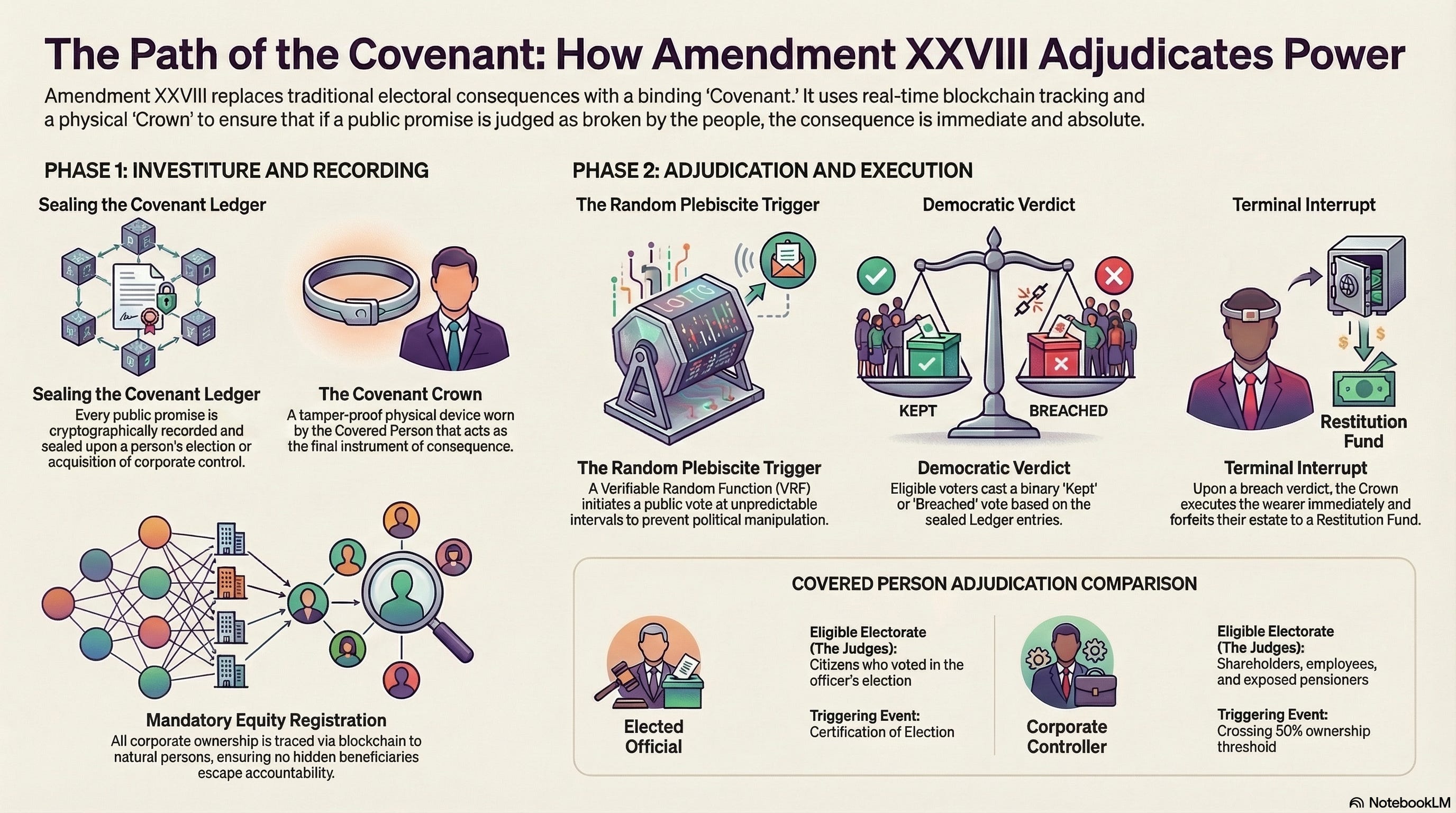
The first operational pillar creates a public equity ledger. The transcript describes a permissionless public blockchain that records corporate equity in real time, and it requires ownership to remain traceable “to the blood,” meaning traceable to an ultimate human beneficiary. The enforcement rule carries force: when a cryptographic chain breaks, the system treats concealed equity as void.
A second pillar records political and corporate promises in an immutable covenant ledger. The hosts describe a core strategic focus on time as a defensive tactic used by incumbents and powerful institutions. The proposed counter uses unpredictability: a stochastic trigger driven by a verifiable random function seeded from “public entropy,” with examples named in the transcript that include millisecond ocean fluctuations, radioactive isotope decay rates, and atmospheric noise. The logic relies on scheduling failure: lawyers, donors, and officeholders cannot plan around a trigger they cannot forecast.
When the trigger fires, the transcript sets a 72-hour voting window. The judges vary by target. For elected officials, judges consist of the citizens who voted in that election. For corporate controllers surfaced by the equity ledger, judges include affected stakeholders such as shareholders, employees, and pensioners. The ballot reduces the decision to a binary based on recorded promises and observed conduct: kept or breached.
The Covenant Crown: Consequence as a Physical Tool
The blueprint escalates into hardware described as the covenant crown, a tamper-resistant device fitted with redundant biometric sensors and placed on a covered person at investiture, remaining until the term ends. The transcript states the consequence mechanism with direct clarity: a breached verdict triggers a “terminal interrupt” that kills the wearer instantly, and a programmable compliance protocol transfers the estate into a public restitution fund.
The episode grounds this concept in a real-world reference tied to Palmer Luckey. The transcript cites a November 6, 2022, blog post describing a functional VR headset prototype modeled on the NerveGear from Sword Art Online, a device concept that kills the player when the in-game avatar dies. The hosts treat that prototype as proof that engineers can build hardware that links digital adjudication to physical consequence.
Pressure Points Inside the Blueprint
The hosts also surface unresolved zones that the transcript names implicitly through roles surrounding the covenant system. Promise architects—consultants, speechwriters, and policy designers—shape covenant language. Definition: Authorities influence metrics that voters interpret during the 72-hour window. Information platform owners control distribution and visibility when a live plebiscite begins. Who controls the frame that voters use when life and forfeiture sit in the outcome? The amendment gives Congress a two-year window to formalize rules requiring hidden donors and platform controllers to be brought into the liability structure.
The episode closes by returning to the governing claim: accountability requires enforceable structure. The hosts end on the deterrent question embedded in the transcript’s final movement: who seeks power under a system that binds promises to immediate consequence?
Thanks to the generosity of my readers, all my articles are available for free access. Independent journalism, however, requires time and investment. If you found value in this article or any others, please consider sharing or even becoming a paid subscriber, who benefits by joining the conversation in the comments. I want you to know that your support is always gratefully received and will never be forgotten. Please buy me a coffee or as many as you wish.

The Duke Report - Where to Start
My articles on SubStack are all free to read/listen to. If you load the Substack app on your phone, Substack will read the articles to you. (Convenient if you are driving).
Foundational Articles
Podcast (Audio & Video Content)
Palmerston’s Zoo Episode 01 - Solving the Paradox of Current World History (9 Episodes)
Oligarchic Control from the Renaissance to the Information Age
SoundCloud Book Podcasts
I’ve taken almost 200 foundational books for understanding how the world really works and posted them as audio podcasts on SoundCloud. If you load the app on your phone, you can listen to the AI robots discuss the books on your journeys across America.
Duke Report Books
Over 600 foundational books by journalists and academics that never made the New York Times Bestseller list, but somehow tell a history we never learned in school. LINK


