


Thank you Thomas Gilligan, Maemae, Carole, Renee Devereaux, M.S., Alan Hamilton, and many others for tuning into my live video!
Between Ignorance and Evil – Thoughts on Venezuela examines the January 2026 removal of Venezuela’s president through a lens of epistemological warfare, imperial economics, and information control. Duke anchors the event within a pattern of Anglo-American empire strategy, arguing that modern regime change no longer relies on military conquest but on engineered perception. He describes the operation in Venezuela as a continuity of power extending from British oligarchic banking systems to U.S. foreign policy instruments that operate through deception and corporate consolidation.
The Coup in Venezuela and Its Celebration
Duke begins with the emotional shock of seeing friends on social media celebrating what he calls a “Smedley Butler-style gangster” intervention. The United States, under Donald Trump, has removed a sitting president in Caracas and replaced the government with a pro-Western proxy. He observes that even intelligent people respond with enthusiasm to this spectacle because epistemological manipulation has eroded moral discernment. The enthusiasm, he argues, reflects how psychological operations have shaped popular political identity. He defines this as the ultimate victory of epistemological warfare: a population so conditioned by media frames that it applauds imperial violence disguised as liberation.
The Transformation of MAGA and the Psychology of Denial
Duke cites commentator Owen Shroyer, who condemns the intervention as a “special interest regime change war for the oil companies.” Duke extends that point, describing the evolution of the MAGA movement from a populist critique of globalism into a cult of obedience.

Supporters who once denounced endless wars now defend them. He identifies denial as the central psychological mechanism: supporters recognize the betrayal but lack the moral courage to name it. Trump’s followers, he says, have inverted their values, celebrating the very imperial tactics they once opposed. Their cognitive dissonance signals an advanced stage of epistemological capture.

The Framework of Global Power
To clarify his reasoning, Duke introduces his explainer, “The Power Structure of the World.” This framework organizes global authority into a five-layer pyramid. At the base are “prisoners of the cave,” citizens bound by illusion, whose worldview is constructed by media shadows projected onto digital screens. The next tier consists of “true believers,” activists whose devotion to ideology replaces personal judgment. Above them operate “assets,” individuals who unwittingly advance elite agendas through journalism, finance, and politics. Overseeing them are “handlers,” the professional class of think-tank operatives and policy directors who shape narratives through institutions like the Council on Foreign Relations. At the summit stand the “power elite oligarchs,” family dynasties whose wealth endures through corporate law and global finance.

Control Through Information and Structure
Duke asserts that the power pyramid endures through epistemological warfare—the organized management of human perception. Media systems function as weapons that create synthetic reality. Governments and corporations merge into what he calls a Global Public-Private Partnership, a structure he symbolizes with the three P’s of “PPP.” Inverting those P’s forms the number 666, which he interprets not as a biblical curse but as a Freemasonic code of presence. Public-private partnerships, he argues, are instruments of hidden governance. They fuse policy and profit under one administrative logic that answers to transnational banking families rather than national electorates.
The Anglo-American Empire and Resource Control
Duke interprets the Venezuelan coup as a strategic move by the Anglo-American empire to secure hemispheric energy dominance. He describes the United States as “the blaster” in a symbiotic pair with “the master” — the financial elite concentrated in London and Basel. The military might of America enforces the economic designs of the British and European oligarchs. This structure seeks continental self-sufficiency under a planned technocracy. By controlling Venezuelan oil reserves, the empire strengthens its grip over North American and global hydrocarbon flows, sustaining the petrodollar system and blocking the emergence of Eurasian energy alliances.
The Absolute Zero 2050 Plan and Neo-Feudal Design
Duke links these operations to the “Absolute Zero 2050” framework published by Cambridge University, which outlines a transition to post-carbon economies with restrictions on aviation, manufacturing, and consumer freedom. He interprets the plan as a feudal technocracy designed to create regional energy autarky. Each continent becomes an isolated economic zone managed through digital governance and carbon compliance. In this design, Venezuela’s resources serve as the foundation for North American energy security while Europe remains dependent on transatlantic oversight. The project, he claims, replicates medieval hierarchy through modern technology, reviving serfdom under the guise of sustainability.
The Continuity of Empire
Tracing the roots of this system, Duke identifies December 23, 1913—the founding of the Federal Reserve—as the moment the United States surrendered its sovereignty. He argues that the Rothschild banking network and the Bank of England absorbed American financial autonomy, converting the republic into an instrument of empire. The Civil War, he contends, represented an earlier phase of this struggle: the British backed the Confederacy to fragment the nation, and when that failed, they subverted it through finance. By 1913, the battle was won without open warfare. The empire achieved control through debt and monetary issuance rather than occupation.
The World War of Information
In response to a viewer’s question about the possibility of a new world war, Duke insists the war has already begun. He defines World War III as an information war, fought through the World Wide Web. The acronym “WWW,” he observes, completes the sequence “World War I, World War II, WWW.” Digital platforms constitute the battlefield where epistemological combat occurs. Memes, algorithms, and narratives replace bullets and bombs. Control over data streams determines control over minds. Victory requires discernment—the ability to recognize manipulative framing and reject synthetic consensus.

Esoteric Codes and Ritual Communication
Duke explores how elites signal their power through symbols hidden in plain sight. He references the concept of “Rituals in Plain Sight,” where Freemasonic and occult codes mark elite coordination. The triad of sixes in PPP exemplifies such signaling. He cites researcher Michael Hoffman’s term “revelation of the method,” describing how elites disclose their mechanisms as a form of psychological dominance.
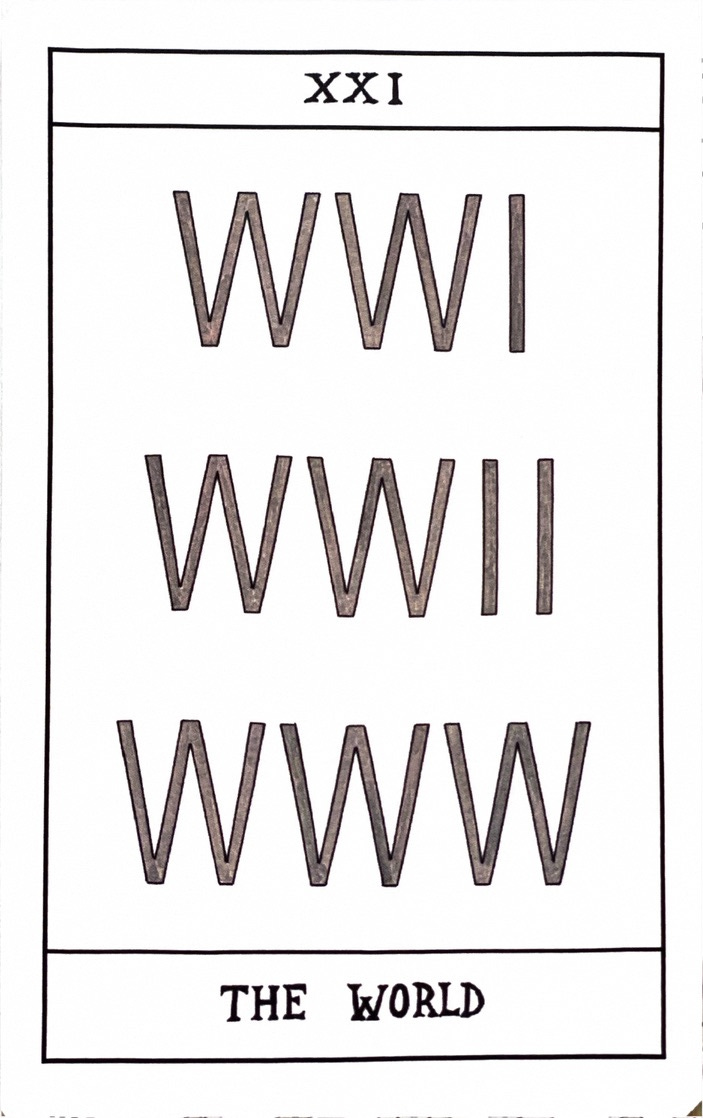
To illustrate the cultural dimension of this phenomenon, he references artist Suzanne Treister’s tarot deck created for CERN, which includes a “World” card labeled “World War I, World War II, WWW.” For Duke, this visual metaphor captures the transition from kinetic to cognitive warfare—the global web as the theater of the Third World War.

The Scapegoat and the Israeli Question
Addressing the Middle East, Duke interprets Israel as a constructed proxy of the British imperial project rather than an autonomous power. He traces Zionism to nineteenth-century English intellectuals like John Ruskin and Henry Wentworth Monk, who promoted a Jewish return to Palestine as part of an esoteric imperial strategy. He references artist Holman Hunt’s 1854 painting “The Scapegoat,” co-sponsored by Monk, as the visual origin of Zionist fundraising. The motif of the scapegoat, Duke suggests, represents the planned role of Israel within the empire’s long game: to serve, flourish, and ultimately bear the blame for broader geopolitical crimes. He anticipates a manufactured reckoning in which Israel becomes the sacrificial front for power realignment toward Qatar and Singapore, emerging as the new financial and military hubs of the Anglo-American system.
Financial Cartels and Hidden Ownership
When asked who calls the shots, Duke points to the controlling interests of the Fortune 2000, the Federal Reserve, the Bank of International Settlements, and the Bank of England. He explains that these entities conceal ownership through layered shell companies. He cites the Panama Papers as a rare window into this structure—a leak revealing how elites distribute holdings across jurisdictions to mask accountability. Yet, he laments, no major media organization pursued the forensic mapping that could expose ultimate control. He references researcher Dean Henderson, whose books, available on dukereportbooks.com, attempt to identify these families and trace the continuity of their power.
From Political to Ontological Freedom
Duke responds to a philosophical query about freedom by distinguishing political and ontological dimensions. Political freedom allows expression within predefined boundaries. Ontological freedom involves awareness beyond the system that defines those boundaries. He argues that modern citizens possess political permission but lack ontological sovereignty. Without control over the structures of meaning, they cannot govern themselves. He urges listeners to move beyond electoral illusions and recognize the deeper manipulation of epistemological warfare.
The Function of the “True Believer”
Expanding on Eric Hoffer’s theory, Duke describes how the “true believer” sustains the pyramid of power. Disillusioned individuals seek meaning in collective movements that promise redemption. Their devotion converts personal frustration into mass momentum. This mechanism explains the energy of ideological movements from MAGA to BLM. For Duke, such devotion forms the raw material of empire. The elites do not care which ideology prevails, only that passion remains contained within scripted opposition. Every cause becomes a managed dialectic reinforcing systemic control.
The Material Infrastructure of Illusion
Duke argues that digital technology functions as the new cave wall of Plato’s allegory. The firelight of ancient myth has become the glow of the smartphone screen. Shadows of narrative flicker through social media feeds, shaping belief without direct coercion. When individuals break free and describe what they see, society mocks them as conspiracy theorists. He defines that label as a linguistic weapon created to isolate dissenters and preserve the illusion of consensus. The term “conspiracy theory,” he says, was popularized to defend institutional credibility and suppress cognitive independence.
The Moral Frame of Empire
Duke closes by returning to the moral dimension. He recalls Hillary Clinton’s reaction to Muammar Gaddafi’s death — “We came, we saw, he died” — and sees Trump’s Venezuela operation as the same imperial gesture with a different face. The laughter of power repeats across administrations. He rejects the idea of partisan salvation and situates Trump and Clinton within the same oligarchic continuum. The frame of good versus evil dissolves when the same empire directs both sides. The battle for humanity, he concludes, unfolds between ignorance and evil: ignorance that accepts illusion and evil that engineers it. The choice before individuals is epistemological. To regain freedom, one must see through the shadowplay, discern the structure, and reclaim the capacity to know.
Thanks to the generosity of my readers, all my articles are available for free access. Independent journalism, however, requires time and investment. If you found value in this article or any others, please consider sharing or even becoming a paid subscriber, who benefits by joining the conversation in the comments. I want you to know that your support is always gratefully received and will never be forgotten. Please buy me a coffee or as many as you wish.

The Duke Report - Where to Start
My articles on SubStack are all free to read/listen to. If you load the Substack app on your phone, Substack will read the articles to you. (Convenient if you are driving).
Foundational Articles
Podcast (Audio & Video Content)
Palmerston’s Zoo Episode 01 - Solving the Paradox of Current World History (9 Episodes)
Oligarchic Control from the Renaissance to the Information Age
SoundCloud Book Podcasts
I’ve taken almost 200 foundational books for understanding how the world really works and posted them as audio podcasts on SoundCloud. If you load the app on your phone, you can listen to the AI robots discuss the books on your journeys across America.
Duke Report Books
Over 600 foundational books by journalists and academics that never made the New York Times Bestseller list, but somehow tell a history we never learned in school. LINK


