


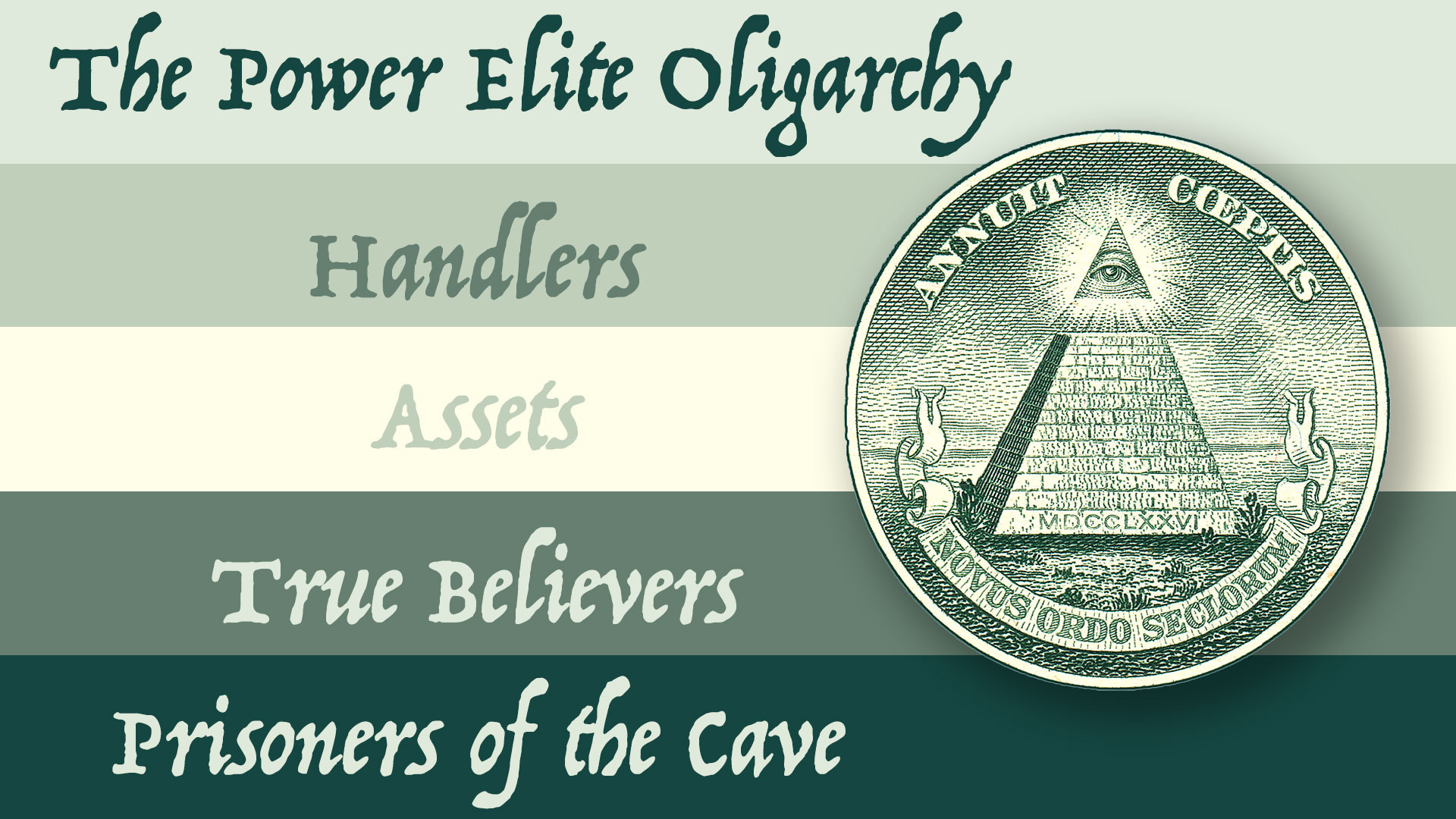
The Power Structure of the World by Peter Duke outlines a five-layer framework of global control that connects philosophy, intelligence operations, and finance into a unified theory of governance. It is a blend of ideas from Plato, Eric Hoffer, C. Wright Mills, and Intelligence Agencies, created to explain how authority organizes and maintains itself over time. Duke defines a continuous system of power — focused on perception management and epistemological warfare — that links the ruled to the rulers through controlled knowledge.
Original Post

Epistemological Warfare and the Control of Logos
Duke identifies epistemological warfare as the organizing principle of this model. The war operates through control of logos: language, culture, and money. This control shapes how societies recognize truth. Stories, media narratives, and financial systems operate as coordinated tools for managing public understanding. When these instruments of persuasion falter, force and coercion restore order. The war functions through perception, embedding its logic in communication and value exchange.
The Base: The Prisoners of the Cave
At the foundation of Duke’s pyramid stand the prisoners of the cave, a direct adaptation of Plato’s allegory. The modern chains are mental — restrictions on attention and critical thinking — while the cave wall is physical, embodied in television and smartphone screens. The light of the real world burns behind the viewer, unseen, while the shadows on the wall become the dominant experience of life. The education system, as Duke defines it, completes this captivity.

Western schooling trains students to memorize and repeat information, producing compliance with institutional narratives. Media and entertainment amplify the conditioning through distraction and division. Managed sports spectacles and party politics sustain emotional investment within safe boundaries, ensuring that the prisoners remain engaged with illusions of choice.

The True Believers and the Energy of Movements
The second layer, the true believers, generates the visible energy of political and social life. Duke draws on Eric Hoffer’s 1951 book The True Believer to define their psychology. True believers act from frustration and find identity within mass movements. They trade the complexity of autonomy for the clarity of obedience. Their devotion gives coherence to personal discontent and transforms private pain into public activism. Duke lists the wide ideological range of such actors — Republicans, Democrats, MAGA supporters, BLM activists, anarchists, Zionists — and shows that their movements share a structure: collective identity anchored in frustration and directed toward a chosen enemy. The system channels this passion into safe contests where outcomes remain contained.
The Operational Core: Assets and Handlers
Above the believers rise the operational layers. Assets occupy the third tier. They perform tasks assigned by handlers to execute the will of the oligarchs. Their work spans intelligence, finance, propaganda, and influence. Bankers and accountants form financial fronts through shell companies. Journalists and media producers, described as “Mockingbird journalism,” manage the flow of information. Social media influencers become contemporary propagandists who can redirect attention within hours. Couriers and cutouts maintain secrecy, while coercive methods such as honey traps and blackmail — illustrated through examples like Jeffrey Epstein and Sean “Puff Daddy” Combs — create leverage over decision-makers. The visible scandal conceals the operational function: to obtain influence over legislation, contracts, and regulations.

Handlers, occupying the fourth layer, supervise the assets. They include political leaders, foundation executives, and managers of global roundtable organizations such as the Council on Foreign Relations, the Trilateral Commission, the Bilderberg Group, the Club of Rome, and the World Economic Forum. Handlers coordinate continuity across governments and industries through what Duke calls the revolving door, where corporate leaders become public officials and later return to private institutions. Elite schools and secret societies, including Rhodes Scholarships and Yale’s Skull and Bones, supply new recruits. Foundations such as Rockefeller, Gates, Ford, Open Societies, The Berggruen Institute, and Clinton manage tax-exempt capital that finances long-term cultural and political agendas. High-ranking politicians act as doges — public faces absorbing blame and praise while true authority remains unseen.
The Apex: The Power Elite Oligarchs
At the top of Duke’s hierarchy stand the Power Elite Oligarchs, a hidden class of interlinked family lines. They perpetuate their dominance through corporate and financial instruments that operate beyond the limits of individual life. Trusts, private banks, and corporations function as immortal persons executing inherited strategies. Duke describes this as the legal architecture of perpetual control. The oligarchs govern through financial leverage and debt management rather than production. Their objective is a neo-feudal order where sovereignty dissolves into global financial governance. Offshore havens such as the City of London, Switzerland, and Panama conceal ownership and secure insulation from national law.

The Venetian Prototype and Long-Term Continuity
Duke traces the lineage of this system to the Republic of Venice, where patrician families controlled commerce, intelligence, and information across Europe. Venetian ambassadors and merchants reported on political alliances and royal debts, creating an early form of global intelligence. Printing houses in Venice distributed controlled interpretations of Aristotle, shaping elite education for centuries. When power migrated north, these families transferred capital and alliances into Amsterdam, London, and Geneva, preserving control through calculated succession.
The Logic of Control and the Antidote of Logos
The modern oligarchy, Duke argues, continues the Venetian model through global financial institutions such as the Federal Reserve and the Bank for International Settlements. Historical precedent anchors this claim in J.P. Morgan’s 1915 purchase of newspaper editorial policy, which ensured favorable coverage for corporate interests. The structure expands through gradual institutional infiltration known as the Fabian strategy—a slow capture achieved through language and policy. This continuity produces a population trained to trust the very narratives that define their captivity.

Duke closes his analysis with a direct challenge. The weapon of control is epistemological warfare. The defense is deliberate cultivation of logos. Critical thinking, moral courage, and disciplined inquiry restore autonomy. To see beyond the cave’s shadows, a person must rebuild the faculty of discernment — learning again to distinguish the real object from its projection.
Thanks to the generosity of my readers, all my articles are available for free access. Independent journalism, however, requires time and investment. If you found value in this article or any others, please consider sharing or even becoming a paid subscriber, who benefits by joining the conversation in the comments. I want you to know that your support is always gratefully received and will never be forgotten. Please buy me a coffee or as many as you wish.

The Duke Report - Where to Start
My articles on SubStack are all free to read/listen to. If you load the Substack app on your phone, Substack will read the articles to you. (Convenient if you are driving).
Foundational Articles
Podcast (Audio & Video Content)
Palmerston’s Zoo Episode 01 - Solving the Paradox of Current World History (9 Episodes)
Oligarchic Control from the Renaissance to the Information Age
SoundCloud Book Podcasts
I’ve taken almost 200 foundational books for understanding how the world really works and posted them as audio podcasts on SoundCloud. If you load the app on your phone, you can listen to the AI robots discuss the books on your journeys across America.
Duke Report Books
Over 600 foundational books by journalists and academics that never made the New York Times Bestseller list, but somehow tell a history we never learned in school. LINK


