


h/t I was directed to this video by The Hidden Life Is Best. His content is some of the best and most interesting on the interwebs. Highly recommended. More details on the Money Masters below.👇🏻
The Money Masters, directed by William T. Still and produced by Patrick S. J. Carmack, traced the complete lineage of monetary power from ancient systems of debt to the Federal Reserve’s command of twentieth-century finance. The film defined money as the primary instrument of governance, created and withdrawn by private institutions that shaped national destiny through the issuance of credit. Across its structure, the documentary revealed the recurring pattern through which control of money issuance determined political and social outcomes.
The Origin of Monetary Authority
King Henry I of England established the tally-stick system in 1100 AD, transforming wooden notches into official money accepted for taxes. His design created a stable, debt-free medium that sustained England for seven centuries. Private financiers later overturned that stability, promoting credit backed by gold and converting money into debt. By the late seventeenth century, the Bank of England formalized this transformation. In 1694, a royal charter granted private bankers authority to lend money created from nothing to the Crown at interest, institutionalizing permanent public debt. England became the model for a global system of monetary control anchored in credit and taxation.
Merchant banking houses then carried this structure across Europe. In 1743, Amschel Moses Bauer opened a financial enterprise in Frankfurt beneath a sign marked with a red shield. His son, Mayer Amschel Rothschild, built a network of banks in London, Paris, Vienna, Frankfurt, and Naples. The Rothschild family financed wars, lent to monarchs, and collected interest through government borrowing. Their model fused credit, war, and state finance into a single mechanism of control.
The Roman Precedent and the Assassination of Caesar
Centuries before England’s banking empire, Rome confronted the same conflict over the power to issue money. Julius Caesar broke the dominance of private money changers by issuing debt-free currency directly from the Roman treasury. His coinage circulated without interest and revived prosperity across the empire. Farmers regained land, commerce expanded, and the economy stabilized. Caesar’s monetary reform transformed Rome from a society ruled by creditors into one supported by productive labor.
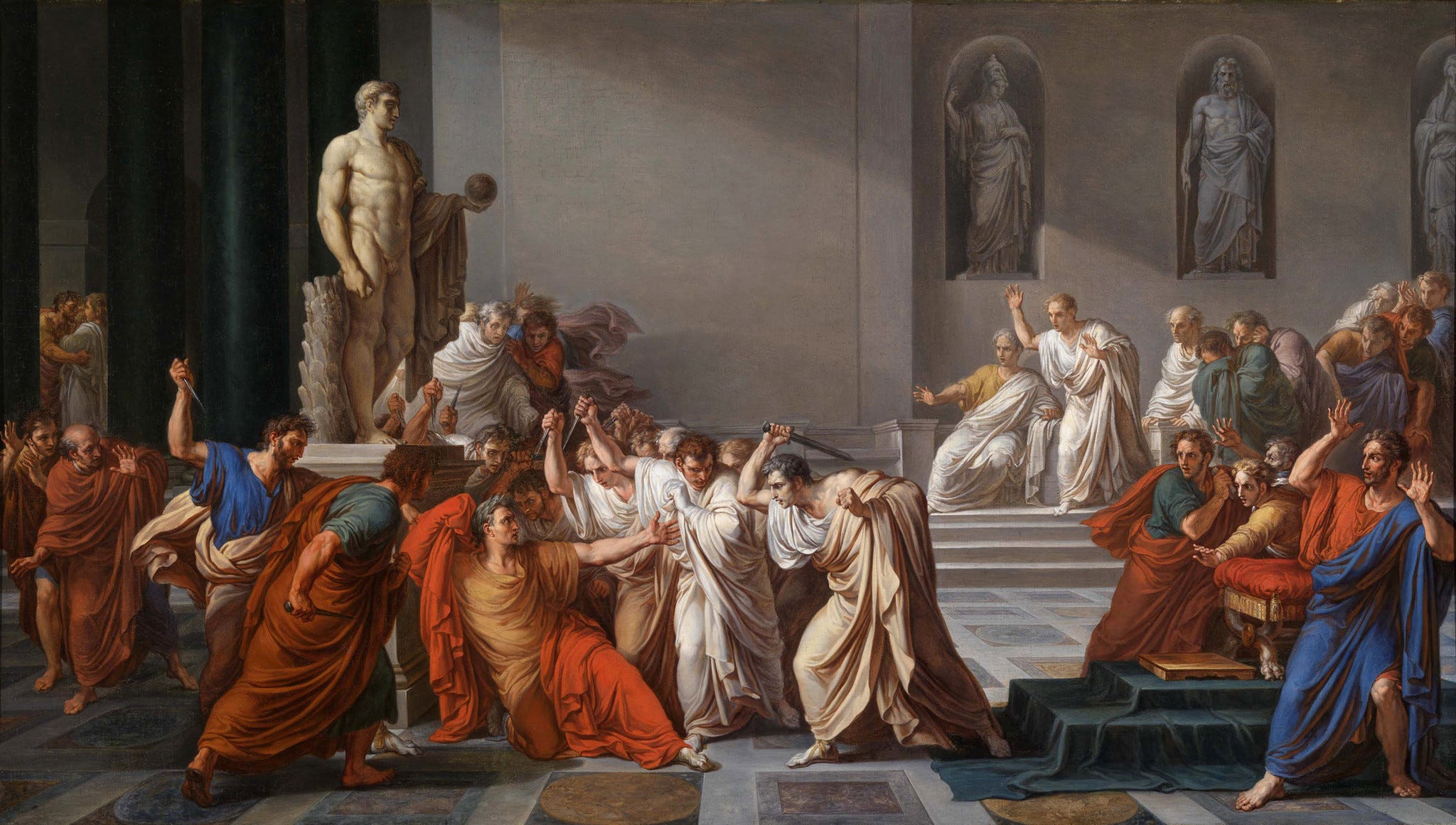
The film stated that his assassination ended this policy. The money changers regained control, restricted the money supply, and drove the empire back into debt. The episode served as the first recorded instance of financiers destroying a leader who restored public control of money. The Roman example established the central thesis of the documentary: monetary sovereignty determined national survival.
From Empire to Revolution
In 1764, the Currency Act forbade the American colonies from issuing their own paper money. Benjamin Franklin described this law as the direct cause of colonial poverty and rebellion. Colonial Scrip — debt-free money issued by local assemblies — had maintained full employment and a stable exchange rate. The British restriction forced the colonies to depend on the Bank of England’s credit and drained gold from them. The depression that followed set the stage for revolt.
The American Revolution converted monetary independence into a constitutional principle. The framers granted Congress the authority to coin money and regulate its value, embedding currency sovereignty into the nation’s framework. Yet the young republic soon faced private banking pressure. In 1781, Robert Morris founded the Bank of North America, operating on fractional-reserve banking. The institution issued loans far beyond its deposits, generating profit from interest on imaginary capital. A decade later, Alexander Hamilton created the First Bank of the United States, modeled on the Bank of England. The government borrowed funds that the bankers themselves created.
The Struggle for Control
The War of 1812 and the chartering of the Second Bank of the United States restored private dominance. President Andrew Jackson dismantled the bank in 1836. He withdrew government deposits, vetoed its charter renewal, and declared victory over “the money power.” For a generation, the United States issued its own currency through the Treasury. That sovereignty ended during the Civil War.
When financiers demanded ruinous interest to fund the Union, President Abraham Lincoln bypassed them by printing Greenbacks — debt-free notes created by the Treasury. They circulated successfully and proved that a government could issue money without borrowing. Lincoln’s assassination terminated the experiment. The National Banking Act of 1864 reinstated debt-based currency, tying the money supply to government bonds held by private banks. Money once again equaled debt.
The Rise of Modern Banking Power
At the dawn of the twentieth century, the pattern repeated. The Panic of 1907, coordinated by J. P. Morgan and allied bankers, collapsed credit markets and persuaded Congress that only a central bank could stabilize the economy. In 1910, leading financiers met secretly on Jekyll Island, Georgia, to design the Federal Reserve System. Paul Warburg, Nelson Aldrich, and representatives of Morgan and Rockefeller interests drafted legislation that concealed private ownership beneath a federal title.
President Woodrow Wilson signed the Federal Reserve Act in 1913. The law transferred the power to issue money from Congress to the Federal Reserve, a private corporation composed of regional banks owned by member institutions. The system created money as debt, lent it to the government, and charged interest on it. Wilson later admitted that he had delivered the nation’s liberty to the control of financiers. The Federal Reserve became the dominant force in American life, determining interest rates, credit supply, and the value of money.
Cycles of Expansion and Contraction
The Federal Reserve’s structure guaranteed alternating prosperity and collapse. When the Fed expanded the money supply, speculation flourished; when it contracted credit, depression followed. Between 1929 and 1933, the Reserve reduced the money supply by one-third. The contraction produced mass unemployment, foreclosures, and bankruptcies. Congressman Louis McFadden accused the Federal Reserve of orchestrating the Great Depression to consolidate ownership.
President Franklin Roosevelt removed the nation from the gold standard in 1933 and prohibited citizens from owning gold. That decree eliminated the final restraint on central banking authority. From that year forward, the United States operated entirely on fiat currency — paper money declared by law to have value, backed only by debt.
Global Architecture of Financial Dominion
After World War II, the global credit system expanded through new institutions. The International Monetary Fund and the World Bank extended loans to developing nations, binding them to perpetual debt denominated in Western currencies. Conditional lending required governments to privatize industries and impose austerity to ensure repayment. The Bank for International Settlements in Basel coordinated policy among the world’s central banks. It conducted settlements between nations and harmonized monetary strategies beyond the jurisdiction of parliaments.
The film identified these institutions as components of a single structure. The pattern of debt extended from individuals to nations and from nations to the planet itself. Each loan created new interest obligations that demanded further borrowing. Credit expansion guaranteed dependency disguised as development.
The Last Stage of the Dollar
In 1963, President John F. Kennedy issued Executive Order 11110, authorizing the Treasury to print silver-backed certificates. The action restored partial monetary sovereignty. His death ended the policy. In 1971, President Richard Nixon closed the gold window, halting the convertibility of dollars into gold for foreign governments. The dollar became a purely fiat instrument. From that moment, the global economy operated entirely on debt-based money.
The film described this as the completion of a historical cycle: private institutions now held total authority over money creation, and governments functioned as debtors within their own economies. Inflation, recession, and taxation operated as mechanisms for transferring wealth upward to the banking elite.
The Continuity of Power
Throughout history, the same sequence has repeated. Private financiers created money, lent it to governments, manipulated credit, and seized real assets through foreclosure and taxation. Political independence yielded to financial subordination. Thomas Jefferson warned that banks would dispossess citizens of property until their descendants woke homeless on the continent their fathers had conquered. Andrew Jackson destroyed one bank but was unable to eliminate the system. Abraham Lincoln demonstrated the success of sovereign currency, but a return to private issuance followed after his assassination. Woodrow Wilson signed the treasonous structure into law.
The film situated these events within a continuous timeline of deliberate design. The medieval money changers evolved into modern central bankers. The Roman debasement of coinage reappeared as inflation in paper money. The tally stick’s simplicity preceded complex derivatives and reserve ratios, yet the governing principle remained unchanged: whoever controlled money controlled life.
The Mechanics of Enslavement
Debt-based money expanded through fractional-reserve lending. Banks issued loans and recorded them as simultaneous assets and liabilities, creating deposits from nothing. Interest accumulated on sums that had never existed. The total debt exceeded the available money supply, guaranteeing default. Foreclosure transferred tangible property to the lender. This process governed mortgages, corporations, and sovereign bonds alike. The film presented it as the engine of modern servitude.
Economic crises unfolded as managed adjustments. Expansion inflated asset prices; contraction collapsed them. Ownership concentrated upward in every cycle. The business cycle functioned as a systematic transfer of wealth.
The Reclamation of Monetary Power
The documentary concluded with a program of restoration. The constitutional power to issue money belonged to Congress. That power, it argued, had to return to the government. A debt-free currency issued by the Treasury could fund infrastructure, education, and public works without incurring debt. Such issuance would abolish interest burdens, stabilize prices, and restore economic sovereignty. The filmmakers presented this reform as the essential act for national survival.
The Central Question
Who should control the creation of money — the people through their elected government, or private bankers through perpetual debt? The Money Masters framed that question as the measure of freedom itself. History, it asserted, recorded a continuous struggle between public sovereignty and private finance. From Julius Caesar’s coinage reforms to Henry I’s tally sticks and the Federal Reserve’s electronic ledgers, the form of money changed, but the principle is the same — money is law, and whoever commands its creation governs.
Thanks to the generosity of my readers, all my articles are available for free access. Independent journalism, however, requires time and investment. If you found value in this article or any others, please consider sharing or even becoming a paid subscriber, who benefits by joining the conversation in the comments. I want you to know that your support is always gratefully received and will never be forgotten. Please buy me a coffee or as many as you wish.

The Duke Report - Where to Start
My articles on SubStack are all free to read/listen to. If you load the Substack app on your phone, Substack will read the articles to you. (Convenient if you are driving).
Foundational Articles
Podcast (Audio & Video Content)
Palmerston’s Zoo Episode 01 - Solving the Paradox of Current World History (9 Episodes)
Oligarchic Control from the Renaissance to the Information Age
SoundCloud Book Podcasts
I’ve taken almost 200 foundational books, for understanding how the world really works, and posted them as audio podcasts on SoundCloud. If you load the app on your phone, you can listen to the AI robots discuss the books on your journeys across America.
Duke Report Books
Over 600 foundational books by journalists and academics that never made the New York Times Bestseller list, but somehow tell a history we never learned in school. LINK


