


The Wife Who Talked: A Complete Overview of the Kay Griggs 1998 Interview
The Duke Report™ | EpiWar™ Series
h/t to Brendon O'Connell for the reminder.
In 1998, a woman named Catherine “Kay” Pollard Griggs sat in front of a camera for roughly seven and a half hours and described, in granular detail, the interior architecture of American military intelligence as she had come to understand it through eleven years of marriage to Marine Corps Colonel George Raymond Griggs. The resulting interview — raw, unedited, and sprawling — constitutes one of the most detailed firsthand accounts of corruption, covert operations, and institutional capture within the U.S. military-intelligence apparatus ever recorded on video.
Kay Griggs was a credentialed historical researcher with a Master’s degree in Scottish History and a Bachelor’s in Virginia History. She had studied with scholars like Ian Cowan, Geoffrey Barrow, and Tom Devine. She had worked as Assistant Director of the Virginia Center for World Trade, served as the first woman on the board of the Foreign Commerce Club of Norfolk, chaired the International Shippers and Brokers board, served on the NATO Wives Club executive board, and founded the Virginia International Visitors Association as a State Department escort. She was rooted in old Virginia — born in Norfolk Naval Hospital, raised on her grandfather’s farm, married first to the grandson of a Virginia governor, and married for twenty-one years.
She was, in short, an insider by birth, by marriage, and by professional trajectory.
Her second husband, Colonel George Griggs — Princeton Class of 1959, Chief of Staff under General Al Gray, Head of Special Operations under Admiral Kelso at NATO — was, by her account, a severe alcoholic who drank three or four straight gins, a bottle of wine, and drew from a beer machine beside his desk every day for thirty years. During those drinking sessions, he talked. He talked about operations, about personnel, about the organizational mechanics of American covert power.
This overview covers the major claims Kay Griggs made across the full interview, organized thematically.
How She Came to Know What She Knew
Kay married George Griggs after knowing him for only two months. She describes a pattern of surface-level compatibility — both drove Saabs, both spoke French, both had family connections to the same Princeton eating clubs — that she later came to view as a targeted arrangement. George had been married before; his first wife, Sue, died of a cerebral hemorrhage under circumstances Kay came to regard as homicide.
During the first three years of their marriage, George drank heavily and spoke freely about his intelligence career. Kay describes these conversations as a form of unburdening — a man who could follow orders while inebriated but could not carry on a normal conversation while sober.
She also obtained George’s handwritten Beirut diary, which recorded day-by-day intelligence operations during his time as White House liaison to President Gemayel of Lebanon. The diary documented the operational movements of Marine snipers and assassins in Beirut, the shooting of a figure named Dale Dorman, medvac procedures, and operational relationships with General Jim Joy and General Carl Steiner.
When Kay called General Joy directly in February 1996 to locate her missing husband, Joy initially denied knowing George Griggs. Only when she mentioned the diary — and its documentation of their near-daily meetings in Beirut — did Joy suddenly remember: “Oh, that George Griggs.”
The Brotherhood: Organizational Structure
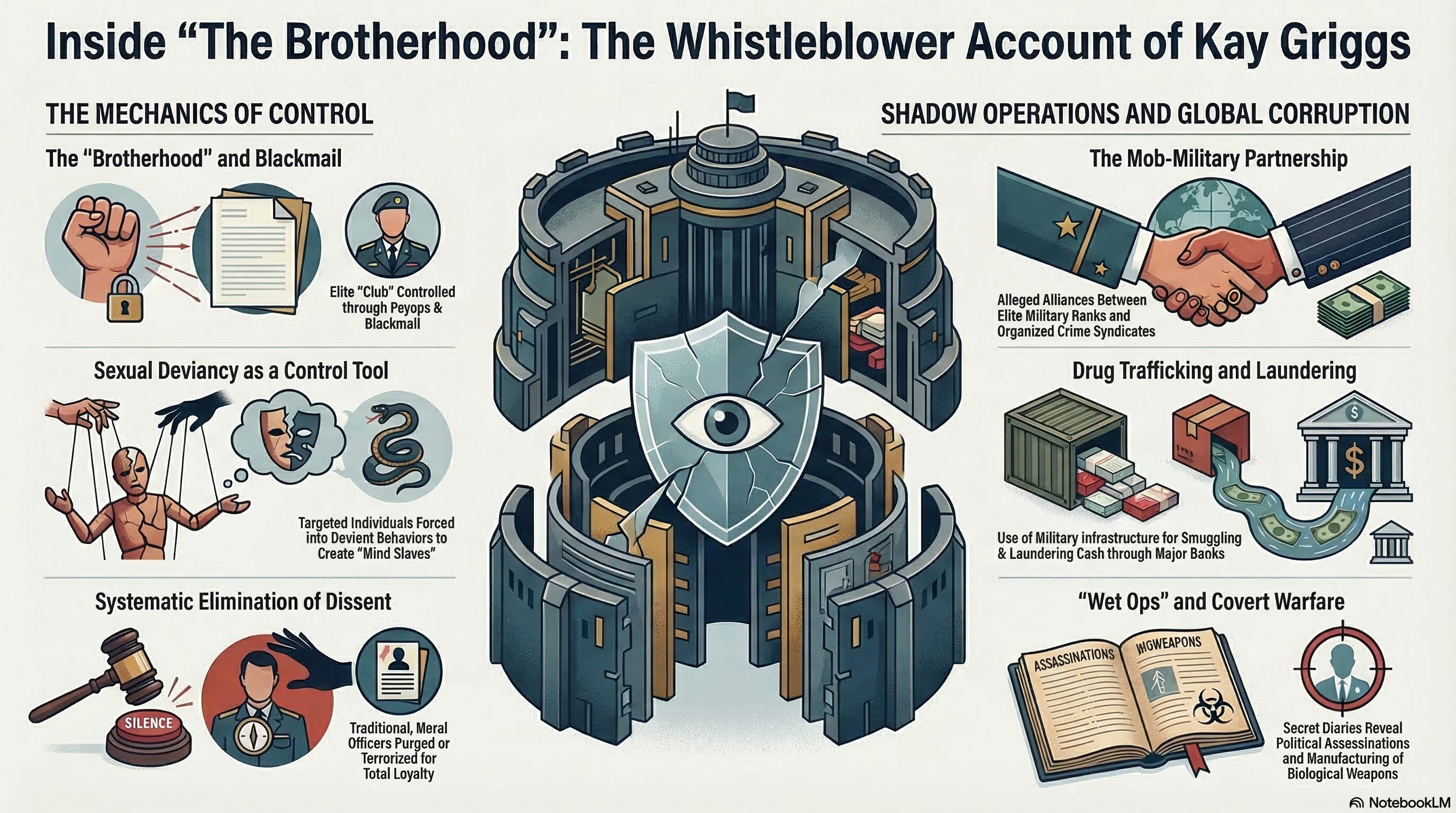
George Griggs referred to the inner circle by several names: “The Firm,” “The Brotherhood,” “The Old Guard.” Kay describes a tightly hierarchical, self-selecting group that operated across service branches — Marine Corps, Army, Navy — and extended into the judiciary, the State Department, and civilian political life.
The chain of loyalty, as George articulated it: the Marine Corps (the Brotherhood) came first — before God, before Jesus Christ, before the country, before the family.
Kay identifies the operational culture as rooted in what she calls a “German” model — referencing the organizational patterns of the SS under the German High Command, which she connects to Opus Dei, Masonic networks, and organized crime (specifically the Brooklyn-New Jersey mob). She names General Al Gray, General Sheehan, General Krulak, and her husband as participants in what she characterizes as a joint mob-military partnership, particularly in Special Operations.
The Marines, in this telling, function as “hitmen” — mercenaries who serve whatever institutional master holds authority at a given moment. George told her that the Marines could work for the State Department, the Army, or any operational authority with equal ease. “The Marine Corps is just a smoke-and-mirrors thing,” she quotes him saying. They operated out of New Orleans — the same Fourth Marine apparatus connected to Lee Harvey Oswald.
Selection, Recruitment, and Control
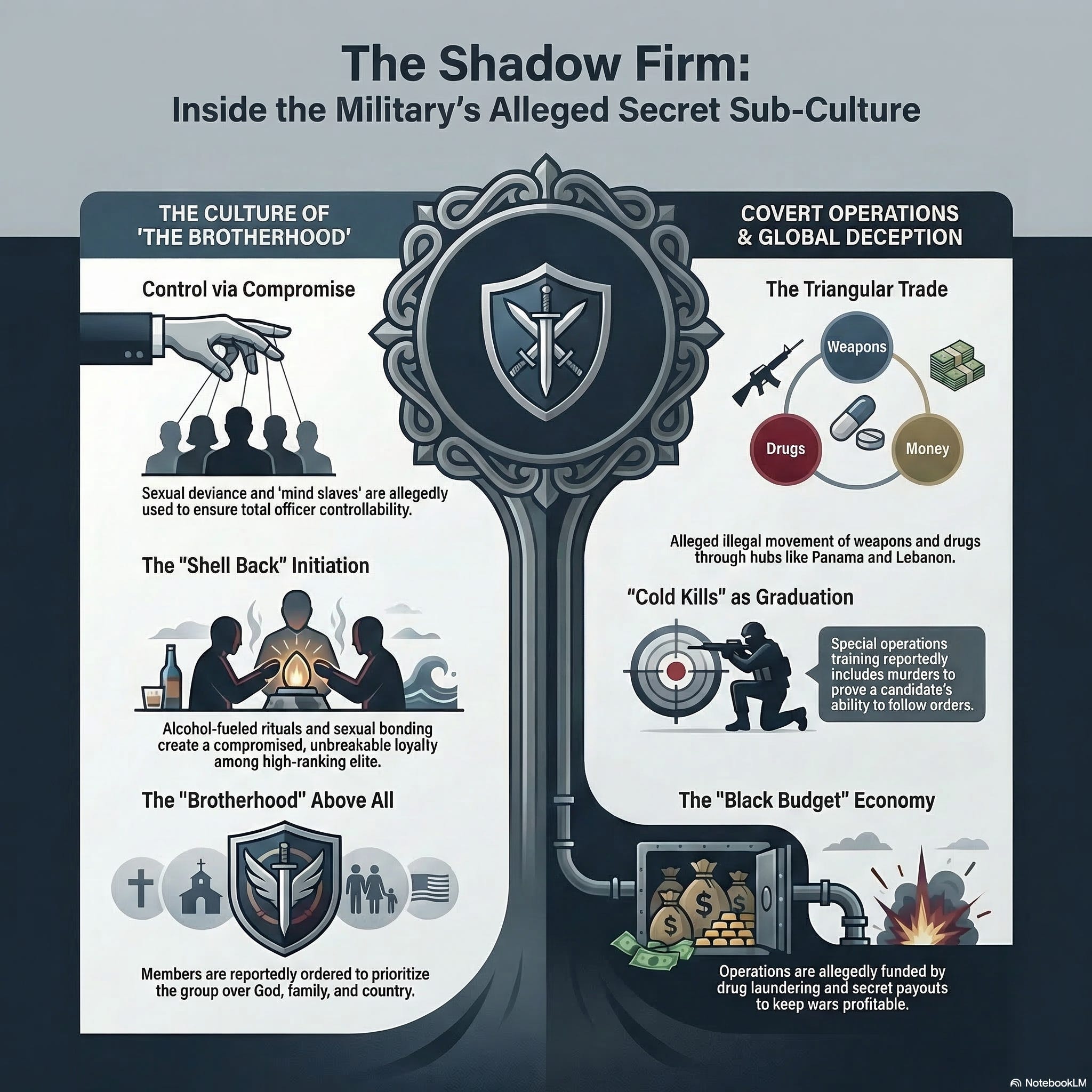
Kay describes a systematic recruitment pipeline. “Rising Stars” — sons of prominent families — were identified by State Department and intelligence personnel. Once identified, operatives “turned” them: if they were alcoholics, handlers supplied more liquor than anyone else; if they wanted women, handlers found the women. Once compromised, the recruit belonged to the organization.
Advancement to the rank of Bird Colonel in Special Operations required participation in initiation rituals. George described these to Kay directly. The rituals involved heavy alcohol, group sexual acts — both oral and anal — conducted in settings called “dining in” or “shellback” ceremonies. The coffin ritual from Skull and Bones at Yale had its parallel in Marine Corps induction ceremonies for Chiefs: the inductee lay in a coffin while group acts took place around and upon him.
Kay states that these acts served as both a bonding mechanism and a control mechanism. Once a man participated, he could be controlled through the threat of exposure. She claims that every Special Operations colonel she encountered had participated: “Not one of them is not a party to this.”
The same pattern extended to elite prep schools and universities. George Griggs attended the Hun School and Princeton, where a teacher named Charles Caddock — described as a known homosexual — recruited him into the network during his teenage years. George’s parents were sent to California; he did not see them for eight years. The transference dynamic was complete: the handlers became the parental figures.
Saudi royals attending Princeton were subjected to the same treatment. Kay describes parties at ARAMCO where young Muslim men were deliberately intoxicated and compromised — creating leverage over the sons of the Saudi ruling class.
Assassinations and Wet Operations
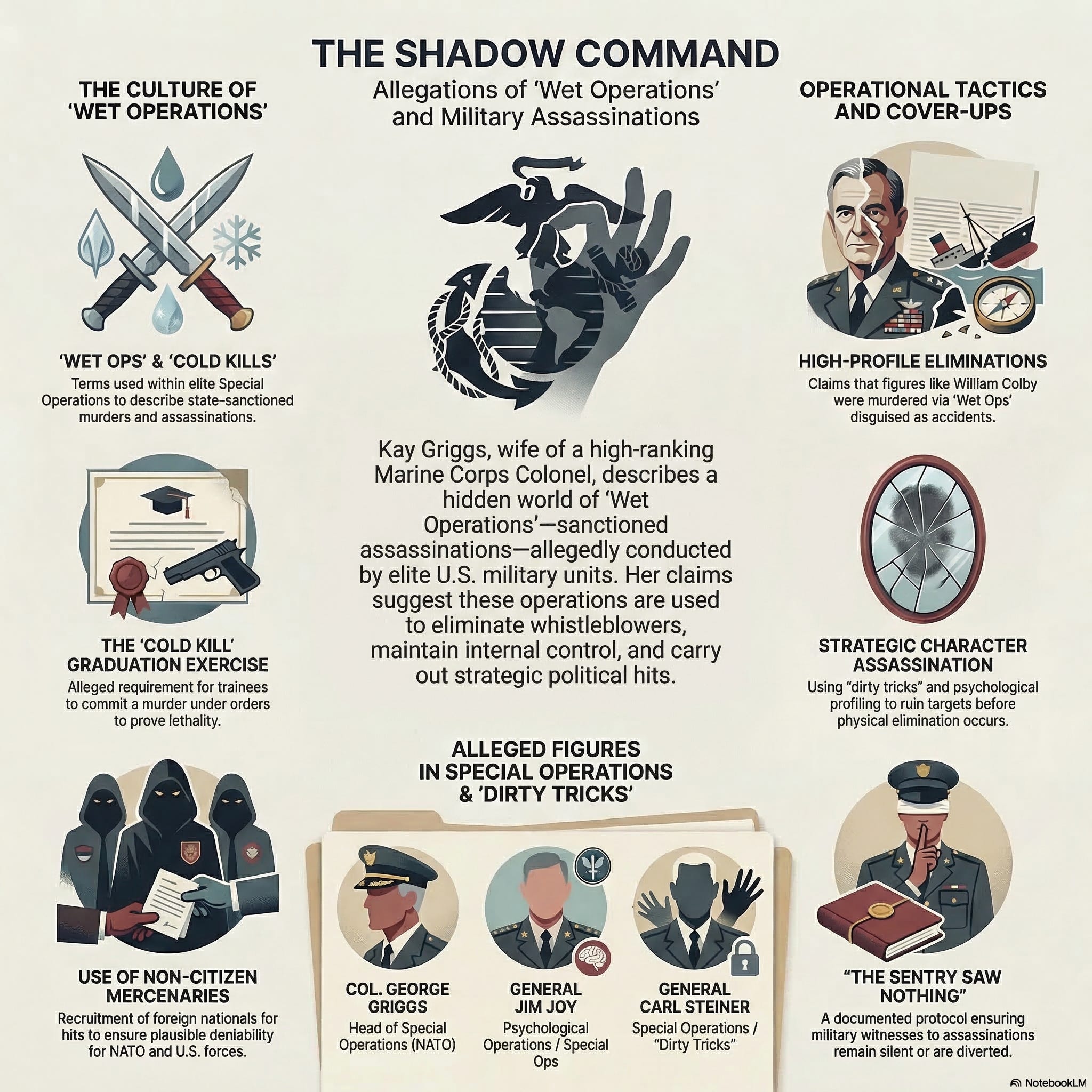
Kay describes a global assassination infrastructure operated through SEAL Teams (specifically Teams Four, Six, and Eight on the East Coast, odd-numbered teams on the West Coast) and Marine Corps Special Operations units.
Young mercenaries — many of them non-citizens from Romania, Haiti, and other countries—lived on $850 a month. They flew from Norfolk’s Oceana base to Stuttgart, then traveled by special helicopter to Turkey, Iraq, Algeria, or parts of Africa to conduct “wet ops.” They killed five, ten, or twenty people, and the operations were attributed to local factions or Arab groups. Kay calls them “NATO rogue assassins.”
She provides specific operational claims:
Malcolm Kerr, the president of the American University of Beirut, was killed because he refused to allow Marine snipers and assassins to use university dormitories as hideouts. George told her the details directly.
William Colby: The former CIA director, a Princeton graduate who knew George, spoke with Kay by phone. Two weeks later, Colby was found dead in an apparent canoeing accident. Kay suggests SEAL Team involvement — noting how easy it would be for a trained diver to approach from underwater and tip a boat.
George’s first wife, Sue: Kay states she was “battered to death.” Sue suffered a cerebral hemorrhage. A psychiatrist whom Kay consulted confirmed her suspicions. George admitted to battering Sue, admitted he dragged her body back after she collapsed at dinner, and admitted he did not love her.
Ron Brown: The Secretary of Commerce was murdered, in Kay’s account, because he attempted to break the State Department’s monopoly on illegal weapons sales and drug-funded arms deals.
Kay herself suffered severe domestic violence: broken bones, strangulation, a punch to the breast requiring surgery, and a .45 held to her head while her husband laughed. She filed criminal battery charges, and every judge assigned to her case turned out to be connected to the military-intelligence fraternity.
Drugs, Weapons, and Money
George told Kay directly, “We have never been an enemy of the Soviet Union.”
The drug trade operated through established routes: Burma, Turkey, and the Bekaa Valley. Banks in Beirut, Panama, Mexico, and St. Thomas laundered cash. The cash-funded weapons purchases. Brand-new American weapons were sold through Israeli agents and middlemen, with proceeds flowing through the Bank of Rome and into Israel.
Kay traces the financial architecture to Meyer Lansky’s organization, which she says established the template in the 1940s and grew like a pyramid scheme. She describes retired Marine Corps officers transitioning seamlessly into drug trafficking and secondary weapons sales, particularly in Miami (the “Dixie Mafia”) and Mexico (Lake Chapala, Guadalajara).
After George’s operations in Beirut, Kay found stock stubs—thousands of dollars in shares from a quasi-government company—which she identifies as his payoff for illegal weapons sales routed through Tel Aviv.
Biological and Chemical Weapons
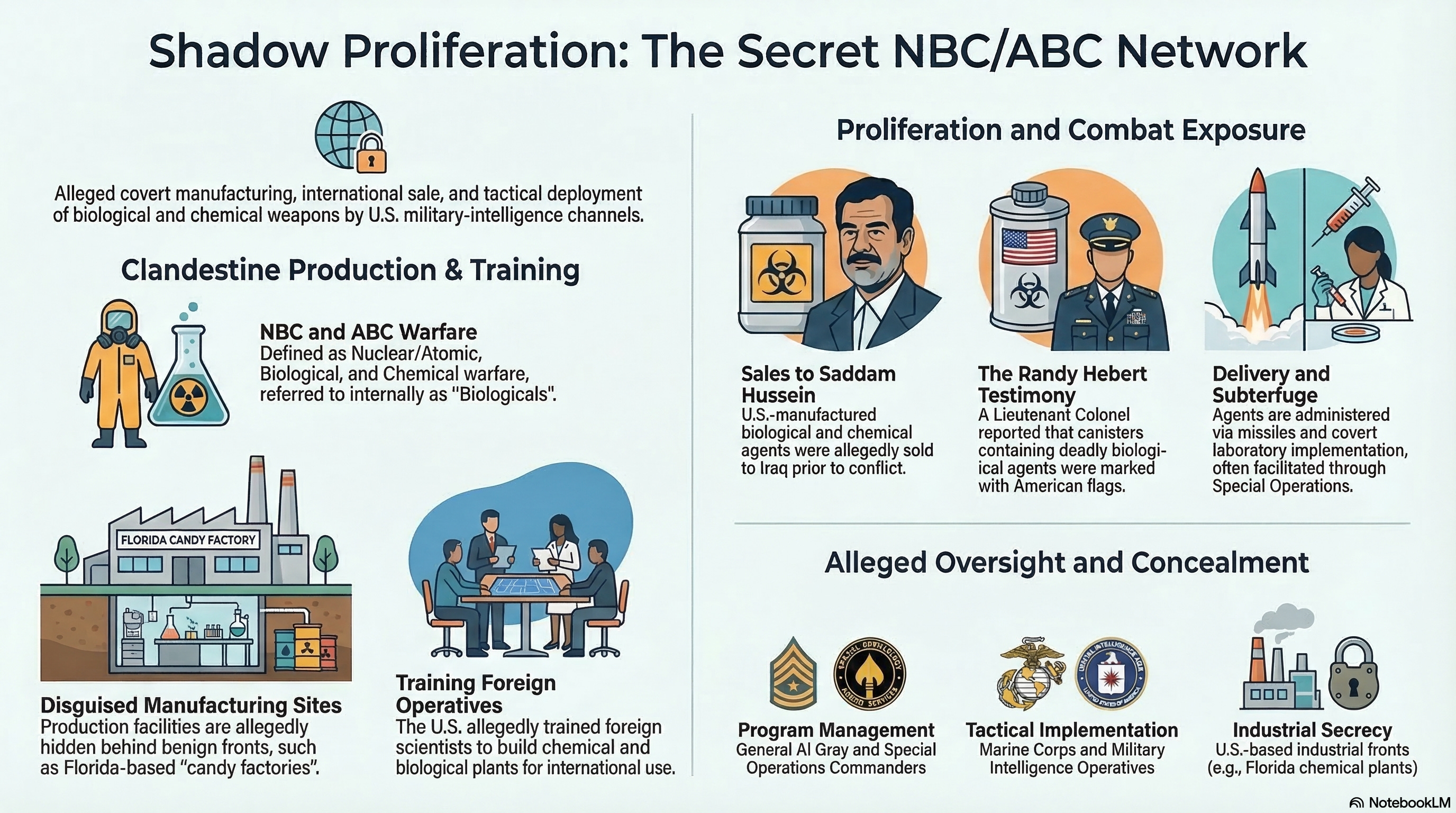
George used the term “ABC” (Atomic, Biological, Chemical) or “Biologicals” to describe this area of operations. Kay connects Marine Corps leadership—Gray, Krulak, McFarlane — to the manufacture and sale of chemical and biological weapons to Iraq.
She cites Lieutenant Colonel Randy Abear’s congressional testimony, in which Abear described leading a platoon into Iraq while all instruments registered chemical and biological contamination. On the canisters and boxes in the field, Abear found American flags. The biological and chemical agents that poisoned American troops had been manufactured in the United States and sold to Saddam Hussein.
Kay further describes a Florida factory, disguised as a candy plant, where these materials were manufactured. Peter Kawaja, a Marine Corps colonel who worked there in plain clothes, reported the same and alleged that his wife was killed for his knowledge.
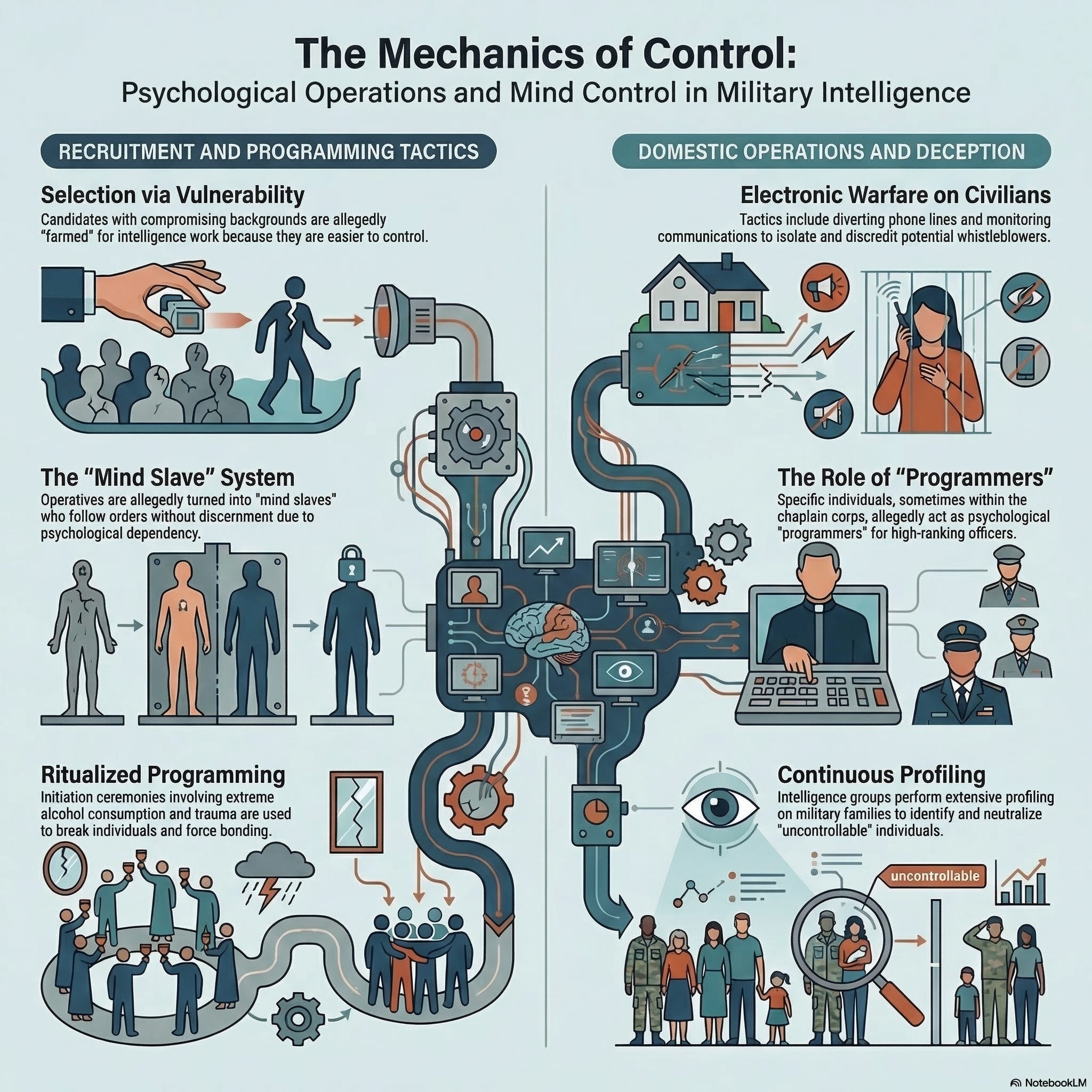
Mind Control and Psychological Operations
Kay describes a systematic program of psychological manipulation targeting both military personnel and civilians. The operational methods she identifies include:
Electronic warfare against individuals: Kay’s phone was diverted so that callers heard “This is a military base; the Griggs’s don’t live here anymore.” Sarah McClendon, the senior White House correspondent who sheltered Kay, had to use a phone in Maryland to reach her. Kay’s caller ID was downloaded, her car sabotaged, and her home broken into repeatedly.
Gaslighting operations: Operatives entered Kay’s home and rearranged objects in ways designed to make her appear mentally unstable—filling drawers with dozens of batteries, placing twelve screwdrivers neatly on a table, putting black dots on her white blouses. These operations are uncallable to police: “You can’t call the police and say I’ve got 12 screwdrivers.”
Farming: Intelligence operatives cultivated Kay using psychological profiling. A man named “Ern Reynolds” (born Ernest Frank Reynolds), a Fourth Marine JAG who had done seven years of dirty tricks for the Republican National Committee, approached her through an intermediary named Tim Hunter. Reynolds posed as a Christian whistleblower offering free legal help. Kay later caught him sneaking around her house at 2 a.m. and discovered he had stolen original documents from her briefcase.
The psychiatric weapon: Military wives who reported abuse were declared insane. Hannah Moore, wife of Judge John Moore — an Army Ranger who battered her — was committed to a mental institution so that her husband’s career could proceed. Kay identifies this as standard procedure: “If they’re a colonel or a rising star, the wife has got to be crazy.”
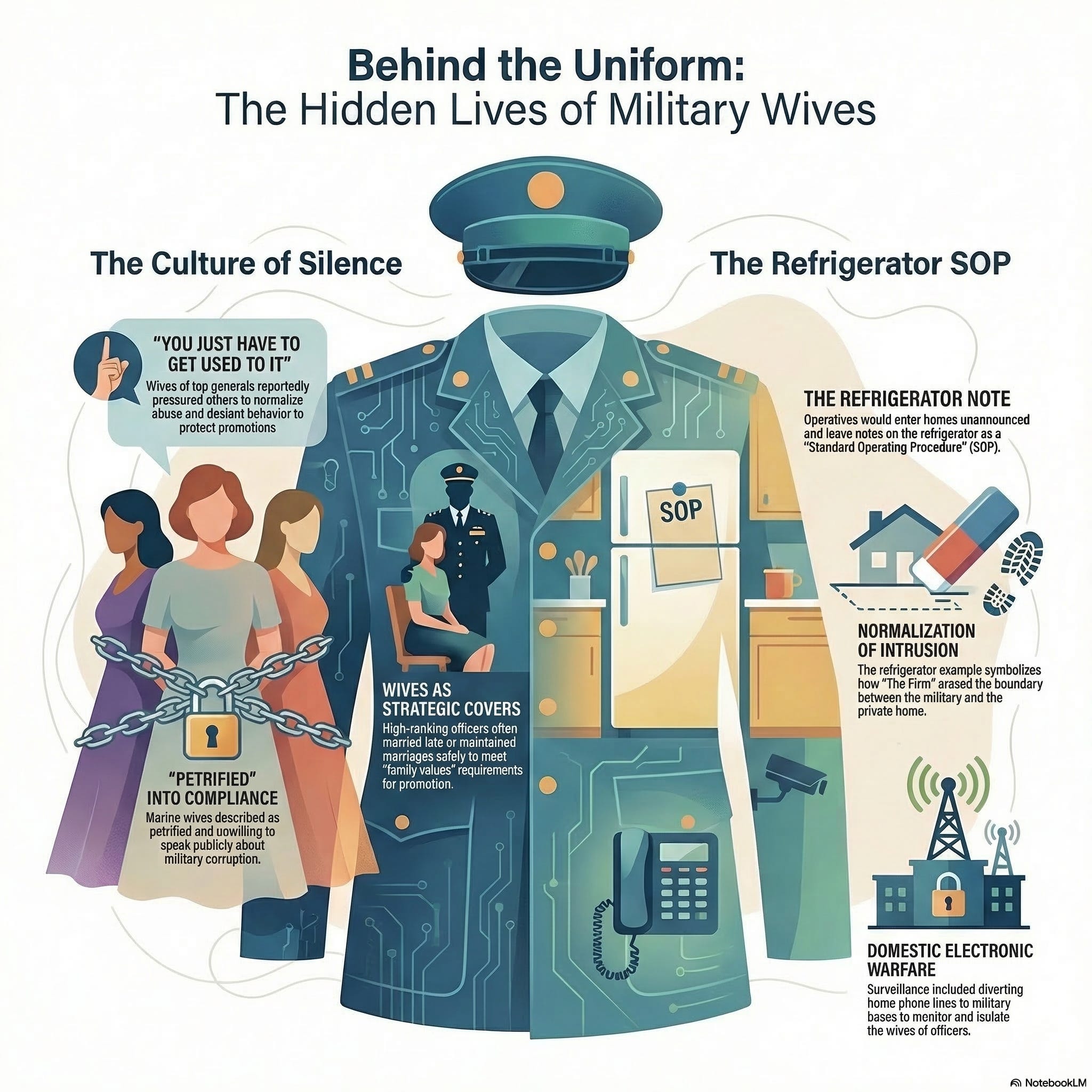
The Wives
Kay was the only senior-level military wife who spoke publicly. She describes the others as “petrified.” They supported her privately — ”Oh yeah, we talk about it” — but refused to speak with their lips. Some would not talk inside their own offices. Some had men come by their houses. Some had papers stolen.
Peggy Sheehan, wife of the NATO SACLANT commander, told Kay to “just leave a note on your refrigerator” for George — acknowledging, casually, that operatives entered Kay’s home at will. Carolyn Millis, wife of Colonel Ken Millis, warned Kay against reporting go-go dancers at the Officers’ Club because it would “ruin George’s career.” Valerie Wilhelm, wife of General Charlie Wilhelm, told Kay matter-of-factly that her husband “had to” engage in sexual affairs because “he’s under so much pressure.”
The wives knew.
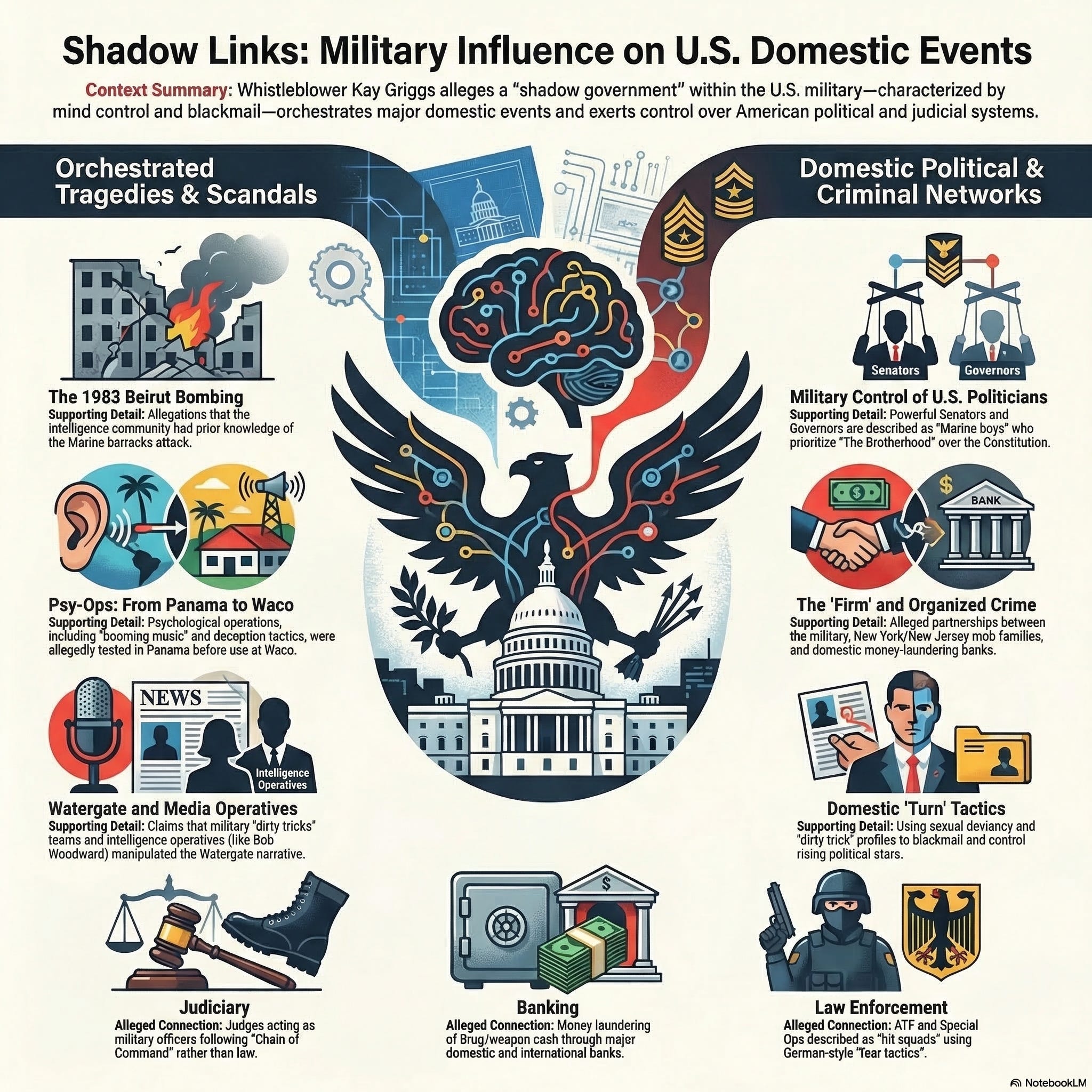
Connections to Domestic Events
Kay draws lines between the operational infrastructure she describes and several high-profile domestic events:
Waco: General Jim Joy and General Carl Steiner directed the psychological operations—the booming music, the siege tactics—using the same methods deployed against Noriega in Panama.
The Oklahoma City Bombing: Timothy McVeigh fit the same psychological profile as her husband: a loner, easily controlled, processed through military intelligence channels.
The JFK Assassination: George and Lee Harvey Oswald were “in the same club.” Oswald was homosexually recruited by Clay Shaw and David Ferrie in New Orleans — the same Fourth Marine network. Jack Ruby (born Jack Rubinstein) was Meyer Lansky’s man. George’s psychological profile and Oswald’s were, in Kay’s description, nearly identical — down to physical resemblance.
Monica Lewinsky: Kay and Sarah McClendon believed Monica was placed in the White House to compromise Clinton. Linda Tripp, the handler, was “Delta Force” — trained by Carl Steiner, the same general documented in George’s Beirut diary.
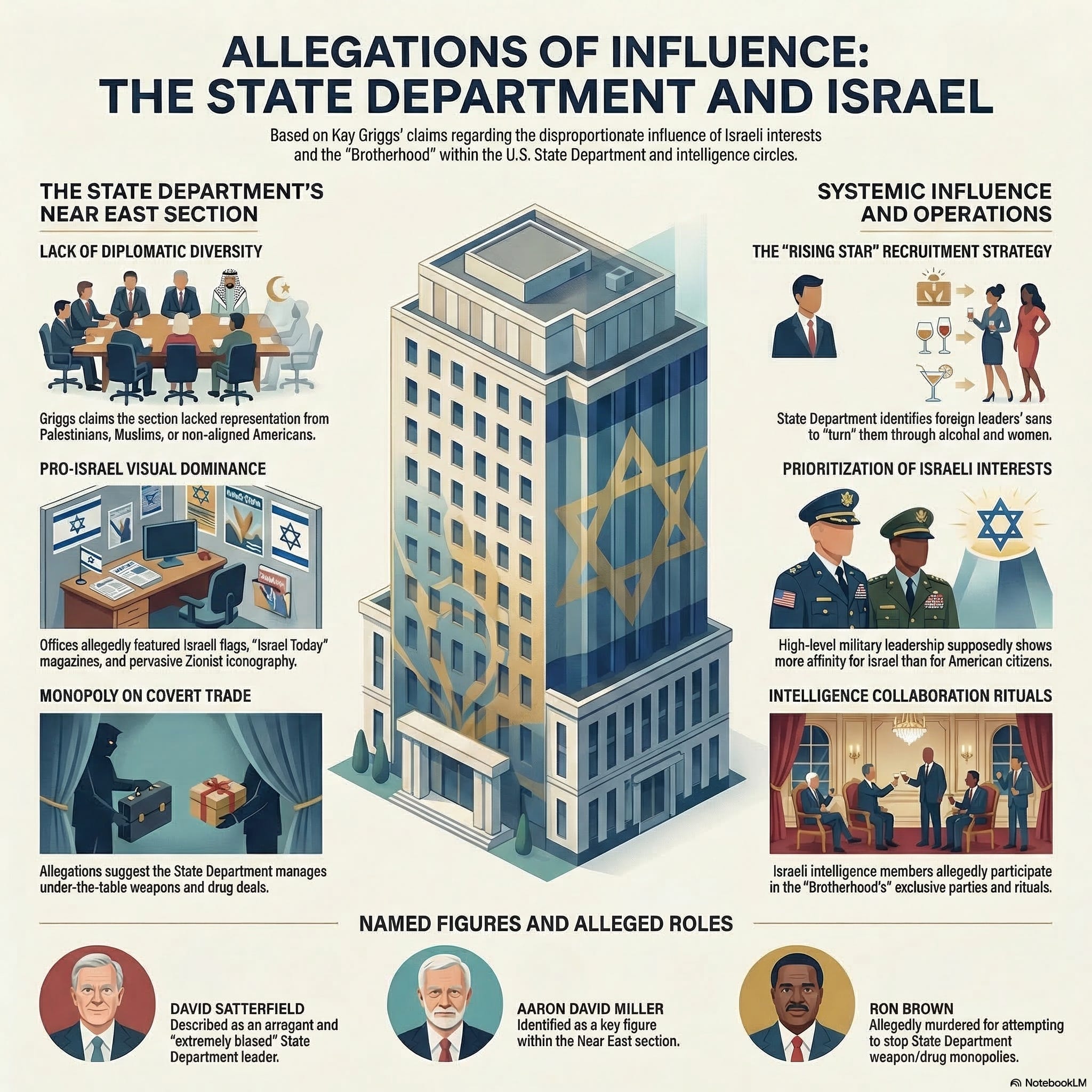
The State Department and Israel
Kay describes visiting the Near East section of the State Department and finding that every person in every office was, in her characterization, a Zionist or Israeli national. She found no Palestinians, no Muslims, no Protestant Christians, no Catholics. Israeli flags, Israeli magazines, and Hebrew writing decorated the offices. When she asked where the Palestinian desk was, a staffer told her: “We handle all that.”
She identifies the weapons pipeline: drug money funded the purchase of new American weapons, which were sold through Israeli agents. She calls this the reason Ron Brown was killed — he attempted to break the State Department’s monopoly on this trade.
Kay maintains a distinction between Jewish people as individuals and the institutional capture she describes. She expresses admiration for Madeleine Albright’s relative balance compared to her predecessors, such as Weinberger, Eagleburger, and Schultz. Her critique targets the organizational structure: “Something is strange when you have a State Department that is run by Israel. Something really strange. It’s no wonder there’s no peace.”
Who Saved Her Life
Sarah McClendon — the senior White House correspondent, the feisty red-haired Texan who broke the Billie Sol Estes story — called Kay and told her: “Mrs. Griggs, you get up here to Washington right now, or you’re dead.”
Kay lived with McClendon for five or six months. McClendon gave her shelter, a platform, and access to the National Press Club, where Kay first went public on July 3, 1996.
Kay also names Ted Gunderson, a retired FBI agent, who had three confirmed contracts on his own life and survived through what he calls “divine intervention” — staying at a friend’s house on the nights assassins waited outside his door.
What She Wanted
Kay Griggs presented herself as a Christian woman from old Virginia who married a man she loved, discovered he had been psychologically destroyed by the system that employed him, tried to save his soul, nearly died in the attempt, and decided — after broken bones, stolen papers, sabotaged cars, diverted phone lines, and death threats — to talk.
She wanted Americans to understand that the military they entrusted with their sons had been captured by a self-perpetuating fraternity that selected for controllability, advanced through sexual compromise, funded itself through drugs and illegal weapons, and eliminated anyone who threatened the structure.
She named names. She showed the diary. She displayed photographs and documents on camera. She described operations in Beirut, Indonesia, Norway, Panama, New Orleans, and the Mediterranean.
She said she would probably be killed.
She talked anyway, and as a result, the government did absolutely nothing to serve justice.
Thanks to the generosity of my readers, all my articles are available for free access. Independent journalism, however, requires time and investment. If you found value in this article or any others, please consider sharing or even becoming a paid subscriber, who benefits by joining the conversation in the comments. I want you to know that your support is always gratefully received and will never be forgotten. Please buy me a coffee or as many as you wish.

The Duke Report - Where to Start
My articles on SubStack are all free to read/listen. If you load the Substack app on your phone, Substack will read the articles to you. (Convenient if you are driving).
Foundational Articles
Podcast (Audio & Video Content)
Palmerston’s Zoo Episode 01 - Solving the Paradox of Current World History (9 Episodes)
Oligarchic Control from the Renaissance to the Information Age
SoundCloud Book Podcasts
I’ve taken almost 200 foundational books for understanding how the world really works and posted them as audio podcasts on SoundCloud. If you load the app on your phone, you can listen to the AI robots discuss the books on your journeys across America.
Duke Report Books
Over 600 foundational books by journalists and academics that never made the New York Times Bestseller list, but somehow tell a history we never learned in school. LINK


