

Caesar’s Monetary Revolution
12 Centuries of Relative Stability Ended in the Fourth "Crusade"

Introduction
This investigation applies the Leading Indicator Rubric of Epistemological Warfare (EpiWar™) to the death of Julius Caesar. It examines how monetary control, narrative authorship, and the manufacture of belief converge across time. The inquiry began with two data points: Caesar’s economic reforms, which redefined money as an instrument of lawful sovereignty and established a monetary order that lasted in one form or another until the Fourth Crusade, and his portrayal in William Shakespeare’s Julius Caesar, which omits all mention of his financial reforms. That omission constitutes an act of vericide — the deliberate killing of truth through deletion.

Caesar’s legislation restructured the Republic’s debt system, abolished usury, and restored the state’s authority over credit. These acts threatened the patrician monopoly on finance. His assassination restored that monopoly. The erasure of these motives from later cultural memory replaced political cause with moral allegory, transforming a battle over law and debt into a lesson about ambition.

The same oligarchic logic resurfaced in Venice fourteen centuries later. After the Fourth Crusade, the Venetian patriciate seized Byzantine gold, established the ducat as the new universal coin, and institutionalized private authority over monetary exchange. Venice became the operational center of maritime intelligence, espionage, and propaganda. As Webster Tarpley documents in Against Oligarchy, the Venetian system exported its epistemological model through Italian intermediaries, including figures such as Paolo Sarpi and Giordano Bruno, as well as their English patrons in the Cecilian and Baconian circles. This migration fused Venetian financial rationalism with English statecraft, producing an information order in which knowledge itself became the field of control.

Francis Bacon, as the central architect of this synthesis and likely the executive producer of the Shakespearean program, translated the Venetian method from finance to language. The Julius Caesar of that corpus completes the cycle of vericide. It redefines the first assertion of monetary law in Western history as personal arrogance and moral failure. Caesar’s lawful economy is buried beneath Bacon’s epistemological empire.
Caesar’s Restoration of Monetary Order
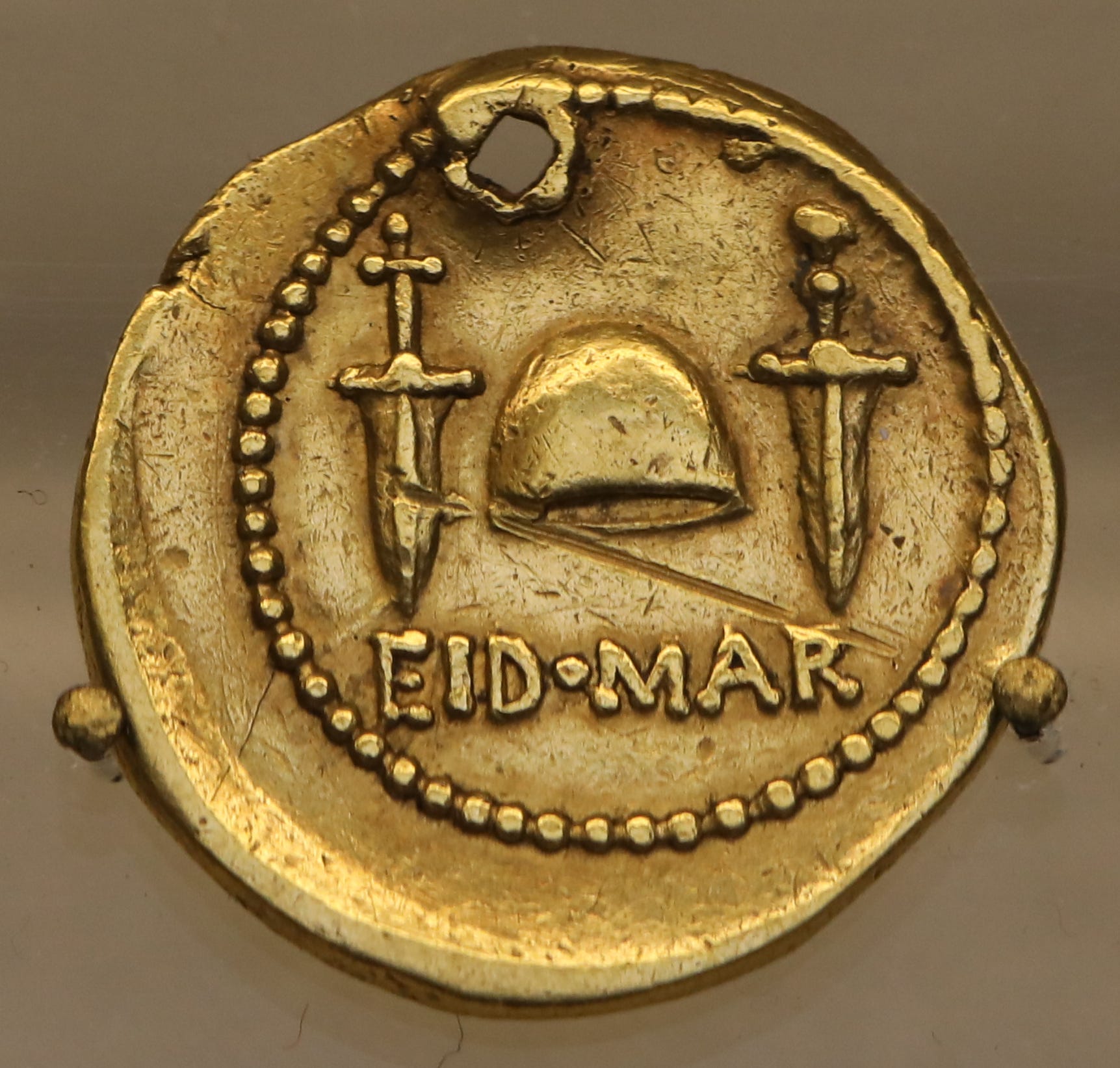
Caesar treated money as an act of lawmaking.1 He saw that the paralysis of the Republic came from private control of circulation and from the belief that gold defined value. He reduced state debt by a quarter,2 transferred the mint from patrician usurers to the government,3 and issued abundant base-metal coins to restore exchange.4 He outlawed compound interest, capped rates at one percent per month,5 and forbade lenders from collecting more interest than the loaned capital.6 He abolished debt slavery and ordered the wealthy to invest their holdings in productive work rather than hoard them.7 These actions rebalanced the Republic toward labor and away from rent. The oligarchs killed him because he broke their monopoly on debt. His assassination restored private control over credit.8
The Augustan Gold Standard
After Caesar’s death, Augustus bound the empire to gold.9 The aureus became the empire’s measure of value. Its scarcity drove conquest, and its purity tied exchange to extraction. The empire’s armies advanced to seize the metal that sustained imperial spending. Gold from Spain, Wales, and Transylvania entered the treasury while Rome’s markets lacked liquidity.10 When Augustus reduced the aureus from 122 to 72 grains in 13 BCE, he briefly relieved deflation but reinforced the empire’s dependence on metal.11 The state lost authority over its medium of exchange. Law yielded to commodity. The aristocracy reclaimed the weapon of scarcity, and the civic economy hardened into imperial hierarchy.12
Crisis and the Debasement Spiral
The third century exposed the contradiction in the gold creed.13 Empire demanded expansion, yet the supply of coinage narrowed. Emperors diluted the denarius, washing bronze with silver until citizens refused to trust it.14 The people bartered, and soldiers demanded goods instead of wages. Diocletian responded with coercion. His Edict on Prices tried to command value through legislation.15 He fixed wages and prices in a schedule of equivalence while pretending that silver and gold still held a twelve-to-one ratio. Beneath this arithmetic, exchange broke down. Diocletian’s edict fixed prices but left coinage debased, so traders withdrew goods rather than sell at legal limits. Courts punished violation instead of stimulating trade, and the law that once organized payment now preserved shortage.16
Constantine and the Solidus
Constantine restored form without freeing substance.17 He standardized the solidus at seventy grains, struck seventy-two to the pound. He punished counterfeiting with death and burned corrupt minters alive.18 The reform held its weight for seven centuries because the empire enforced purity through fear. The solidus served as the sacred object of rule, bound to the throne and the altar. After the Edict of Milan, the emperor as pontifex maximus merged divine authority with fiscal command.19 The tithe of one-tenth of income to the Church concentrated gold behind ecclesiastical walls. Officials locked the wealth of Constantinople and the Vatican away. Circulation stopped because those in power treated hoarding as virtue. Imperial officials preserved the standard with obsessive precision, and in doing so they halted the flow of exchange that sustained ordinary life.20
The Byzantine Continuum
The Byzantine emperors preserved the solidus through rigid discipline.21 Basil I through Basil II maintained the same ratios of copper, silver, and gold, the same weights, and the same subdivisions. Twelve miliaresia equaled one solidus; five solidi equaled one libra of account. The silver-to-gold ratio remained twelve to one.22 The rulers achieved consistency without collapse. Byzantine administrators enforced the same ratios year after year. The bureaucracy rejected any proposal that altered the standard. Officials treated monetary stability as sacred duty and managed it through rigid administrative routines. Imperial officials treated measurement as sacred duty. They maintained precise records and enforced uniform accounting as expressions of loyalty to imperial order.23
Western Silver and Eastern Gold
Western rulers lived under Byzantine authority.24 From Charlemagne to the eve of the Fourth Crusade, they minted only silver because they recognized the Basileus as the sole master of gold. The solidus ruled as the invisible sovereign of Christendom.25 Western mints produced pennies that decayed in alloy and weight. Princes manipulated silver content to depress wages and control trade.26 Officials used silver to pay labor and kept gold for their own treasuries. This dual system preserved class division through metallurgy. The West learned to govern people through its mints.27
The Fourth Crusade and the Transfer of Gold Authority
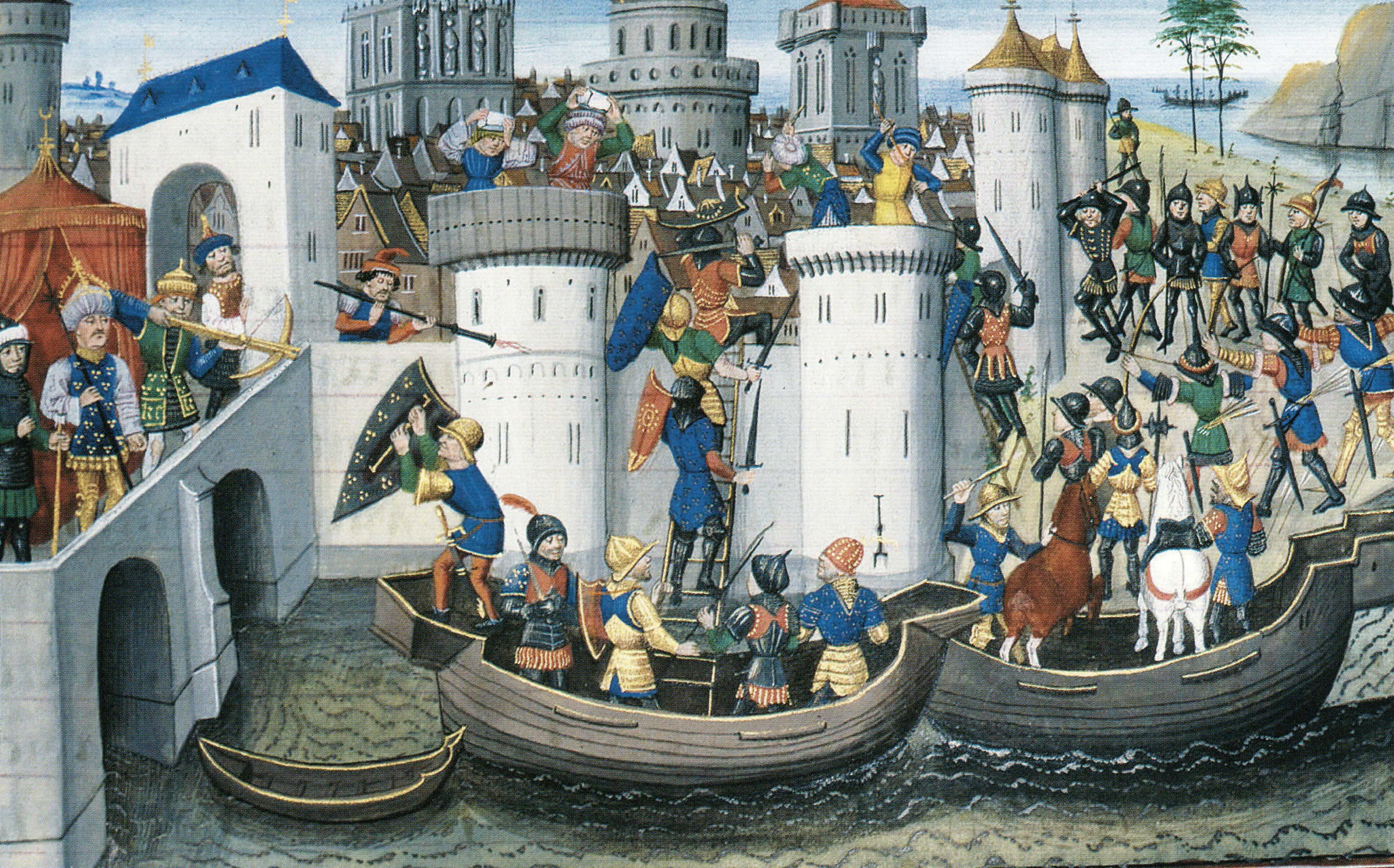
In 1204, crusaders financed by Venice sacked Constantinople and destroyed the Byzantine monopoly over gold.28 Venetian magistrates and Florentine guilds claimed the right to strike pure gold coins. The ducat and the florin appeared as deliberate successors to the hyperpyron. Each held about seventy grains of gold and 0.986 purity.29 The republics of merchants replaced the emperors of faith. Civic councils authorized their mints, and bankers circulated their gold through contracts and bills. Venice turned the mint into a commercial ministry.30 The transfer of minting authority from Constantinople to Venice marked the birth of modern finance. Caesar established state control over money as a legal instrument of law. Successive empires preserved the structure of that control but transferred its authority from the state to private financiers, who revived it as credit.31
The Long Arc
The history of Rome’s coinage shows the struggle between sovereignty and usury.32 Caesar turned money into law. Augustus returned it to metal. Diocletian ruled through decrees that bound production to command. Constantine fused faith with finance. Byzantium maintained form and lost vitality. Venice replaced moral custody with mercantile control. Through each transformation, rulers fought over the same question: who decides the meaning of value? Caesar’s death began a cycle that ended in the counting houses of Florence, where merchants ruled by the same magic arithmetic that was used to kill the Roman Republic.33
Appendix A: The Latin Empire
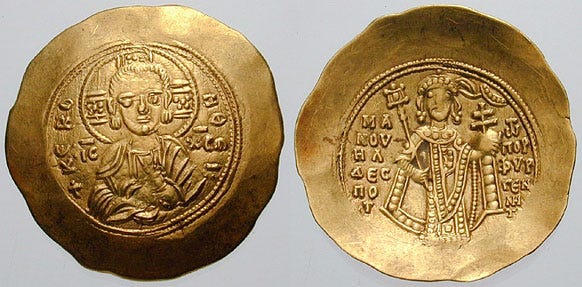
The Latin rulers of Constantinople copied the Byzantine hyperpyron, kept its weight, and failed to restore trust. Their imitation lacked the power to sustain exchange. Within fifty years, Venetian coins displaced their issues. The Latin Empire showed how rulers who mimic form without authority produce only symbols of power.34
Appendix B: The Venetian Ducat
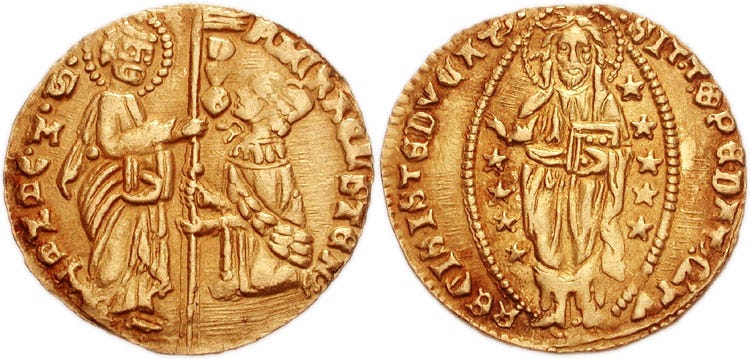
Venice introduced the ducat in 1284, matching the hyperpyron’s weight and purity, and inscribed the phrase "Sit t X Christus Rex Venetiarum" onto gold. The inscription affirmed that the city, not the empire, now sanctified wealth.35 The ducat and the florin unified Mediterranean trade. The transformation was complete. Caesar’s act of monetary law was transformed into the doctrine of mercantile expedience.36
I will have to watch The Merchant of Venice again with this in mind.