

Poll: Duke's Law
Subscribers can Vote!


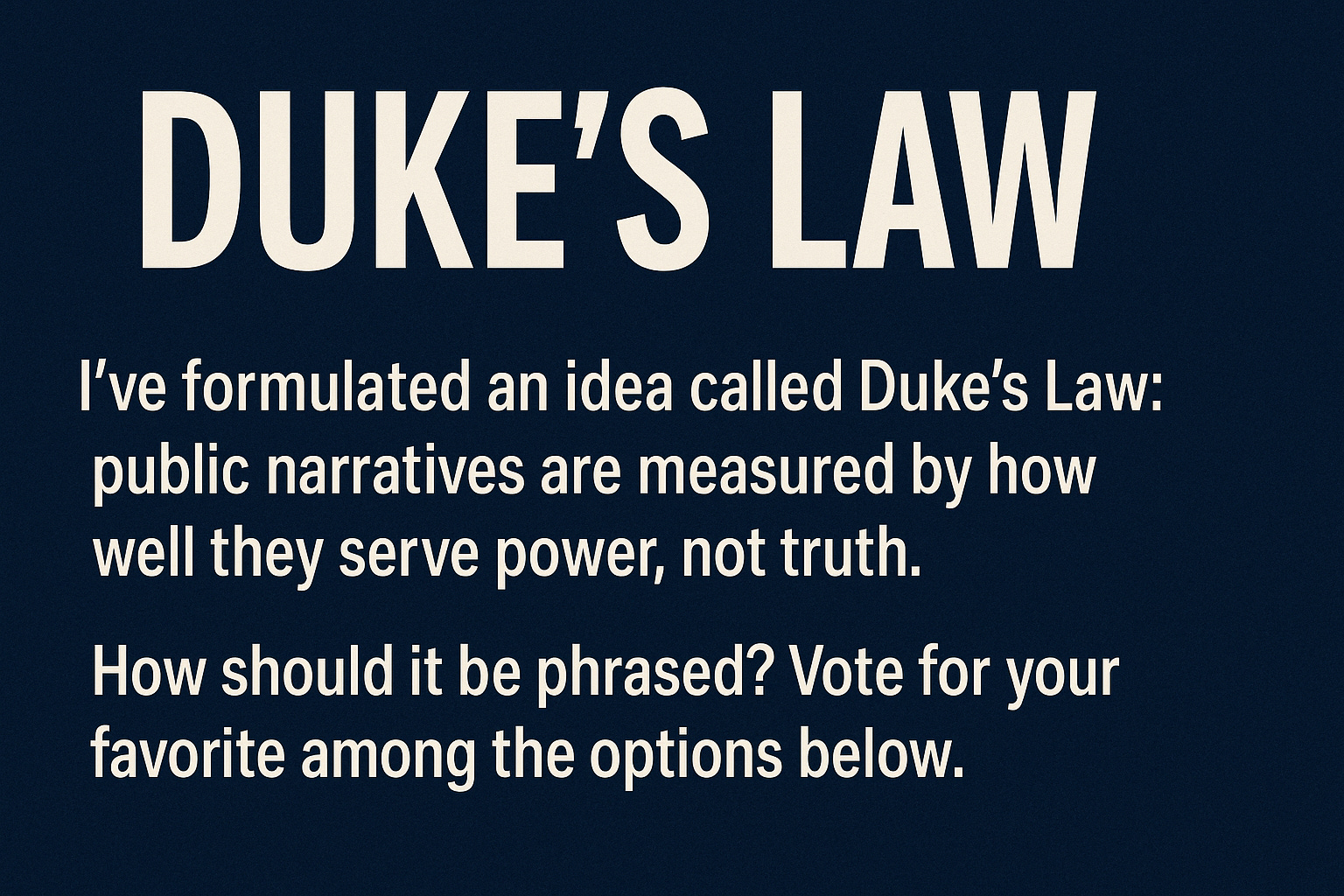
As I’ve been refining the core concepts behind Reframing Reality, one idea keeps crystallizing: the narratives we’re told aren’t measured by their truth — they’re measured by how well they serve power. This insight is now formalized as what I’m calling Duke’s Law. But how should it be phrased? I’ve drafted several versions, each with a slightly different tone or emphasis. Read through the options below and let me know which one resonates most. Your choice will help shape how I communicate this lens of analysis to a wider audience.
Option 1: Clean and Direct
Duke’s Law: The value or veracity of a public idea — be it a meme, conspiracy theory, or psychodrama — is measured by its epistemological utility to the ruling oligarchy.
Comment: This keeps the structure tight, asserting that truth/value is downstream from usefulness — but to them, not to us. It frames "epistemological utility" as the operative lens.
Option 2: With Operational Framing
Duke’s Law: A public narrative’s survival is proportional to its capacity to obscure reality, manage belief, or reinforce consent — serving the epistemological interests of the oligarchy.
Comment: This version implies that even “false” narratives persist because they serve a structural function. The law becomes predictive — narratives survive not on merit, but on function.
Option 3: Reframed as a Diagnostic Tool
Duke’s Law: To understand whether a popular idea is true, ask first: How does this idea benefit those who control perception?
Comment: This reorients it as a heuristic — turning the law into a tool for media literacy. It invites skepticism, without requiring belief in any specific narrative.
Option 4: Cynical-Axiomatic
Duke’s Law: Public discourse is not about truth — it’s about control. The closer a story aligns with oligarchic interest, the louder it gets.
Comment: A punchier version that removes “epistemological” in favor of street-level clarity. High signal for red-pilled audiences, less academic but emotionally resonant.
Option 5: Academic and Formal
Duke’s Law: The persistence and prominence of any cultural narrative is not a function of its empirical truth, but of its capacity to serve the epistemological architecture of elite control.
Comment: Reads like a published thesis line. Best suited for formal writing or high-brow framing.
🗳️ Duke’s Law: Updated Poll Options:
🔹 Option A: Plain Speech
A public story isn’t promoted because it’s true—it’s because it’s useful to those in power.
🟨 Option B: Fused Clarity
A narrative’s value and prominence are determined by its epistemological utility to the oligarchy.
🟩 Option C: Megan’s Edit
A public narrative's value is determined by how well it serves the oligarchy.
I thought “the narratives we’re told aren’t measured by their truth — they’re measured by how well they serve power,” was actually the best but one thing you could do is take option five and then say “put another way: the narratives we’re told aren’t measured by their truth — they’re measured by how well they serve power.”