


Reading Third Kings
Wednesday, September 9, 2026 — I read the Douay-Rheims Bible this morning, the English of the Catholic exiles at Douai and Rheims, made from the fourth-century Latin Vulgate of Jerome. Third Kings, chapter sixteen, verses thirty-one through thirty-three:
Nor was it enough for him to walk in the sins of Jeroboam, the son of Nabat: but he also took to wife Jezabel, daughter of Ethbaal, king of the Sidonians. And he went, and served Baal, and adored him. And he set up an altar for Baal, in the temple of Baal, which he had built in Samaria; And he planted a grove: and Achab did more to provoke the Lord, the God of Israel, than all the kings of Israel that were before him.1
The Septuagint Translator Marks What the Douay-Rheims Translators Drop
The Septuagint translator — one of the Jewish scholars who put the Hebrew scriptures into Greek at Alexandria — wrote the same three verses, and he marked three things the Douay-Rheims translators left out.2
καὶ ἔλαβεν γυναῖκα τὴν Ἰεζάβελ θυγατέρα Ἰεθεβάαλ βασιλέως Σιδωνίων, καὶ ἐπορεύθη καὶ ἐδούλευσεν τῷ Βάαλ καὶ προσεκύνησεν αὐτῷ.
The translator wrote τῷ Βάαλ, with the masculine dative article, and wrote it twice — once for the god Achab served, once for the altar Achab raised. He used the article to point at one deity. Hebrew scribes wrote the same article before him, הַבַּעַל.3
Podcast Version of this Post

He named Jezebel’s father Ἰεθεβάαλ and called him king of the Sidonians. He built the god into the father’s name: ʾEtbaʿal, “with Baal.”4
He closed with ἄλσος, “grove” — the word the Septuagint translators use for the Hebrew ʾăšērâ.5 Achab planted an Asherah, the consort’s cult pole.
Three marks, three verses, one royal house. The translator named a specific god of a specific dynasty, and the goddess beside him.
I closed the Bible and thought about a cold morning in Washington, January 5th, 2021.
I’ve written in other articles about the pediment on the Mellon Auditorium, and the Heritage statue in front of the National Archives,6 but this morning I wanted to drill down on the Baal figure at the entrance of the temple.

Three Faces over the Doors
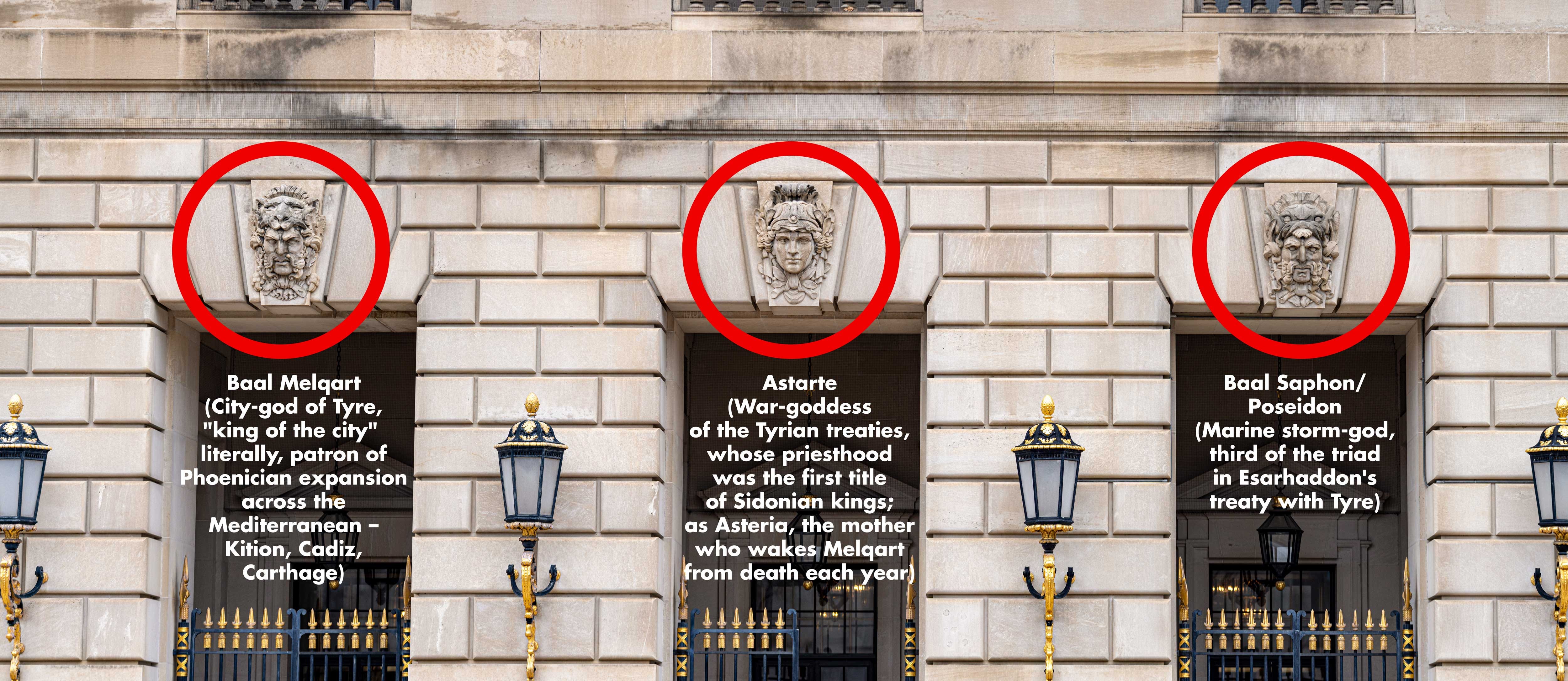
Sculptor/modeler Leon Hermant, French by birth, trained in Paris and working out of Chicago, modeled eleven keystones for the Labor–ICC complex between 1934 and 1936, and the Piccirilli Brothers company carved them in limestone. Three of the eleven appear over the auditorium’s entrance doors.7 The same composition is repeated on all three: a face centered on the stone, an ornament at the brow, and different elements framing the face.
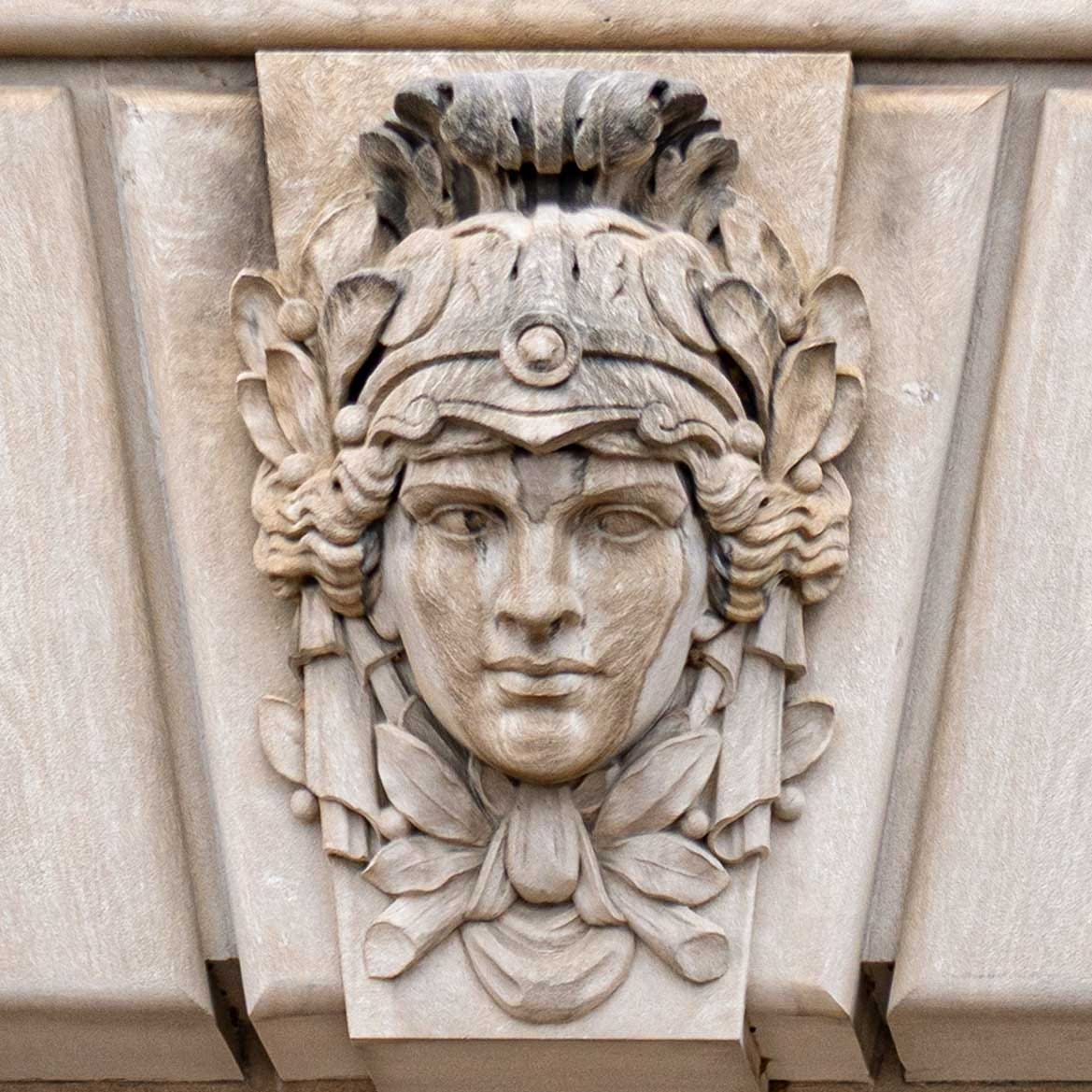
The Middle Door. A clean, slightly feminine face under a close-fitting helmet with a crest of stiff curling leaves rising from the crown and a headpiece, or crown, running across the brow. At the center of that crown, a raised ring, and inside the ring a five-pointed star. The face is framed from temple to jaw with broad leaves paired with round berries.
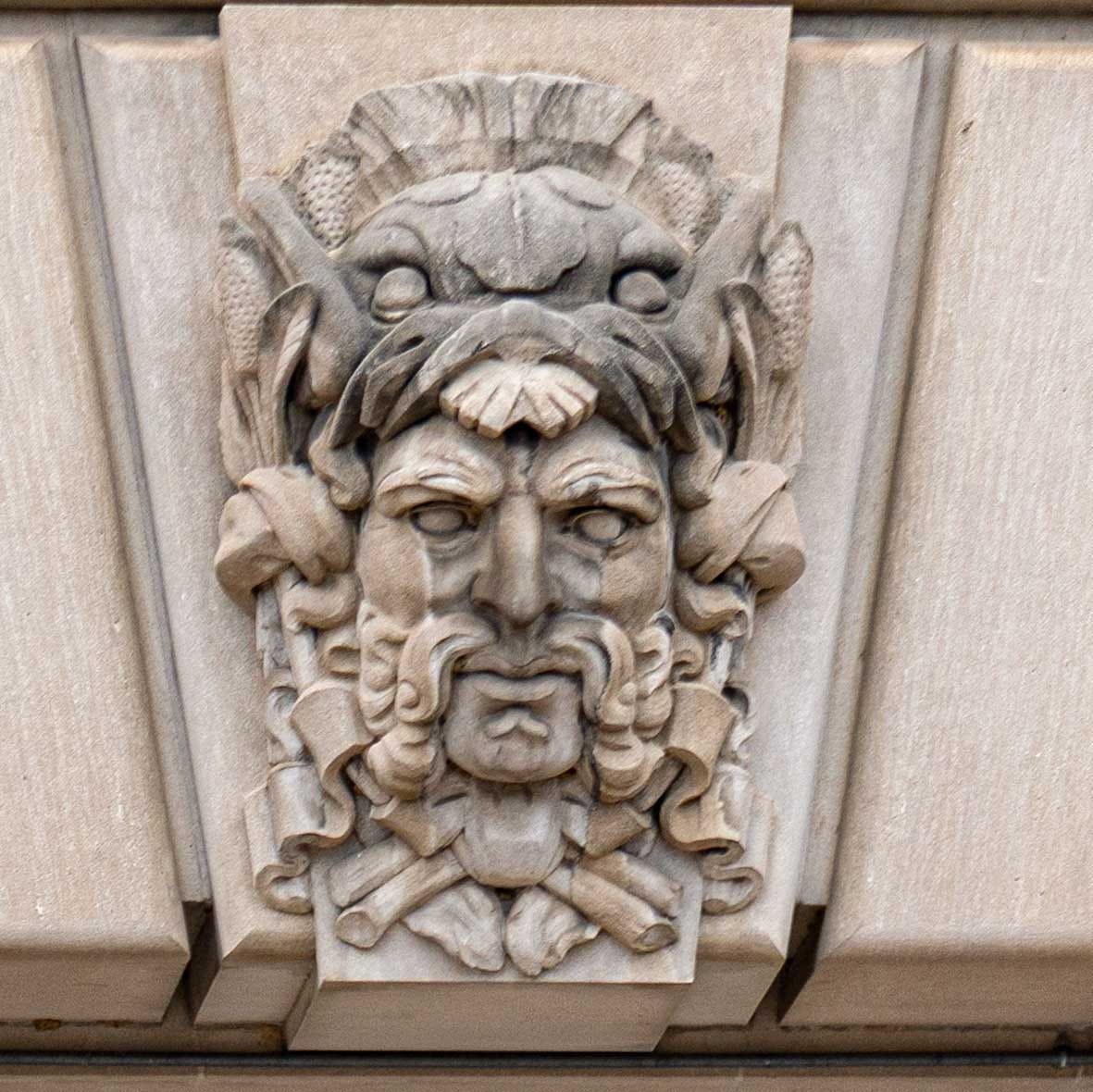
The Right Door. A bearded face with heavy brows and a curled beard. Behind the face, a scallop shell, and on that a beast’s face with round lidded eyes and fin-like crests sweeping outward, and cattails at each side.8 Below the chin, he crossed what looked like two bones in an X.
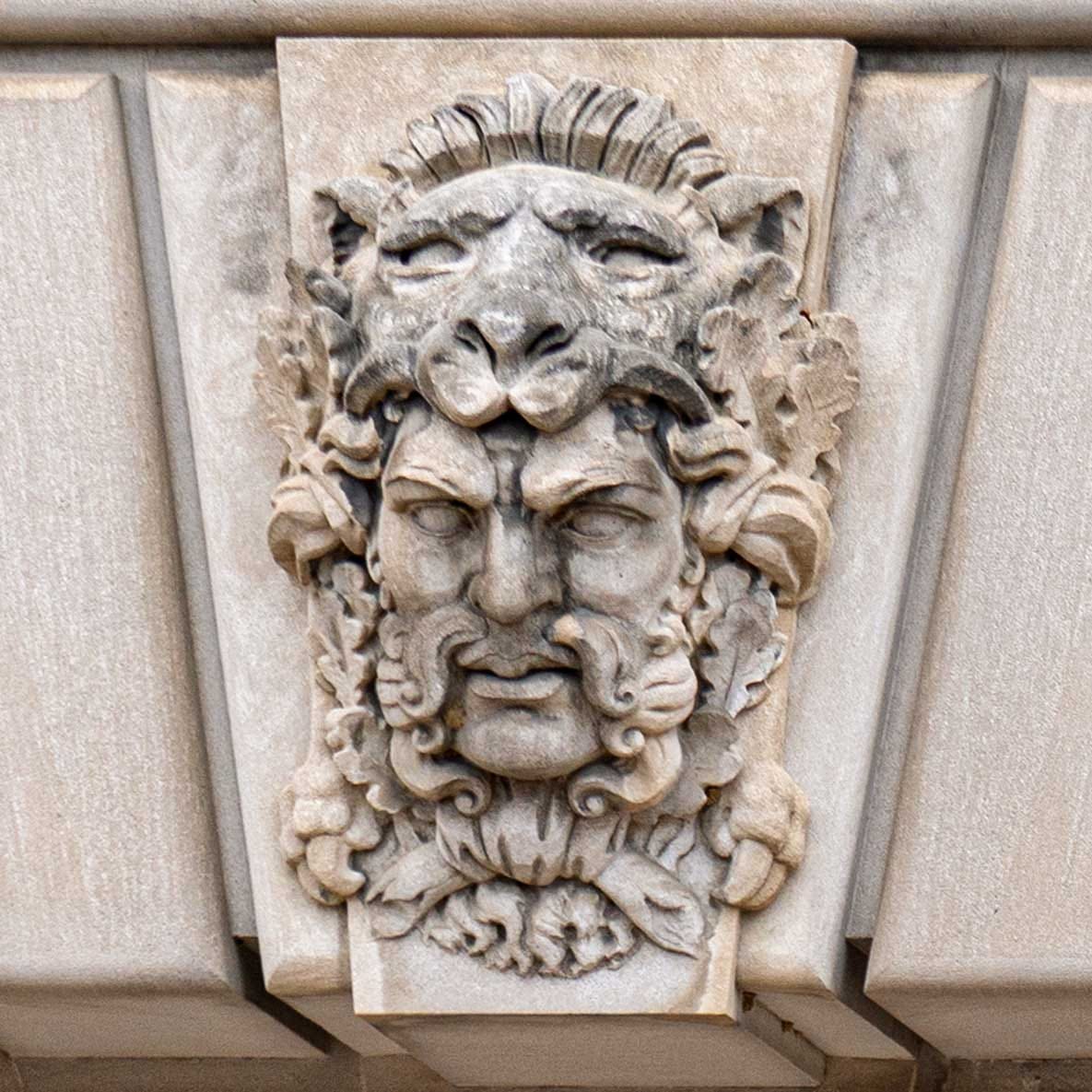
The Left Door. Hermant modeled a bearded face crowned with the Nemean lion scalp — the mane across the top of the head, the jaws above the brow, the skin descending along the temples.9

The Faces of Pagan Gods
Greek carvers associate the lion scalp with Herakles, and Tyrians with their own city-god, Baal Melqart. Two marble pillars show the same words twice, once in Phoenician and once in Greek. In the Phoenician, two brothers, ʿAbdʾosir and ʾOsirshamar, address Melqart, Baal of Tyre, and say that he heard their voice. In the Greek, the same men give their names as Dionysios and Sarapion and call themselves Tyrians. Scholars date the pillars to the second or third century BCE. The Phoenician reads lʾdnn lmlqrt bʿl ṣr, “to our lord, to Melqart, Baal of Tyre,” and names the dedicators ʿAbdʾosir and his brother ʾOsirshamar, sons of ʾOsirshamar son of ʿAbdʾosir, “because he heard their voice.” The Greek reads Διονύσιος καὶ Σαραπίων οἱ Σαραπίωνος Τύριοι Ἡρακλεῖ ἀρχηγέτει — “Dionysios and Sarapion, the sons of Sarapion, Tyrians, to Herakles Archegetes,” Herakles the founder.10

They cut bʿl there, the same Semitic word Jerome left untranslated in the Vulgate and the Douay-Rheims translators kept after him — “lord, owner, master.” They conferred that title on Melqart, in the third or second century BCE, six or seven hundred years after Achab. The Greek historian Herodotus sailed to Tyre in the fifth century to see the temple of the god Greek writers called Heracles.11
Greek and Roman carvers associated the scallop shell and the sea-beast with their sea gods. Phoenicians worshipped a sea-god of their own, and Greek writers rendered him as Poseidon — Phoenician dedications to him survive from Delos, put up by Tyrians, Berytians and Ashkelonites, and Hanno raised the sea god a temple on the African coast. No surviving bilingual, side-by-side, dual-language comparison renders that god’s Phoenician name.12
Herbert Niehr and Paolo Xella, editors of the Encyclopaedic Dictionary of Phoenician Culture, claim the star as Astarte’s mark, the Semitic Venus.13 Greek artists gave Athena the helmet, the aegis, the owl, the olive, Nike and the spear. George Gurney, cataloging the Federal Triangle sculpture for the Smithsonian in 1985, saw the star and wrote in his book: the middle keystone shows “a female head wearing a helmet with a star featured on the front, suggesting possibly the goddess Athena.” He gave the other two the same treatment — male heads “capped by a lion’s head skin and by a fishhead and cattails, perhaps to imply respectively associations with Hercules and Poseidon.”14 Gurney noted the star, then offered Athena as a possibility, and left the star unexplained.

Two older texts put Astarte beside the male god. In the Ugaritic Baal Cycle — six tablets recovered at Ras Shamra from 1929, the fullest surviving Canaanite myth15 — Athtart stands over the defeated Sea and speaks: "Scatter, O Mighty Ba[al], scatter, O Cloudrider. For our captive is Prin[ce Yamm], our captive is Judge River."16 Philo of Byblos describes the order that followed the fight: "Greatest Astarte and Zeus, called both Demarous and Adodos, king of gods, were ruling over the land with the consent of Kronos." Smith describes Astarte and Baal there as exercising power jointly, under El. Philo reports elsewhere that Astarte found a star flying in the sky, seized it, and consecrated it on her holy island of Tyre.17

Beaux-Arts Sculptors Worked a Greek Repertory
Hermant drew on a Greek and Roman repertory, and he modeled the guardian-goddess type for the middle door — helmet, leaf crest, leaves at the temples.
Greek writers set Athena against Poseidon in the contest for Athens, and they record no dealings between Athena and Herakles’ (Baal Melqart18) city-cult. Hermant put the Nemean lion scalp on the left door. An Athenian reading of the three doors accounts for the helmet and leaves both the left door and the star at the middle brow unexplained.
Menander Supplies the Tyrian Side of Achab’s Story
Menander of Ephesus, a Hellenistic historian, researched the Tyrian royal archives, and the first-century Jewish historian Josephus quotes him twice on the same king. Hiram of Tyre “pulled down the ancient temples and built the temple of Hercules (Baal Melqart19) and of Astarte, and first made the egersis of Hercules in the month Peritius.”20 One temple, two gods, and a rite Hiram fixed to a month of the year. Most scholars interpret that rite as the waking of Melqart from death.21
Menander describes Hiram in the tenth century and Ethbaal roughly a century after him. Of Ethbaal, Menander records that he held Astarte’s priesthood before he killed his predecessor and took the throne of Tyre.22 The father of Achab’s wife served the goddess of the Tyrian state cult by profession.
Josephus names that king in the biblical narrative. Achab “took to wife the daughter of Ethbaal, king of the Tyrians and Sidonians, whose name was Jezebel, of whom he learned to worship her own gods.”23 Writing later about Jehu burning the Samaria temple, Josephus makes the connection again: “Now this Baal was the god of the Tyrians; and Achab, in order to gratify his father-in-law, Ethbaal, who was the king of Tyre and Sidon, built a temple for him in Samaria.”24 The writer of Third Kings calls Ethbaal king of the Sidonians. Josephus calls him king of the Tyrians and Sidonians.
Josephus then quotes Menander on a drought in Ethbaal’s reign:
Under him there was a want of rain from the month Hyperberetaeus till the month Hyperberetaeus of the year following; but when he made supplications, there came great thunders. This Ethbaal built the city Botrys in Phoenicia, and the city Auza in Libya.
Josephus adds: “By these words he designed the want of rain that was in the days of Achab, for at that time it was that Ethbaal also reigned over the Tyrians, as Menander informs us.”25 The biblical narrator runs a drought through Achab’s reign and breaks it on Carmel, where Elijah meets the prophets of the Baal and the rain returns.
Menander wrote nothing about Israel, Achab or Elijah. He recorded a year without rain in a Tyrian king’s reign, ending when the king made supplication. Josephus read that notice, matched it to the drought in his own narrative, and said so. Josephus made that match three centuries after Menander wrote.
Scholars identify Achab’s Baal as Melqart by inference, and they rest that inference on three documented facts: Kings calls Jezebel’s father king of the Sidonians and Menander lists him among Tyre’s kings; Ethbaal held Astarte’s priesthood at Tyre; and Tyrians conferred the title Baal of Tyre on Melqart in their own writing. All three concern Tyre. The biblical writers provide the clues, but never wrote the god’s personal name.
Limestone doesn't lie. Hermant didn't tell anyone (officially) that the central figure is Astarte, but he modeled a five-pointed star in the headpiece of the middle figure, between a lion-scalped face on one side and a sea-beast-scalped face on the other.
Tyre's King Swore His Oath on These Three Gods
Aaron Brody, who wrote a study of the religion of Canaanite and Phoenician seafarers, reads the Tyrian title Baʿl Ṣur as "the lord of Tyre," and points to Esarhaddon's treaty, where the Assyrian scribes list the three storm gods — Baʿl Šamem, Baʿl Malage, Baʿl Ṣapon — and name Milqart apart from them, alongside Eshmun, for effects on the land and its fecundity.26 René Dussaud interpreted Melqart as a storm god in a 1940s study of the cult, and Brody calls that interpretation a mistake that has long persisted among French scholars. Corinne Bonnet reviews the evidence in her 1988 monograph on Melqart.27
Phoenicians built Melqart sanctuaries on headlands and in ports from Tyre west to Gades (Cadiz), and Arrian records a Tyrian warship consecrated to Herakles-Melqart. Brody asks why a god with no power over the weather mattered to men at sea, and answers by comparing Melqart with his Greek, Hurrian and Mesopotamian counterparts — Herakles, Irsappa and Nergal. Herakles became “the paradigm of the intrepid traveller” through the twelve tasks, and a guardian of voyagers with it.28 Tyrians sailed for a living out of a city built on rocks in the water, and their sailors on Delos dedicated to the sea-god the Greeks called Poseidon.
One Tyrian treaty names all three.
Esarhaddon of Assyria and Baal I of Tyre swore a vassal treaty around 675 BCE, and the scribes who drew it closed with curses. Break the oath, and three gods raise an evil wind against the Tyrian fleet — Baal Shamem, Baal Malage and Baal Saphon — sinking the ships under a strong wave. Melqart appears further down the same column, alongside Eshmun, holding a different office: land, food, oil, clothing. The scribes gave Astarte the battlefield. Break the oath, and she breaks your bow in the thick of the fight, throws you at your enemy's feet, and lets a foreign enemy divide your goods.29
Melqart, Astarte, and the storm god of the sea, named together in one seventh-century Tyrian state document. Greek writers called that storm god Poseidon, and Niehr and Xella hold the identification open — Baal Saphon is probably the best claim to the name associated with the Greek name.30
What Would Hiram of Tyre Recognize?
Hiram pulled down the ancient temples of his city and put up one temple for Melqart and Astarte, and he instituted the egersis in the month Peritius, which most scholars interpret as the waking of Melqart. Menander recorded it from the Tyrian archives, and Josephus quoted him.
Hiram also supplied Solomon. Solomon sent to Tyre for timber and gave his reason: "there is not among my people a man that has skill to hew wood like to the Sidonians." Hiram's servants brought the cedar down from Lebanon, floated it along the coast in rafts, and landed it where Solomon asked; Solomon paid in wheat and the purest oil. The one true god temple in Jerusalem went up in Tyrian timber, cut and rafted by Tyrian crews, for a king whose Tyrian partner had lately finished a double temple to his own two gods, Melqart and Astarte. Herodotus saw two columns at the Melqart temple in Tyre, one of gold and one of smaragd, shining at night. R. D. Barnett found that pair on an Assyrian relief and called them the prototypes of Jachin and Boaz, the twin columns Hiram's craftsmen raised for Solomon at Jerusalem.31
So what would that man make of three faces over three doors on Constitution Avenue?
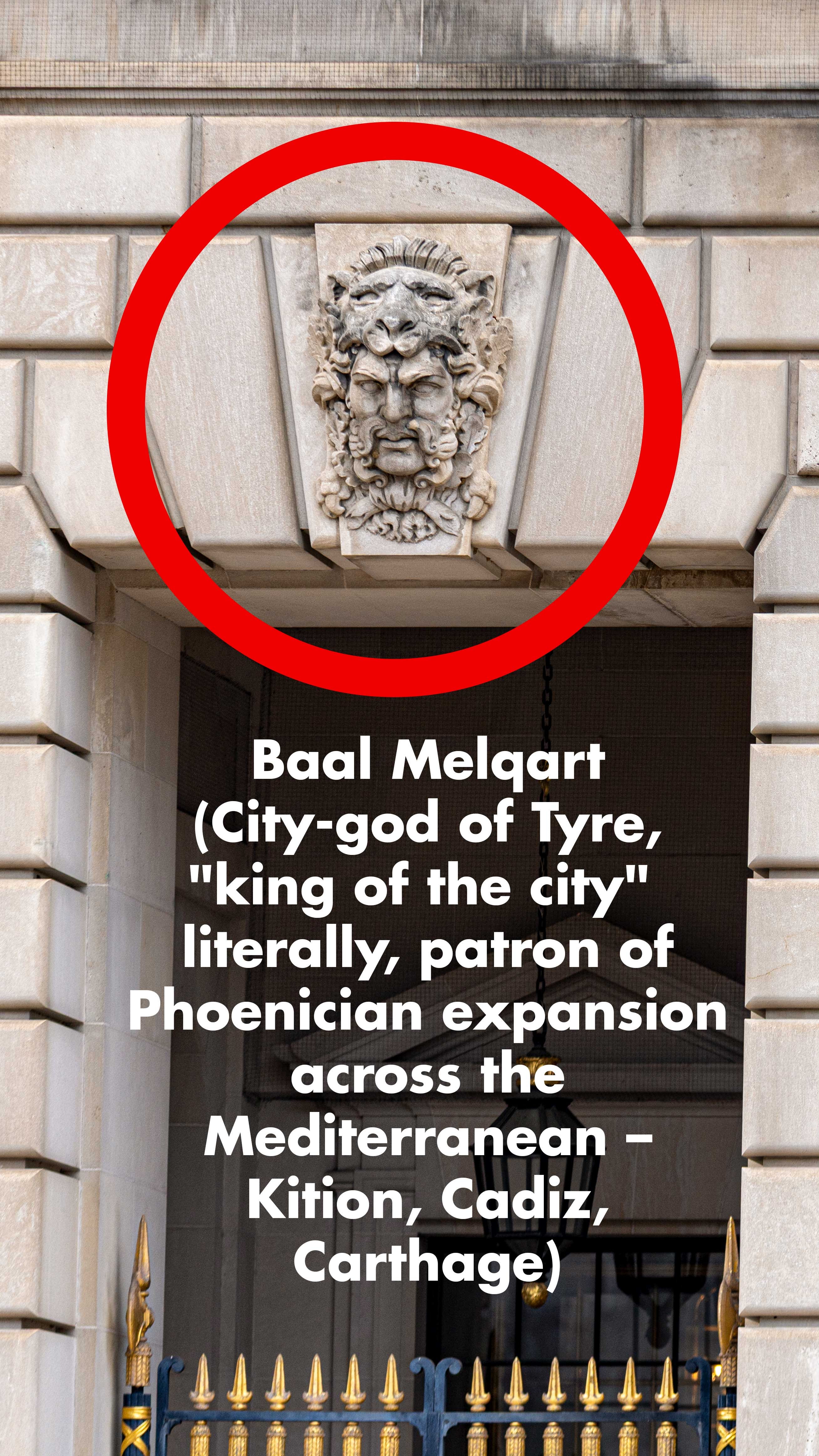
Would he know the lion scalp? His own god’s name means king of the city. Tyrians on Delos called him founder of the fatherland, and the brothers on Malta wrote him Herakles the founder in Greek. Phoenicians raised his sanctuaries on headlands and in harbors from Tyre west to Gades (Cadiz), and Arrian saw a Tyrian warship consecrated to him — the god sailors addressed before a voyage. On the majority of interpretations, his priests performed his waking every year at Tyre, because every year he had died. Did Elijah know that rite? He taunted Baal’s prophets in its language. At Carmel, after the four hundred and fifty had called from morning until noon with no answer, he told them to shout louder: “for he is a god; and perhaps he is talking, or is in an inn, or on a journey; or perhaps he is asleep, and must be awaked.”32
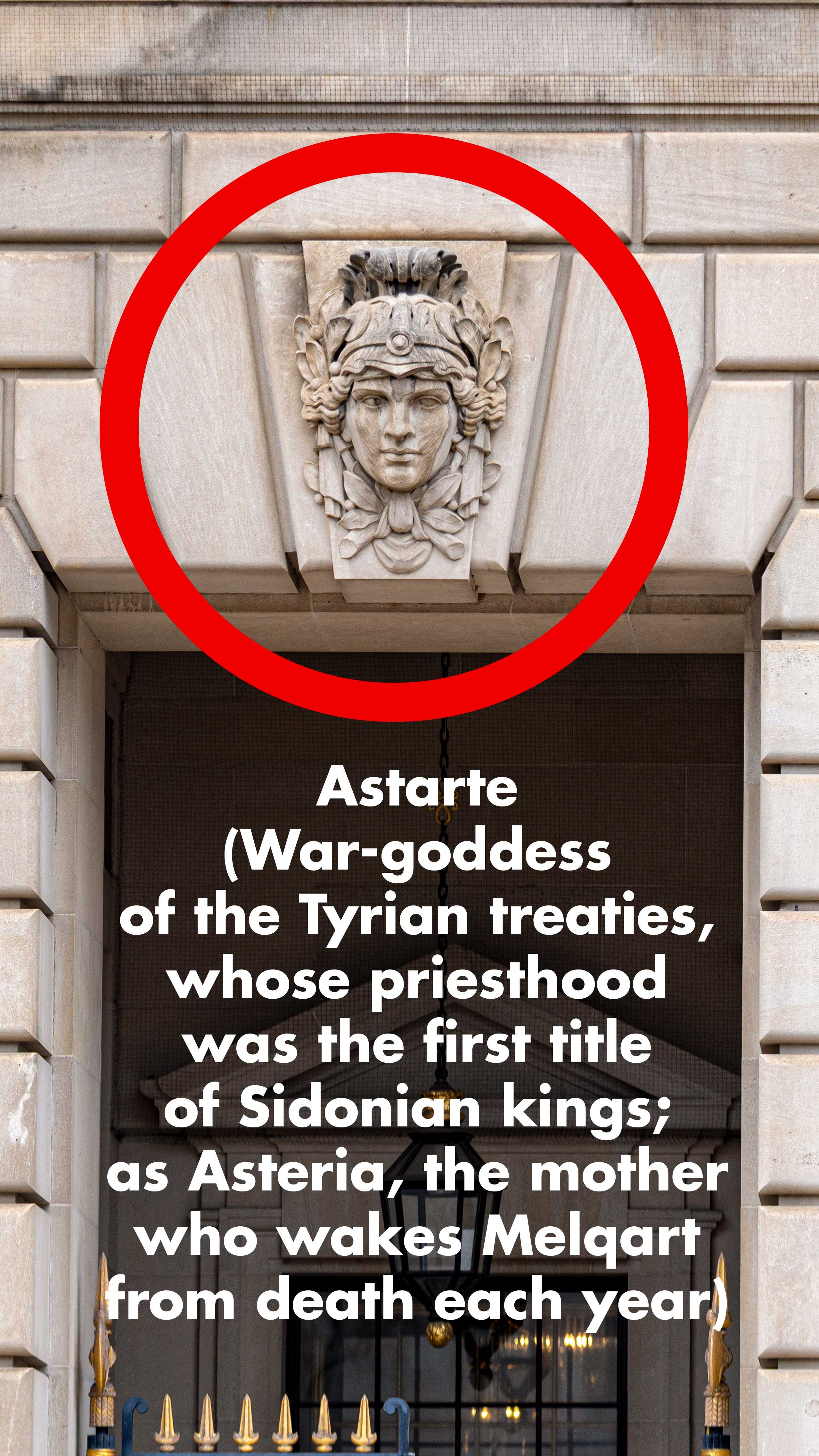
Would he know the star? Ethbaal served as Astarte’s priest at Tyre before he killed Pheles, took the throne and reigned thirty-two years. His daughter carried the cult into Samaria as Achab’s queen. Astarte shared Hiram’s own temple with Melqart. In the Ugaritic tablets she stands over the beaten Sea and tells the storm god to scatter him. Philo of Byblos describes the order that settled afterward as a joint reign: “Greatest Astarte and Zeus, called both Demarous and Adodos, king of gods, were ruling over the land with the consent of Kronos.” What did a priesthood of Astarte get a man at Tyre? A throne.
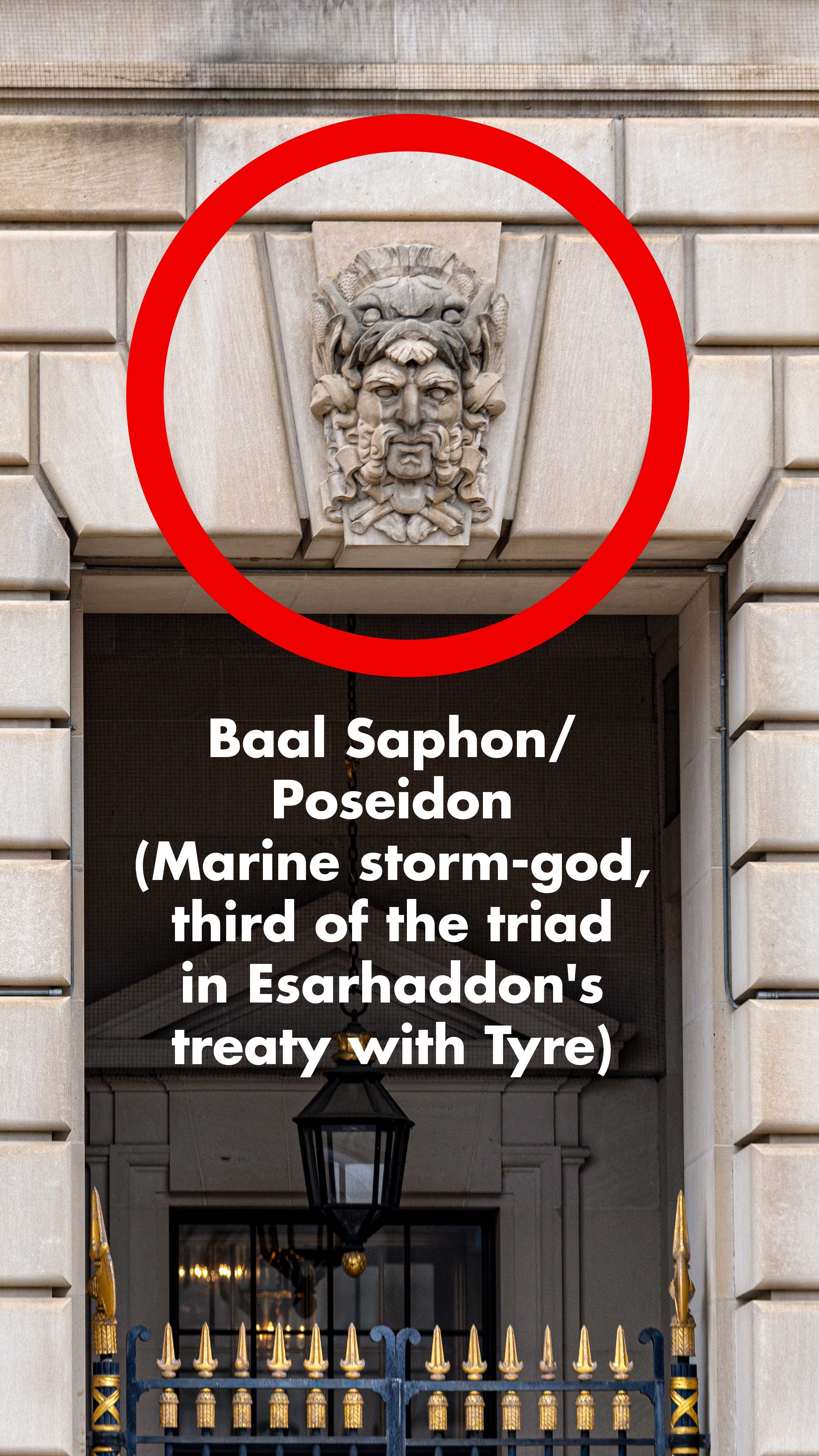
Could he name the third? Phoenicians worshipped a god of the sea and sailed under him. Tyrians, Berytians and Ashkelonites left him dedications on Delos, and Hanno raised him a temple on the African coast. Greek writers called him Poseidon, and no bilingual linguistic example survives to say what his own people called him. Philo puts him in a family: Poseidon appears there as the son of Pontos, the Sea, whom Demarous kills — the death the storm god deals the Sea at Ugarit. Two of these three can be named in Phoenician. Can the third?
Hiram built a temple for Baal Melqart and Astarte together at Tyre, and his crews cut and rafted the timber for Solomon’s house in Jerusalem. Would he walk up those steps on Constitution Avenue and see a building he had no name for?

What Officeholders Have Signed in This Room
Presidents and cabinet officers have used this temple hall for a particular class of act.
Start with the one whose anniversary falls this Friday. The National Commission on Terrorist Attacks Upon the United States released its final report in that temple hall on July 22, 2004. Five months later, on December 17, George W. Bush signed the Intelligence Reform and Terrorism Prevention Act in the same temple and created the Director of National Intelligence.33 The account of the attacks was handed to the public under those three faces, and the surveillance architecture built on that account was signed into law under them.
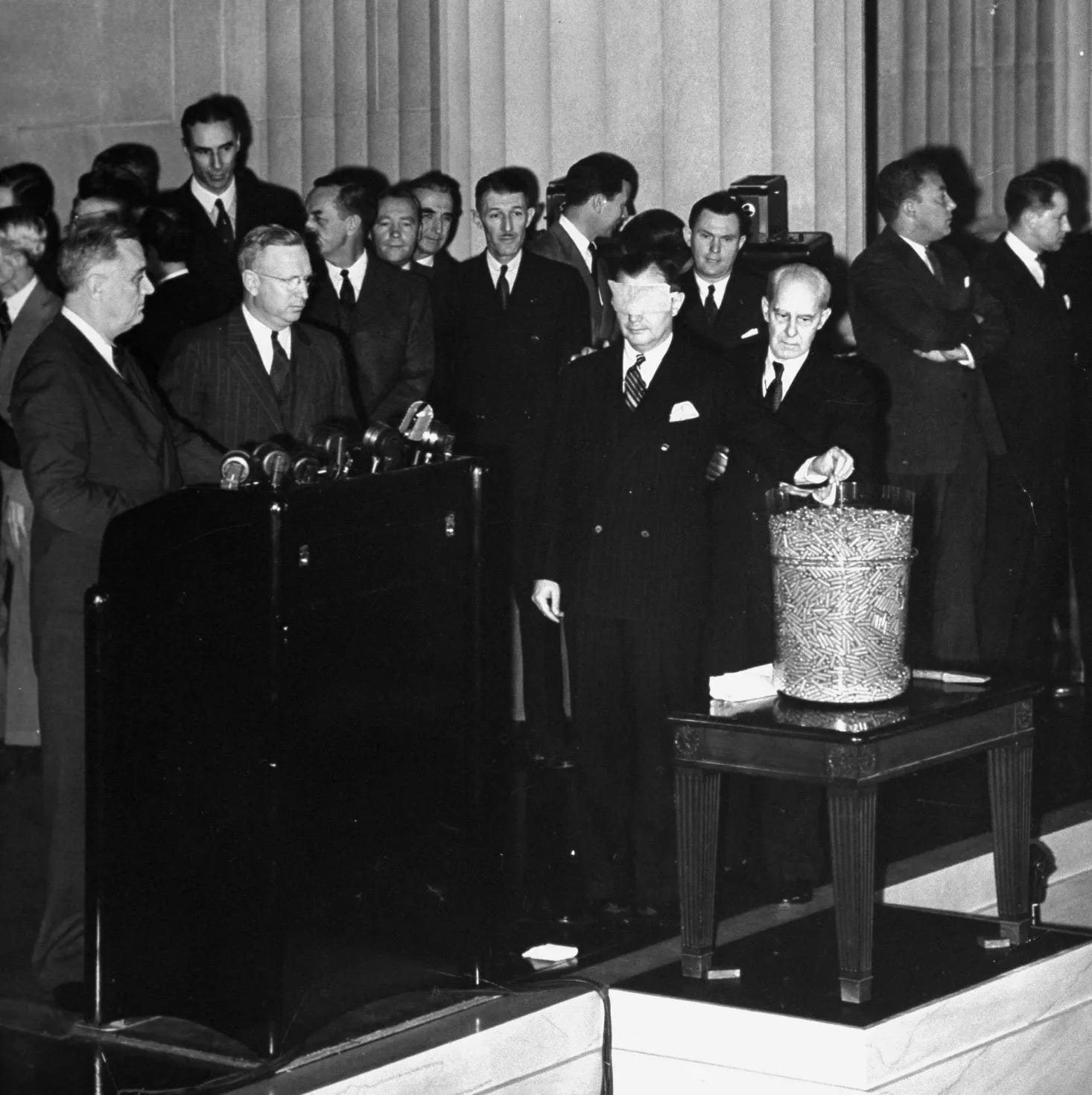
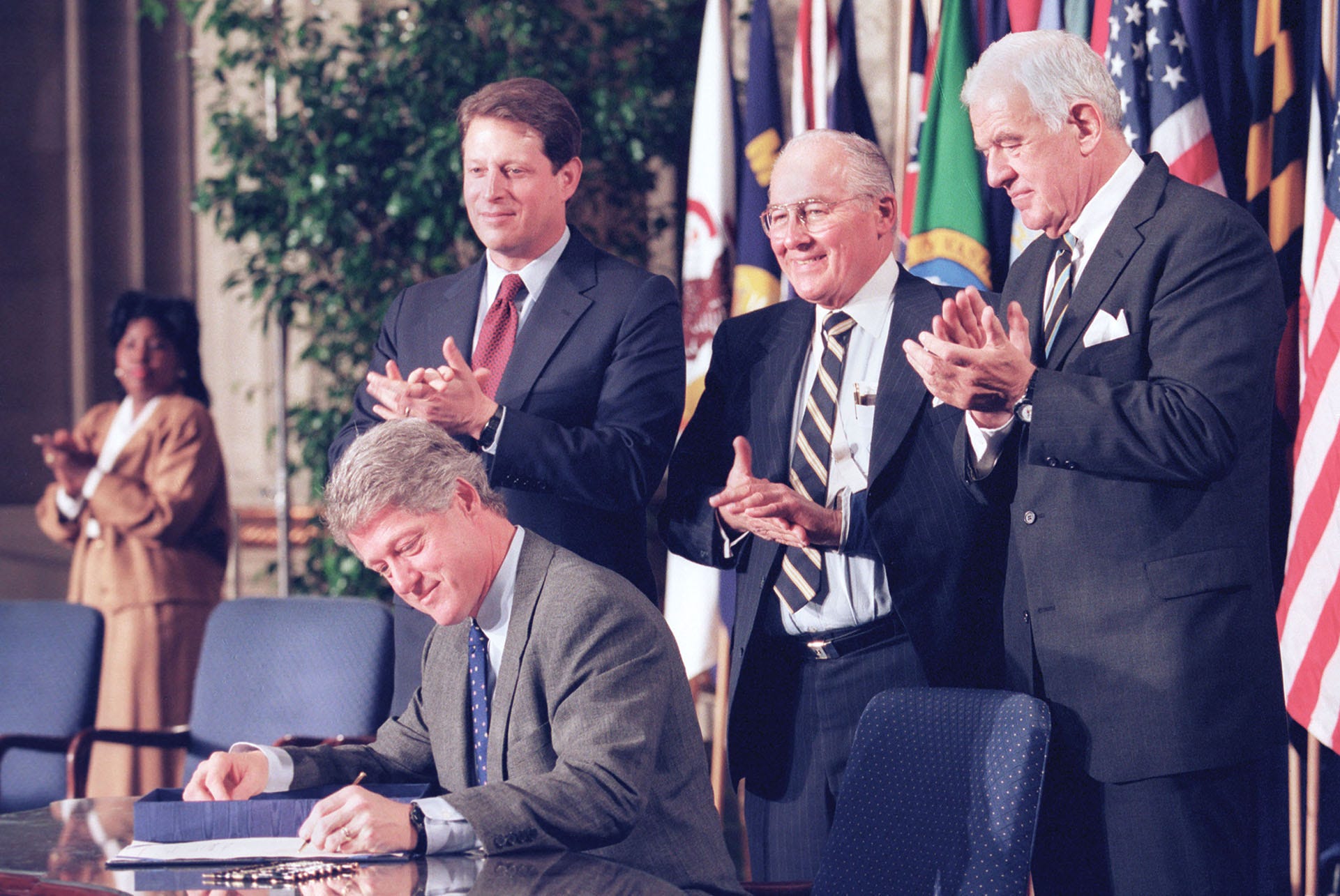
The rest of the room’s record is consistent. Henry Stimson, Roosevelt’s Secretary of War, drew the first capsule of the peacetime draft lottery from the stage on October 29, 1940, blindfolded, after the President’s address.34 Truman signed the North Atlantic Treaty there on April 4, 1949, and spoke at half past four.35 He signed the Mutual Defense Treaty with the Philippine president in the same room on August 30, 1951.36 Clinton signed the NAFTA Implementation Act there at 10:37 in the morning on December 8, 1993.37 Trump signed the artificial-intelligence executive orders there on July 23, 2025.38
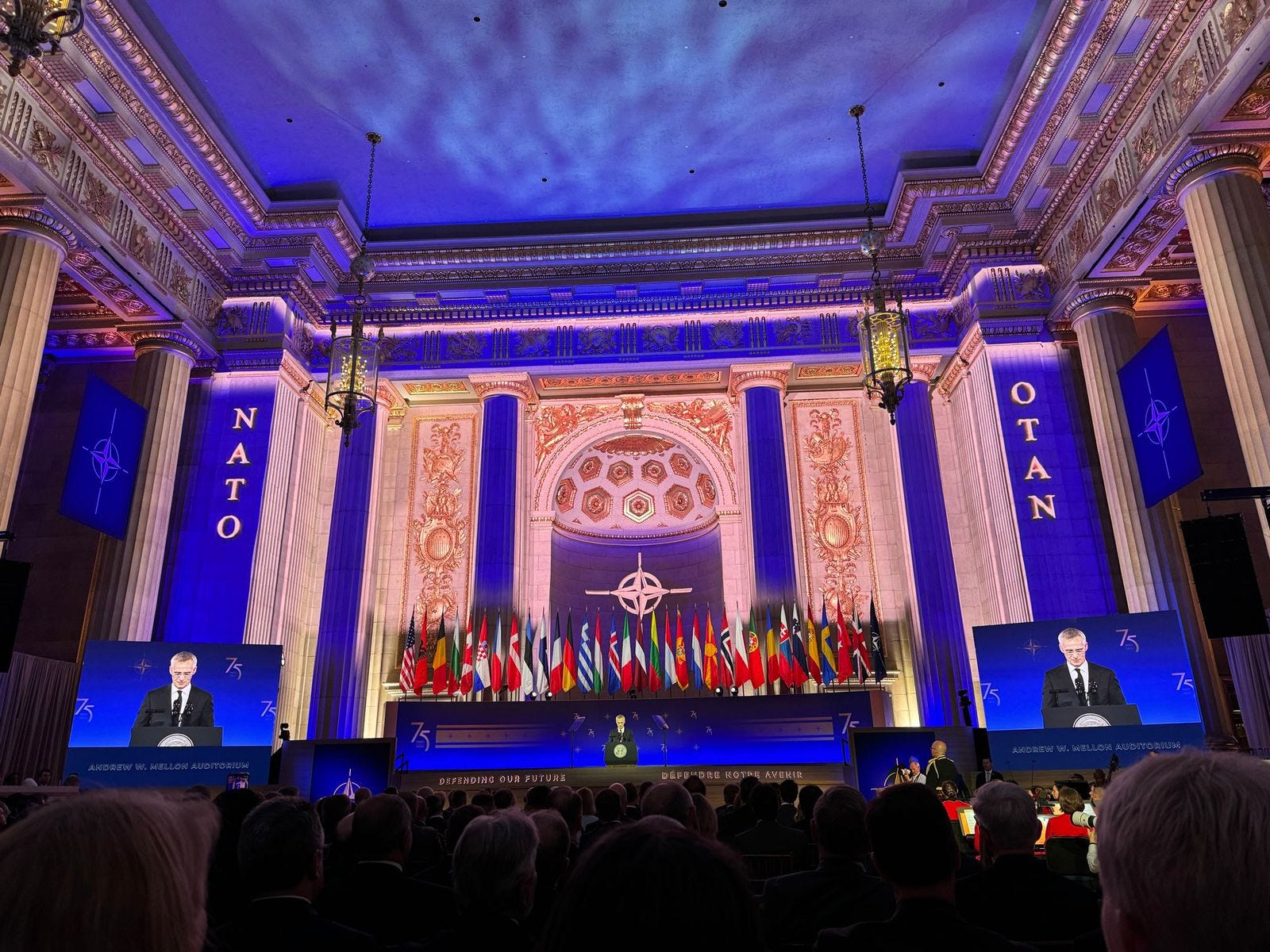
The North Atlantic Council has returned to the room across NATO’s whole life — the founding signature in 1949, the tenth-year ministerial under Eisenhower in 1959, the twentieth-anniversary session under Nixon in 1969, the fiftieth-anniversary summit under Clinton in 1999, the seventy-fifth under Biden in 2024.39
Young men by lot. Allies by treaty. The continent’s economy. The intelligence apparatus. The machine future. Officeholders have committed those futures in that room since 1940.

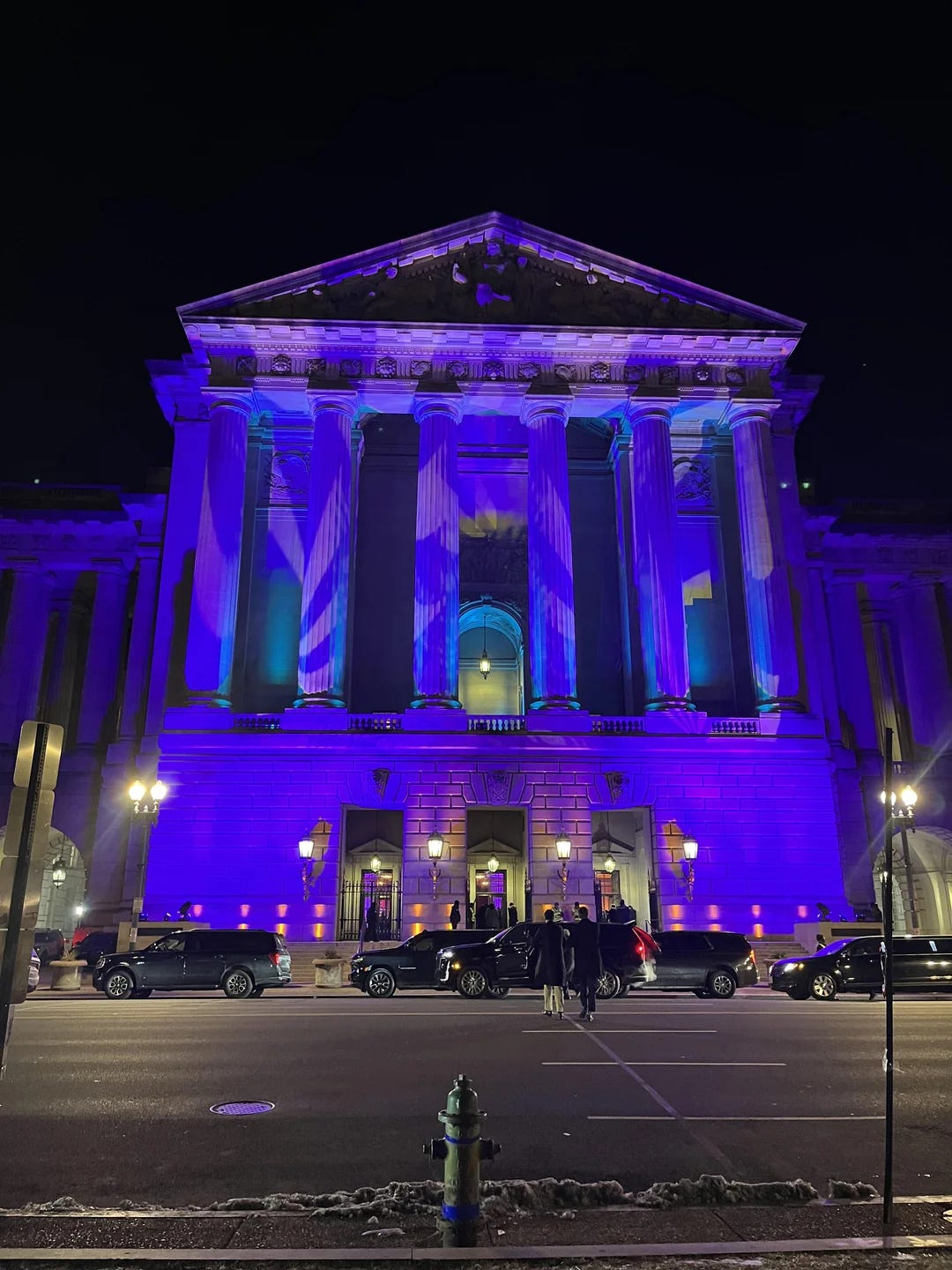
Event producers light the front in purple, like the Tyrian merchants who sold the dye that made that color the mark of kings across the Mediterranean.
Thanks to the generosity of my readers, all my articles are available for free access. Independent journalism, however, requires time and investment. If you found value in this article or any others, please consider sharing or even becoming a paid subscriber, who benefits by joining the conversation in the comments. I want you to know that your support is always gratefully received and will never be forgotten. Please buy me a coffee or as many as you wish.

The Duke Report - Where to Start
My articles on SubStack are all free to read/listen to. If you load the Substack app on your phone, Substack will read the articles to you. (Convenient if you are driving).
Foundational Articles
Podcast (Audio & Video Content)
Palmerston’s Zoo Episode 01 - Solving the Paradox of Current World History (9 Episodes)
Oligarchic Control from the Renaissance to the Information Age
SoundCloud Book Podcasts
I’ve taken almost 200 foundational books for understanding how the world really works and posted them as audio podcasts on SoundCloud. If you load the app on your phone, you can listen to the AI robots discuss the books on your journeys across America.
Duke Report Books
Over 600 foundational books by journalists and academics that never made the New York Times Bestseller list, but somehow tell a history we never learned in school. LINK

3 Kings 16:31–33, The Holy Bible: Douay-Rheims Version (London: Catholic Way Publishing, 2016), translated from the Latin Vulgate; Old Testament first published by the English College at Douay, 1609. Protestant Bibles number the book 1 Kings; the Septuagint calls it Βασιλειῶν Γʹ.
Βασιλειῶν Γʹ 16:31–33, Septuagint, Swete's text via the Open Greek and Latin First Thousand Years of Greek corpus. Verse 32 repeats the article: καὶ ἔστησεν θυσιαστήριον τῷ Βάαλ ἐν οἴκῳ τῶν προσοχθισμάτων ἀυτοῦ ὃν ᾠκοδόμησεν ἐν Σαμαρείᾳ.
The Masoretic Text reads הַבַּעַל, ha-Baʿal, with the Hebrew definite article. The Greek τῷ renders the Hebrew article.
Hebrew ʾEtbaʿal, Greek Ἰεθεβάαλ, Josephus's Ἰθώβαλος. Both readings of the name — "with Baal," "Baal is with him" — include the god's name as the theophoric element.
The Septuagint translators regularly render Hebrew ʾăšērâ — the cult pole, and the goddess it stands for — with ἄλσος, "grove." The Douay-Rheims translators followed the Greek and Latin and left the name out.
James Earle Fraser, the sculptor of the Indian Head nickel and of the seated figures at the National Archives, Heritage, installed 1935 at the Constitution Avenue entrance of the National Archives Building. Inscription: "THE HERITAGE OF THE PAST IS THE SEED THAT BRINGS FORTH THE HARVEST OF THE FUTURE."
George Gurney, Sculpture and the Federal Triangle (Washington, D.C.: Smithsonian Institution Press, 1985), 270–73. Gurney's sculpture key: "Exterior Keystones (11 designs) with figurative heads surrounding building over first-floor entrance doorways and windows, by Leon Hermant, 1934-36. Limestone, heroic scale. Carved by the Piccirilli Brothers company." Three major keystones stand over the auditorium entrances; eight minor ones over the first-floor windows carry "male and female heads adorned with such botanical materials as corn cobs, oak leaves, cattails, and pine boughs." Hermant (1866–1936) was French by birth and trained in Paris. A photograph of 22 May 1935 shows him on the scaffolding behind his full-scale clay model for one of the three major keystones.
Gurney describes this keystone as a male head "capped by … a fishhead and cattails." Gurney, Sculpture and the Federal Triangle, 273.
Description from the author's photographs of the left keystone.
Cippi of Melqart: CIS I nos. 122 and 122 bis = KAI⁵ no. 47 = ICO Malta 1–1 bis = IG XIV no. 600. Josephine Quinn dates the bilingual to the third or second century BCE and gives both texts in full: In Search of the Phoenicians (Princeton, 2018), with the Punic and Greek at 225 n. 105. Jean-Jacques Barthélemy deciphered the Phoenician alphabet from this bilingual in 1758. Quinn notes that the stones came to light on Malta in the late seventeenth century, which does not establish that anyone erected them there; see M. G. Amadasi Guzzo and M. P. Rossignani (2002), 6–18.
Herodotus, Histories 2.44. Herodotus reports that the priests told him the temple had stood for two thousand three hundred years.
Aaron J. Brody, "Each Man Cried Out to His God", 23–24: "Though we are not sure of his Semitic identity, it is clear from a number of sources that 'Poseidon' was worshiped by the Phoenicians. I place the name 'Poseidon' in quotation marks because it comes down to us as a translation in Greek of the equivalent Phoenician god; unfortunately we possess no bilinguals which allow us to know for sure which Semitic deity the Greek authors identified with their god of marine winds and earthquakes, whose abode was the sea." Brody's evidence includes dedications by Tyrians, Berytians and Ashkelonites on Delos, Hanno's temple on the African coast, and the altar in the periplus of Pseudo-Scylax. On Philo of Byblos: Poseidon appears as a son of Pontos (Greek Sea, Ugaritic Yamm), and Demarous slays Pontos, paralleling Yamm's death at Baʿl-Haddu's hands (Praeparatio Evangelica 1.10.26–28, 35). Brody calls Dussaud's identification of the seahorse god as a Yamm/Baʿl-Haddu syncretism in Melqart "totally unfounded."
Astarte as the Semitic Venus, the star of the morning and evening. Herbert Niehr and Paolo Xella, eds., Encyclopaedic Dictionary of Phoenician Culture, vol. 2.1, Religion, Deities and Mythical Characters (Leuven: Peeters), s.v. Astarte.
Gurney, Sculpture and the Federal Triangle, 273. Gurney's own verdict on the commission: Hermant's contributions "were of relatively minor importance by comparison with those of the other sculptors because his commission involved purely decorative, non-symbolic works." The Commission of Fine Arts told Hermant his models "should be less ornamental in type and have more character."
KTU 1.1–1.6 in Die keilalphabetischen Texte aus Ugarit, the standard catalogue. Mark S. Smith, The Ugaritic Baal Cycle, Volume 1: Introduction with Text, Translation and Commentary of KTU 1.1–1.2 (Leiden: Brill, 1994). Smith dates the extant form to the first half of the fourteenth century BCE, from Ugarit, modern Ras Shamra, near Latakia on the Syrian coast.
KTU 1.2 IV 28–34, Smith's translation. Baal kills Yamm outright — line 27, "Baal drags and dismembers (?) Yamm, He destroys Judge River" — and the poet says it twice over: "Yamm surely is dead! Baal rei[gns]!" Smith places Athtart at both ends of the fight: she restrains Baal in 1.2 I and rebukes him in 1.2 IV.
Philo of Byblos, Phoenician History, the sentence with which Smith opens The Ugaritic Baal Cycle, vol. 1.
Author’s note
Author’s note
Josephus, Jewish Antiquities 8.146, quoting Menander of Ephesus: καθελών τε τὰ ἀρχαῖα ἱερὰ καὶ ναὸν ᾠκοδόμησε τοῦ Ἡρακλέους καὶ τῆς Ἀστάρτης, πρῶτός τε τοῦ Ἡρακλέους ἔγερσιν ἐποιήσατο ἐν τῷ Περιτίῳ μηνί. Repeated near-verbatim at Against Apion 1.118–19. Josephus writes "Hercules" throughout for the Tyrian god.
The Greek ἔγερσις carries both "raising up" and "awakening," and scholars split on Menander's sense. For the awakening or resurrection of the god: Charles Clermont-Ganneau, "L'Égersis d'Héraclès et le Réveil des dieux," Recueil d'archéologie orientale VIII (1921), 149–67; Théodore Reinach; Ralph Marcus; René Dussaud; R. Tournay; Edward Lipiński; Corinne Bonnet, Melqart, Studia Phoenicia VIII, 104–12. For the erection of a temple to Herakles: H. St. J. Thackeray in the Loeb Against Apion; J. Teixidor; H. J. Katzenstein, The History of Tyre, 92–93. Two arguments favour the awakening: Josephus uses κατασκευήν and ᾠκοδόμησεν for the other buildings he draws from Phoenician sources, and naming a specific month suits a festival. Les relations entre les cités de la côte phénicienne et les royaumes d'Israël et de Juda, Studia Phoenicia XII (Leuven: Peeters, 1992), 307–8 n. 24.
Josephus, Against Apion 1.123, quoting Menander of Ephesus: Ithobalos, priest of Astarte, killed Phelles and reigned thirty-two years. Josephus connects Ithobalos to the Achab marriage at Jewish Antiquities 8.317–20. Author note: This ascension to the throne by presbytéricide is the foundational conceit of James Frazer’s Golden Bough, where the ascension to the office of high priest in the Temple of Diana Nemorensis is likewise manifested.
Josephus, Jewish Antiquities 8.13.1 (§317), Whiston translation.
Josephus, Jewish Antiquities 9, on Jehu's purge of Samaria. Josephus elsewhere calls the god of the Tyrians Belus in the same narrative.
Josephus, Jewish Antiquities 8.13.2, quoting Menander of Ephesus. The Macedonian month Hyperberetaeus falls in the autumn, so Menander's notice covers a full year without rain. The biblical drought runs from 3 Kings 17:1 to the rain at Carmel in 18:41–45.
Aaron J. Brody, "Each Man Cried Out to His God", 35–36: "Scholars have often mistakenly given Milqart qualities of a storm god, based on the fact that he is called Baʿl Ṣur… The appellation Baʿl Ṣur is more accurately translated as 'the lord of Tyre' than 'Baʿl (the storm god) of Tyre'. This is proven in the Esarhaddon/Baʿl of Tyre treaty which lists the three aspects of the Tyrian storm god separately from Milqart… While Baʿl Šamem, Baʿl Malage, and Baʿl Ṣapon control the marine storm, Milqart and Ešmun are described as having effects on the land and its fecundity." Brody adds that Milqart carries the same title, Baʿl Ṣur, in the Malta bilingual, KAI 47.
René Dussaud, "Melqart," Syria 25 (1946–48), 205–30. Brody, "Each Man Cried Out to His God", 36 n. 120, calls the storm-god reading tenacious among French scholars and traces it to Dussaud. Corinne Bonnet reviews the evidence in Melqart: Cultes et mythes de l'Héraclès tyrien en Méditerranée, Studia Phoenicia VIII (Leuven: Peeters, 1988), 267–69
Brody, "Each Man Cried Out to His God", 36–37: "If Milqart was not a storm god and did not possess any attributes believed to affect the weather, as have all of the nautical patron deities described so far, why was he important to sailors? The answer seems to lie in a comparison with his Greek, Hurrian, and Mesopotamian counterparts, Herakles, Irsappa, and Nergal. Herakles, through the tales of his adventurous twelve tasks, became the paradigm of the intrepid traveller. Thus he was considered a guardian of voyagers." Brody also cites Pausanias on an "Egyptian" statue of Herakles said to have come to Erythrae from Tyre on a raft.
The vassal treaty of Esarhaddon with Baal I of Tyre, SAA 2 no. 5, ca. 675–670 BCE. Text and translation: S. Parpola and K. Watanabe, Neo-Assyrian Treaties and Loyalty Oaths (Helsinki: Helsinki University Press, 1988), 24–27; earlier edition R. Borger, "Die Inschriften Asarhaddons Königs von Assyrien," Archiv für Orientforschung, Beiheft 9 (1956), 107–9; translation by E. Reiner in ANET, 533–34. Brody works the curse section at "Each Man Cried Out to His God", 10–11 and 35–36: Rev. IV.10′ names the three storm gods, who raise an "evil wind" and a "strong wave" against the ships; Rev. IV.14′ names Milqart. Edward Lipiński translates the full curse section in Dieux et déesses de l'univers phénicien et punique, Studia Phoenicia XIV (Leuven: Peeters, 1995), 244–47. Astarte's clause: "Puisse Astarté briser votre arc au fort de la mêlée et vous jeter aux pieds de votre ennemi, puisse un ennemi étranger se partager vos biens." The land-and-deportation curse belongs to Melqart and Eshmun.
Herbert Niehr and Paolo Xella, eds., Encyclopaedic Dictionary of Phoenician Culture, s.v. Poseidon: "In Gk texts related to the Phoen. and Pun. world, P. is the interpretatio graeca of several Phoen. deities, whose identification is controversial." They name Baal Saphon, third of the treaty triad, and El qone ars, the latter resting on a Palmyrene bilingual in Aramaic. On Yamm they answer Dussaud's 1947 proposal: he "is hardly attested in the I mill. BCE." Their MELQART entry runs the other way on the sea, suggesting the seahorse rider on Tyrian coins of the fifth and fourth centuries may be Melqart himself, "as lord of the seas" — the identification Brody calls "totally unfounded." No Phoenician text names a sea-god Baal Yammim. The nearest candidate, rzn ymm in the Neo-Punic inscription from Maktar (KAI 145), is a verb with its object rather than a divine name: Charles R. Krahmalkov files it under R-Z-N I, "qal RULE, GOVERN," and translates the line "ḤTR rules the land, / Mescar rules the seas, / He commands fear because of his might" (Phoenician-Punic Dictionary, Studia Phoenicia XV, s.v. R-Z-N I). Mohamed Fantar interpreted the phrase as "prince of the sea"; the Handbook of Neo-Punic Inscriptions prefers "prince of days"; Krahmalkov's grammar removes both.
3 Kings 5:6–11, Douay-Rheims. Solomon's reason for sending to Tyre: "there is not among my people a man that has skill to hew wood like to the Sidonians." Hiram's terms: "My servants shall bring them down from Libanus to the sea: and I will put them together in floats, on the sea, and convey them to the place, which thou shalt signify to me." Solomon's payment: twenty thousand measures of wheat and twenty measures of the purest oil. On the columns: Herodotus, Histories 2.44; R. D. Barnett, "Ezekiel and Tyre," Eretz-Israel 9, the Albright volume (Jerusalem, 1969), 6–7, identifying the pair on the Sennacherib relief from Kouyunjik, naming them the prototypes of Jachin and Boaz, and comparing the clay temple model from Idalion in the Louvre.
3 Kings 18:27, Douay-Rheims. Escacena Carrasco's La égersis de Melqart is the specialist study of the waking rite the taunt lands on.
George W. Bush, remarks on signing the Intelligence Reform and Terrorism Prevention Act, Mellon Auditorium, December 17, 2004. The 9/11 Commission released its final report in the same hall on July 22, 2004.
Henry L. Stimson and McGeorge Bundy, On Active Service in Peace and War: "The President first made an admirable speech on the purposes and methods and democratic nature of the draft. Then I was blindfolded and drew the first capsule." New York Times, October 22, 1940, announced the venue and hour.
Harry S. Truman, address at the signing of the North Atlantic Treaty, Departmental Auditorium, 4:30 p.m., April 4, 1949. American Presidency Project.
Truman, remarks at the signing of the Mutual Defense Treaty with the Philippines, August 30, 1951. American Presidency Project.
William J. Clinton, remarks on signing the North American Free Trade Agreement Implementation Act, Mellon Auditorium, 10:37 a.m., December 8, 1993. American Presidency Project.
Remarks and executive-order signing at the White House AI Summit, Mellon Auditorium, 5:21 p.m., July 23, 2025.
North Atlantic Treaty signing, April 4, 1949; North Atlantic Council ministerial opening under Eisenhower, April 2, 1959; NATO Commemorative Session under Nixon, April 10, 1969; fiftieth-anniversary summit under Clinton, April 23–25, 1999; seventy-fifth-anniversary remarks by Biden, July 9, 2024. All venue-tagged in the American Presidency Project.
Our rulers in plain sight, but un-recognized.
Kudos! Excellent! Bravo! They say all the goddesses are one goddess and I do believe all the old gods are one. They don't go away, perpetually reborn, dying and rising. I opened my copy of "Who Was Hiram Abiff" after reading your piece and saw in my handwriting: "Orpheus, Dionysus, Attis, Adonis, Tammuz, Melcarth". The Irish I believe, called him Lugh. Those up North, Odin. The masons call him Hiram Abiff. Each mason becomes Abiff! It's the new religion of man. The gods of old have suffered a sea-change, full fathom five. Scientism, the new religion of Man. And it requires sacrifice for Man, the would-be god.