


An EpiWar™ Analysis
Two groups generate more conspiracy theories than almost any other groups in Western history: the Pharisees and the Freemasons (Jesuits notwithstanding; we will deal with them in a follow-up article). Writers have alleged secret lineages, hidden continuities, shared ritual systems, and coordinated agendas. The direct evidence for those allegations remains occulted, disputed, or absent.
Explainer Video:
The following EpiWar™ analysis applies Parmenides razor: what is, is. Set aside what people claim about these institutions. Set aside what the institutions claim about themselves. Look at what each institution does — linguistically, ontologically, epistemologically — and observe what is actually there. What is common to both cases is the same Hebrew root letter, which encodes the same two-phase control architecture and runs the same boundary-and-interpretation loop that has made both institutions durable across centuries of scrutiny.
The following framework requires only that the reader look at what is, as Parmenides suggests.
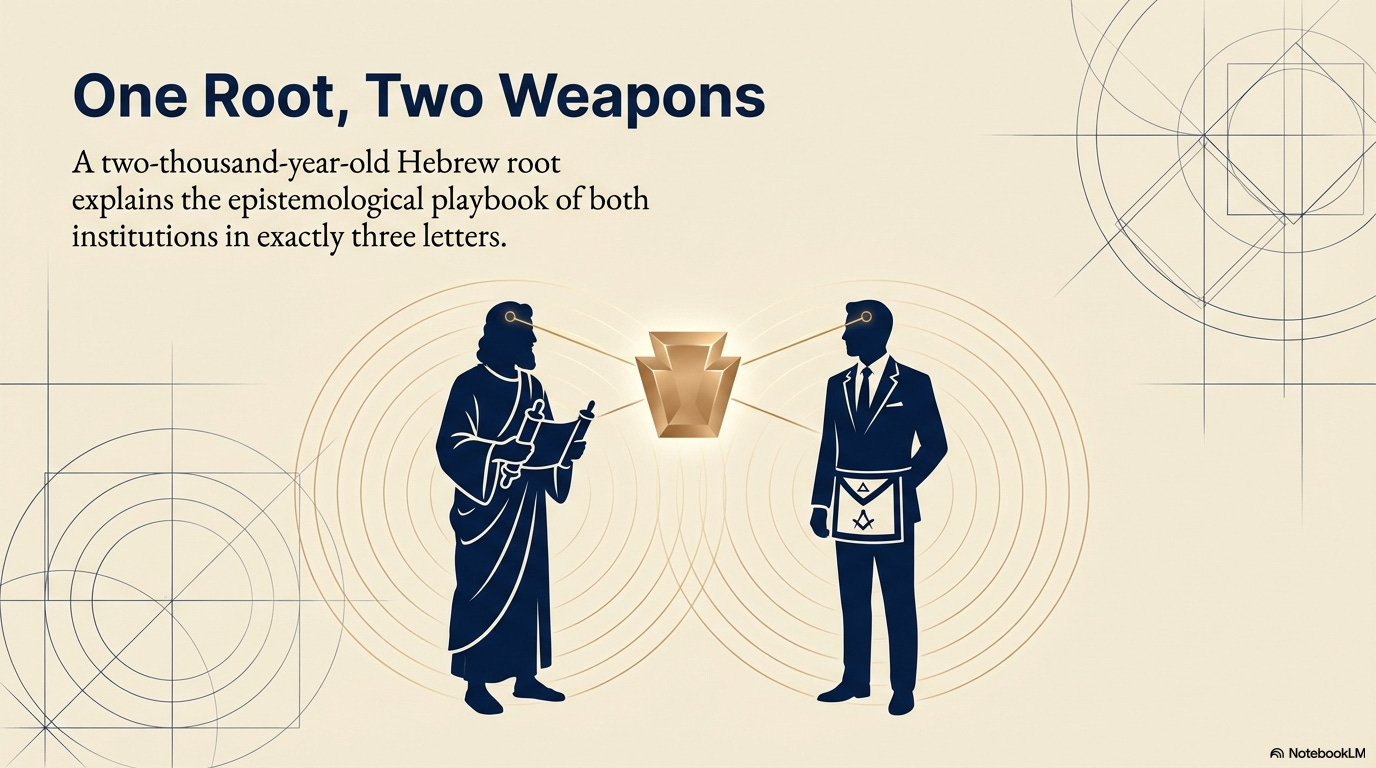
One Root, Two Weapons
The Hebrew root פָּרַשׁ (pāraš) denotes a single organizational function carried out in two phases.1
In phase one, a group of people claims the exclusive capacity to expound a body of knowledge — to stand between a consequential text and the population that needs it decoded.
In the second phase, those same people establish and enforce a boundary system that secures their position as an arbiter.
Teachers promote claims of authority.
Gatekeepers enforce the boundary and create dependency.
Initiates return to authorized members for the next layer of knowledge.
Leaders who control the information and the boundary control the institution.
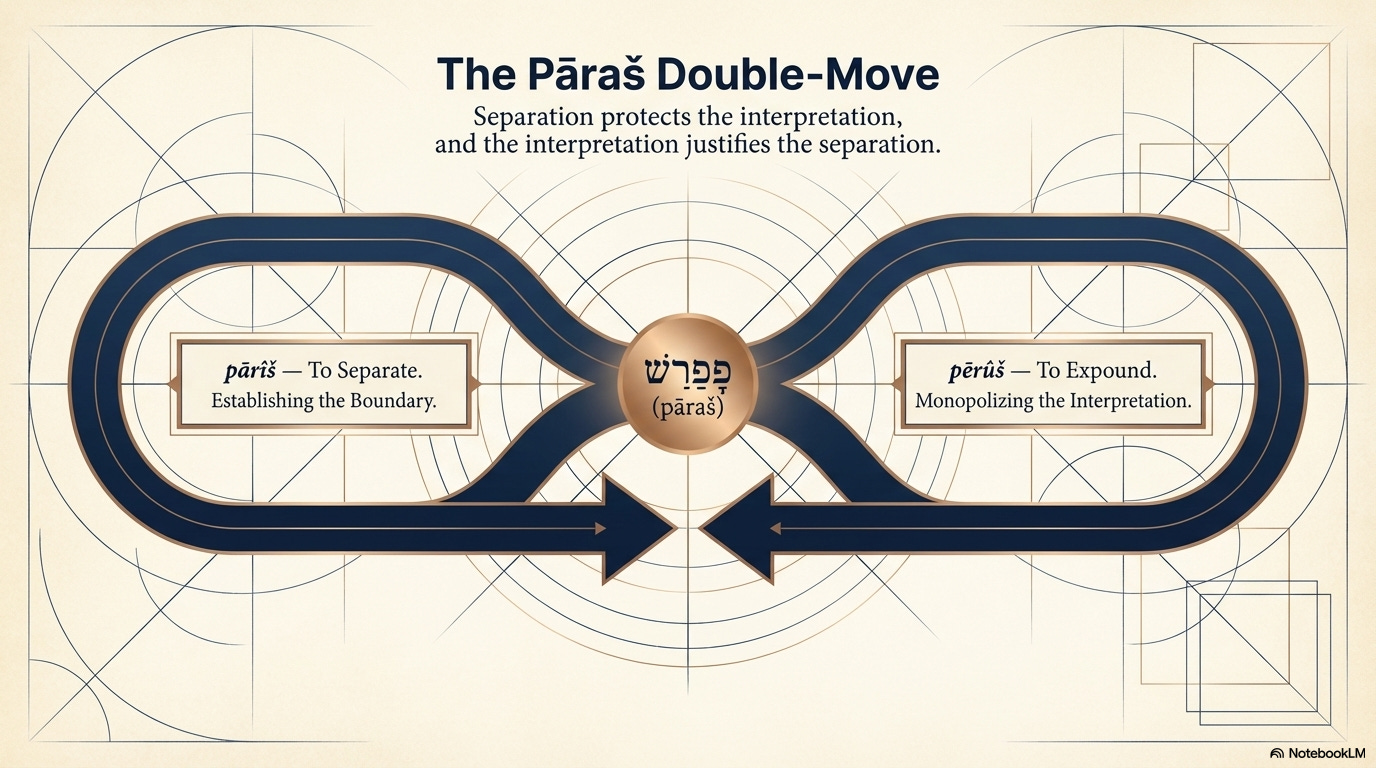
The Pharisees called themselves by the word that describes the method. The word Pharisees reaches English through Latin and Greek transliteration of the Aramaic פְּרִישַׁיָּא (pərîšayyā), from the root pāraš.2 That root has two simultaneous meanings: to separate (pārîš) and to interpret, to expound (pērûš). The group named itself after the double move. Separation and interpretation in the one word.
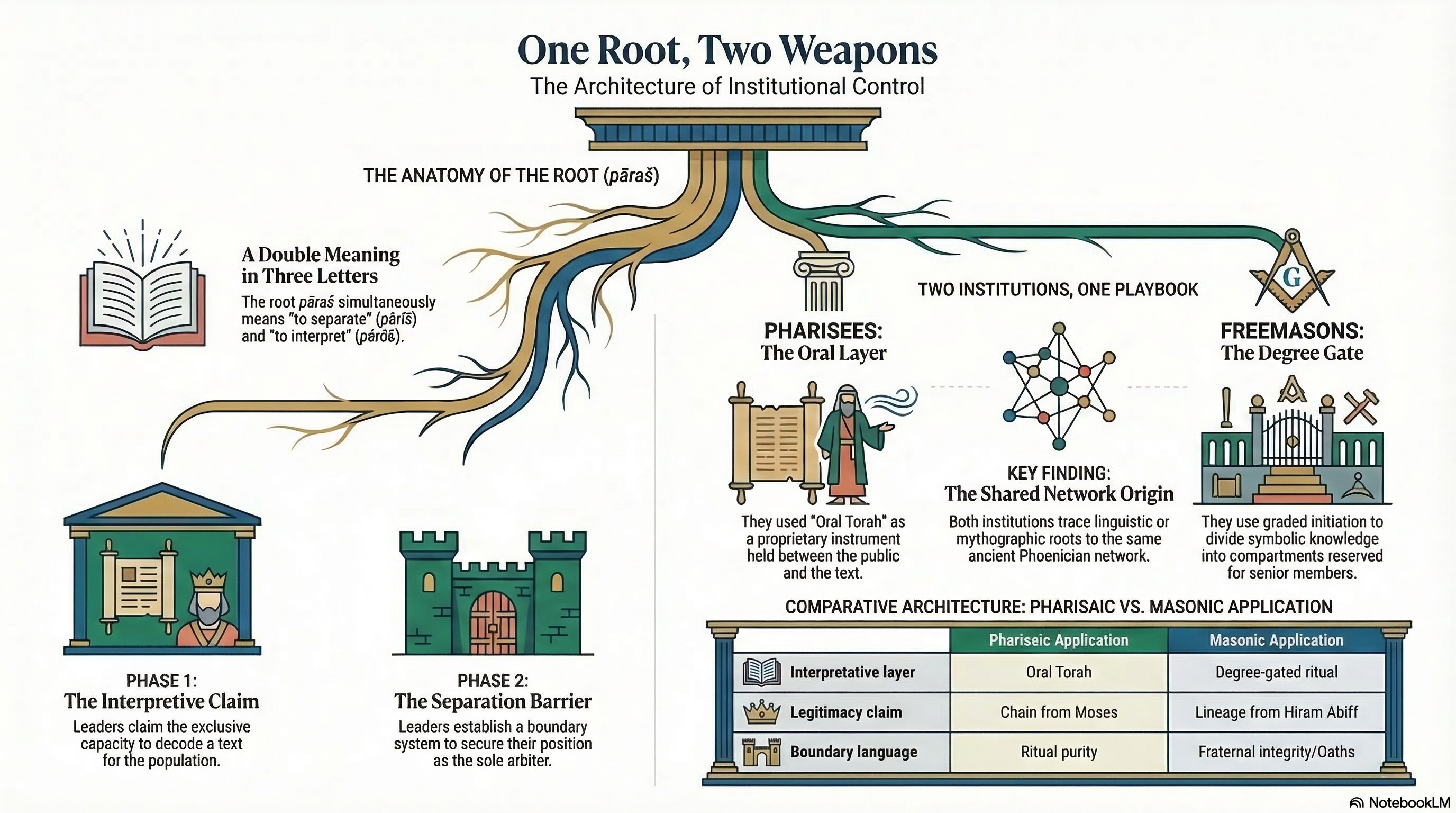
The Freemasons symbolically encoded the concept into the compass, the square, and the central sigil ‘G’ or the Hebrew י (YOD).
In the EpiWar™️ frame, the word ‘magic’ is defined as a method or system in which the self-evident is wrapped in mystery, with the expressed intent to introduce intermediary gatekeepers. פָּרַשׁ (pāraš) fits that definition.
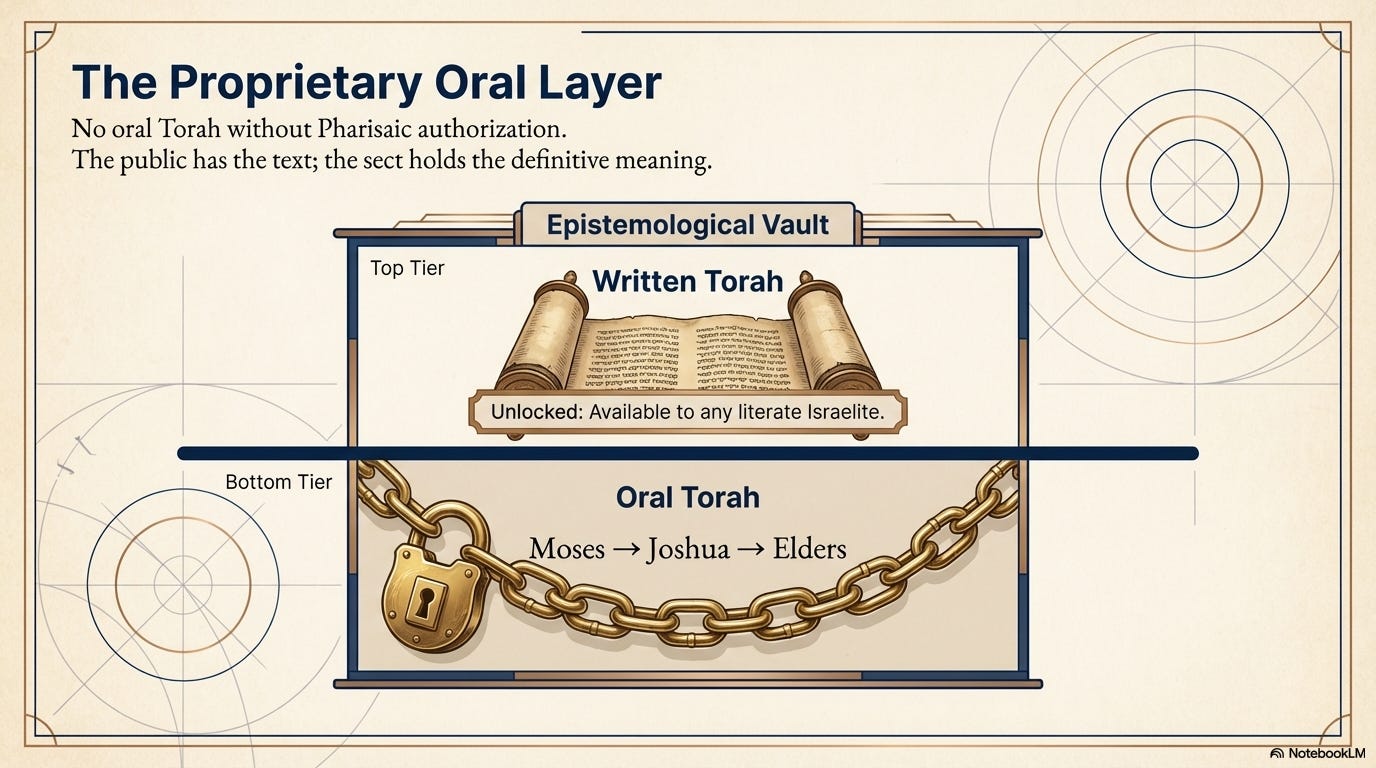
The Oral Layer
The Pharisees held oral Torah as their proprietary interpretive instrument. Written Torah — the five books of Moses — was public. Any literate Israelite could read it. Oral Torah was different. Pharisaic teachers claimed that Moses received two revelations at Sinai: the written text and an accompanying body of interpretation, transmitted from mouth to ear through an unbroken chain of authorized teachers, and belonging exclusively to those within the Pharisaic network.

Mishnah Avot opens with that chain: Moses received Torah at Sinai and handed it to Joshua, Joshua to the Elders, the Elders to the Prophets, the Prophets to the Men of the Great Assembly.3 Readers encountered questions that the written text did not answer. Pharisaic teachers controlled the answers. Israelites who needed rulings on purity, Sabbath observance, tithing, marriage, and inheritance needed Pharisaic teachers to interpret those rulings.4 The self-reinforcing separation (pārîš) protected the interpretation (pērûš), and the interpretation justified the separation. No oral Torah without Pharisaic authorization.
After 70 CE, with the Temple destroyed and the Sadducees eliminated as a competing power center, Pharisaic teachers held the only functioning Jewish institutional structure. Rabbinic Judaism — their direct continuation — eventually wrote the oral layer down in the Mishnah and Talmud. The written record became accessible. Rabbinic leaders shifted the boundary accordingly: the texts were available, but authorized interpretation required years of study inside recognized academies under recognized masters. Rabbinic academies ran the loop continuously. The same leaders rebuilt the same architecture around the new text.
The Degree Gate
Freemasonry runs the same epistemological architecture through a different mechanism: graded initiation.
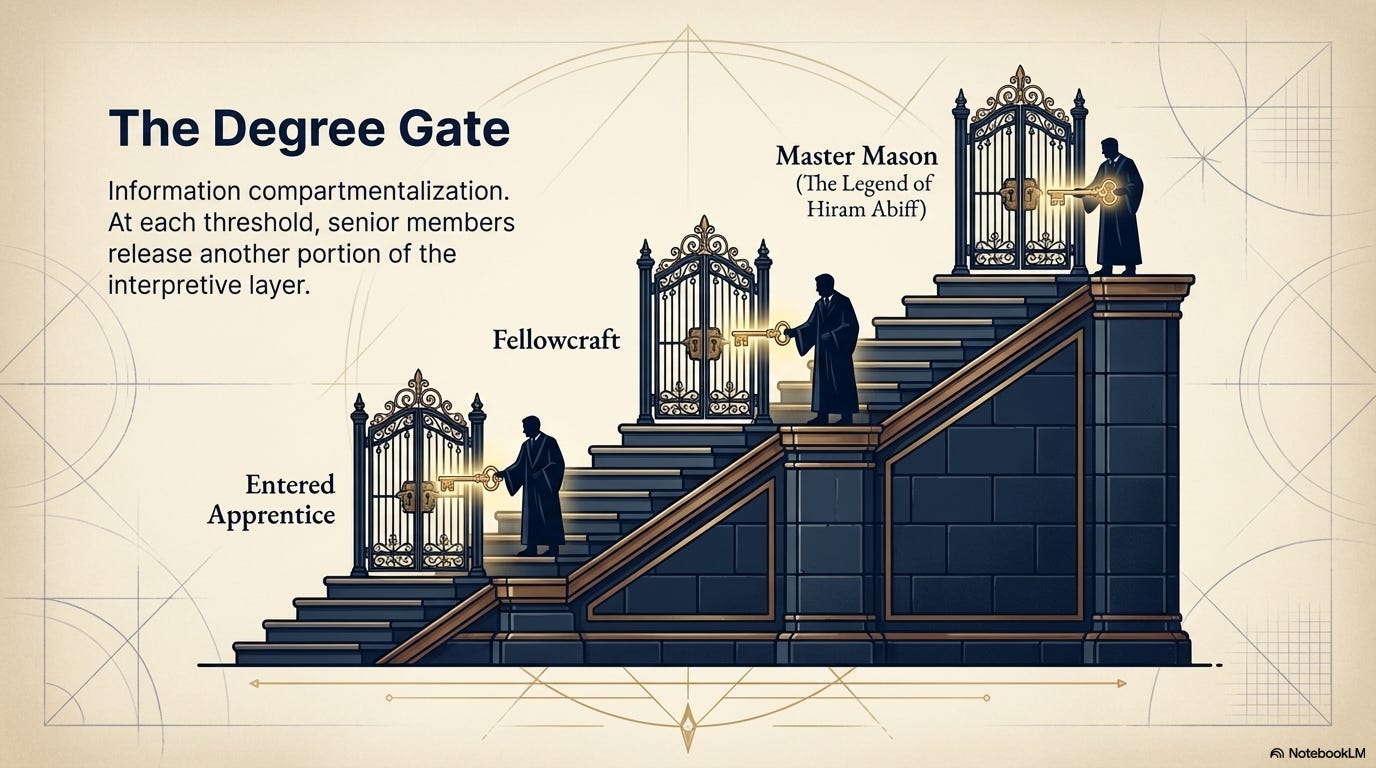
Lodge officers divide their knowledge into degree-locked compartments. First-degree initiates (Entered Apprentices) receive one portion of the symbolic system. Second-degree initiates (Fellowcrafts) receive another. Third-degree initiates (Master Masons) receive the central ritual — the legend of Hiram Abiff, the Phoenician master craftsman from Tyre, whose death and symbolic resurrection structure the most consequential initiation in the fraternity. Above the Blue Lodge, Scottish Rite degrees run to the 32nd, and an honorary 33rd degree sits above those.
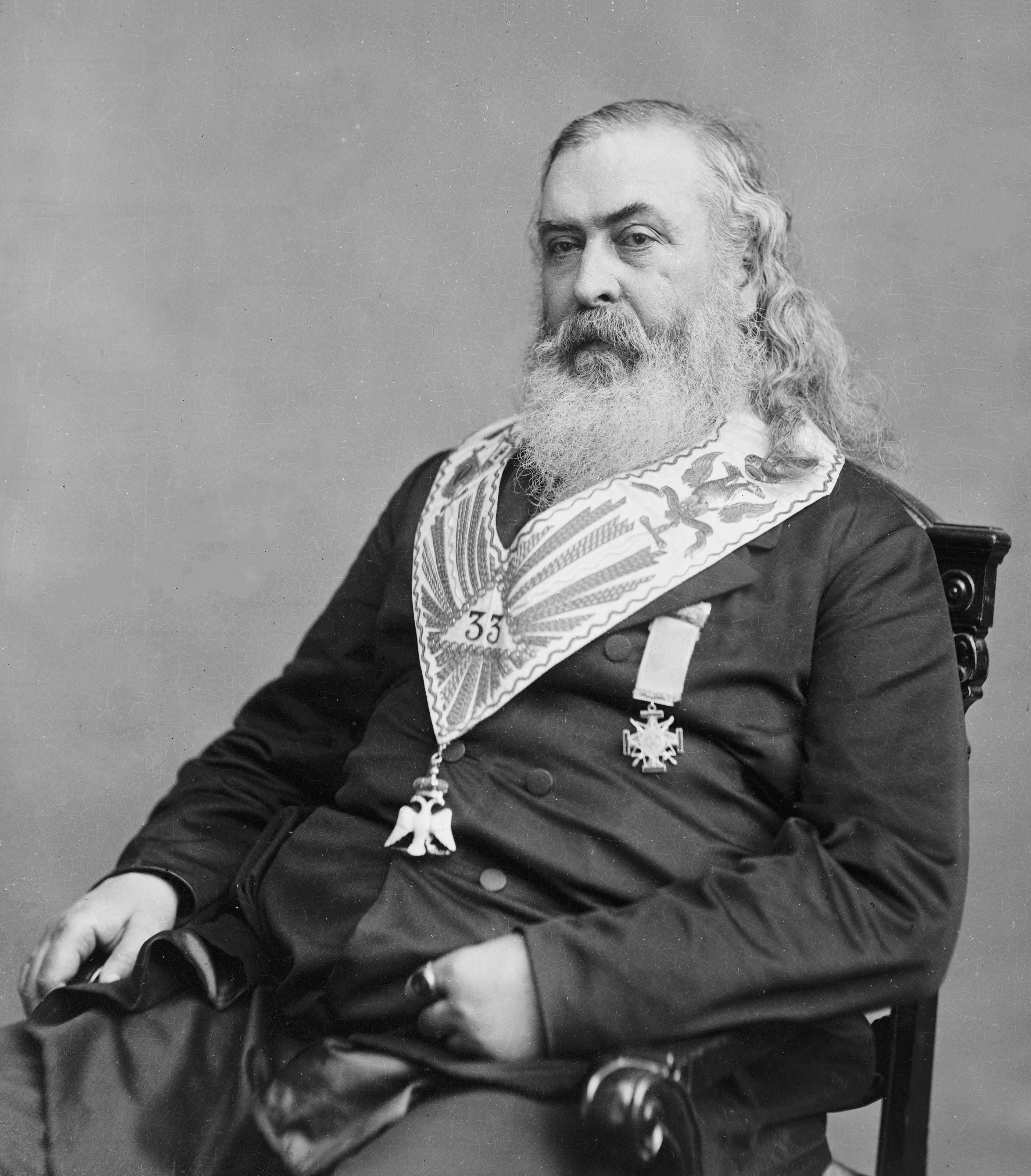
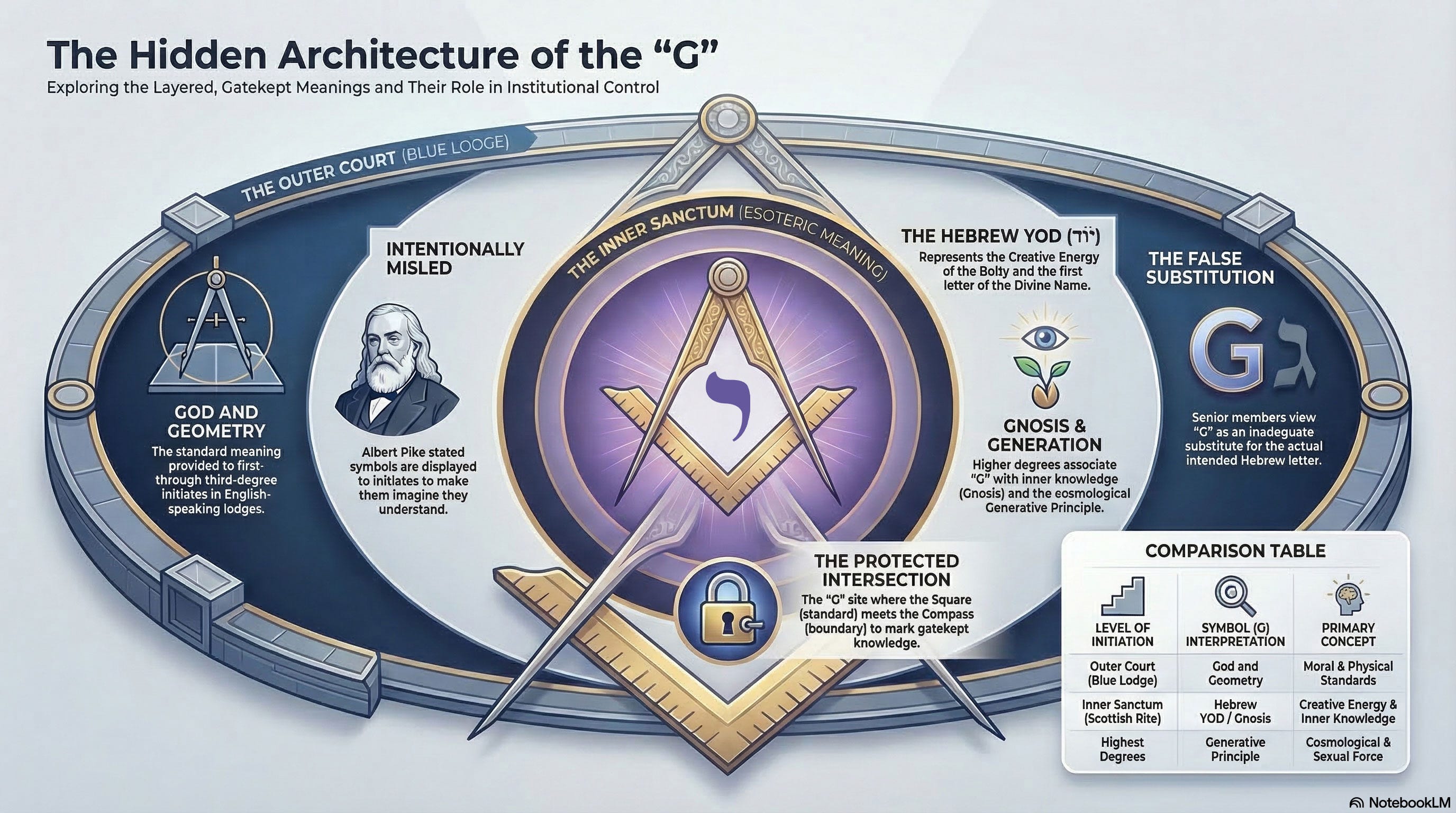
At each threshold, senior members release another portion of the interpretive layer. Lower initiates receive symbols whose meanings senior members hold in reserve. Albert Pike, Sovereign Grand Commander of the Supreme Council of the Scottish Rite, wrote this about Blue Lodge initiates in Morals and Dogma:
“The Blue Degrees are but the outer court of the temple. Part of the symbols are displayed there to the initiate, but he is intentionally misled by false interpretation. It is not intended that he shall understand them, but it is intended that he shall imagine that he understands them. The true explanation is reserved for the Adepts, the Princes of Masonry.”
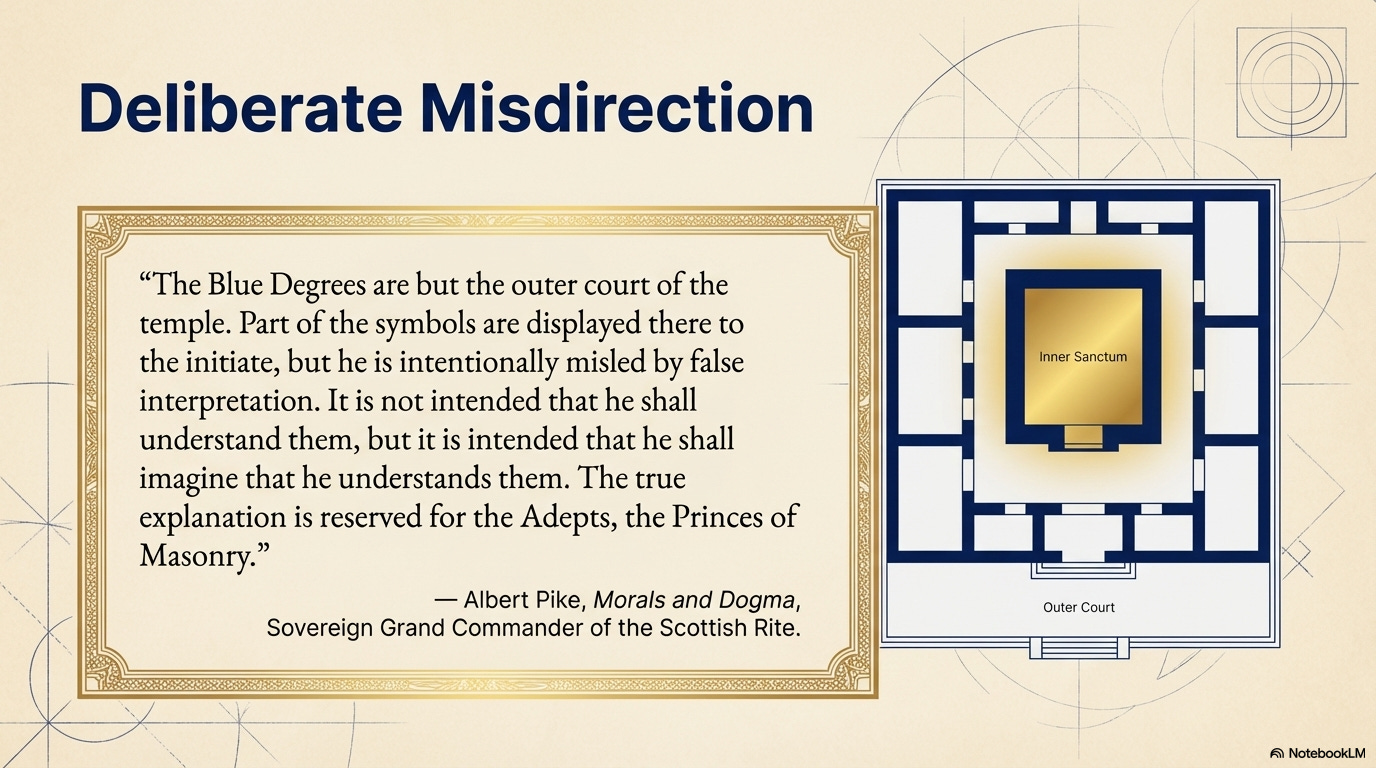
Pike wrote this in the same volume he distributed to every Mason completing the 14th degree in the Southern Jurisdiction of the Scottish Rite — a book that Blue Lodge Masons did not receive.5 He described the deliberate misdirection of lower initiates in text that he made accessible only to higher initiates. Pike put the description of the architecture in plain sight, in text available at that time, only to readers already inside the boundary.
What the Letter Actually Means
In the Blue Lodge, senior members tell initiates that the letter G at the center of the square-and-compass symbol stands for God and Geometry. This is accurate as far as it goes.
Pike went further in Morals and Dogma. He wrote that the G in English and American lodges is a substitution for the Hebrew י (YOD), which French lodge practice preserves in the Blazing Star. Pike called the G substitution inadequate — equivalent, he said, to using D for Dieu in a French lodge. YOD, in the Kabbalistic system Pike drew on, is the Creative Energy of the Deity: the generative principle, the first letter of the Divine Name, the point at the center of the circle of creation, associated with Osiris as the creating force of the Egyptian mystery system.6
Senior members at higher degree levels associate G with Gnosis — inner knowledge available to those who pursue esoteric understanding through authorized advancement — and with the Generative Principle, in its cosmological sense and, at further degrees, in its explicitly sexual sense.7 The Blue Lodge meanings (God, Geometry) are not false. They are the outer court reading, offered to initiates who, in Pike’s own words, leaders intend to leave, imagining they understand the symbol without actually understanding it.
The letter sits at the center of the compass and square. The compass draws the boundary. The square measures the standard. Senior members place the G at the intersection to mark what both instruments protect: an interpretive layer they hold and junior members approach but have not yet reached.
Hiram Abiff and the Phoenician Thread
The founding sacrificial figure of Masonic legend is Hiram Abiff, a master craftsman in bronze and architecture. He appears in 1 Kings 7 and 2 Chronicles 2 as a craftsman dispatched by the King of Tyre to build Solomon’s Temple — a Phoenician master from the city that anchored the primary Mediterranean trade and intelligence network of the tenth century BCE.8
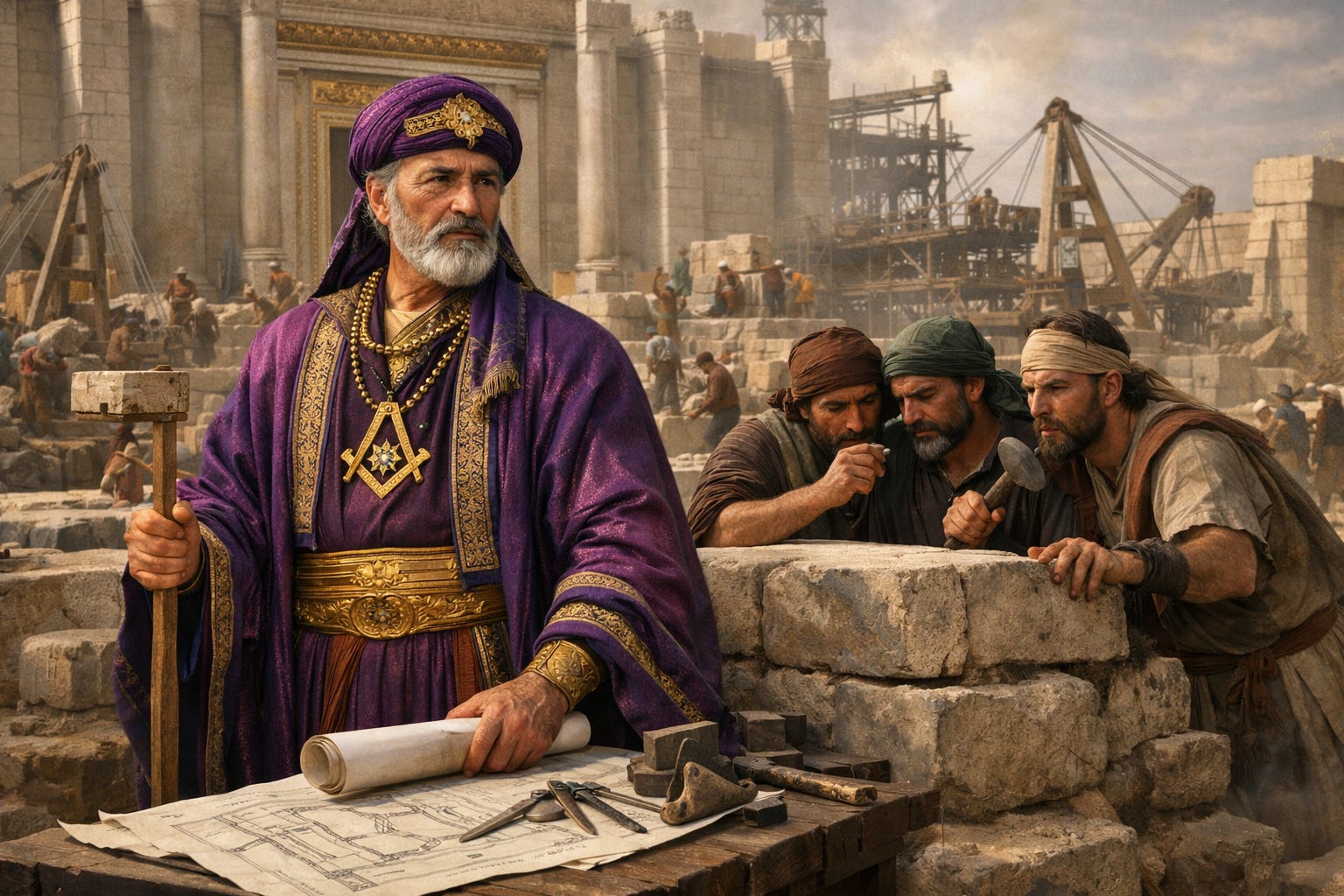
Every third-degree Mason ritually re-enacts the death and recovery of the Tyrian craftsman. Lodge leaders who designed the initiation system built the foundational narrative around Hiram Abiff, the Phoenician craftsman. Masonic mythographers located the fraternity’s founding at the intersection of Israelite institutional power and Phoenician technical and network expertise.
The Pharisees connected to the Phoenician network through the alphabetic infrastructure used by Greek scribes, who had learned from Phoenician traders, to transliterate Hebrew and Aramaic into Greek.9 The word Pharisaioi is recorded in the Greek textual record through that channel. Greek scribes used the letter phi (φ) at the front of the word to render the Aramaic pe (פ) — the aspirated consonant that Phoenician scribal transmission carried into the Greek sound system, where Greek writers had created phi as the dedicated letter for that phoneme.
Divide et Impera: The Macro Strategy
Divide et impera — divide and rule — describes an age-old tactic leaders use against a subject population. They fragment potential opposition, prevent coordinated resistance, and keep competing groups in conflict. Philip II of Macedon applied it to Greek city-states. Roman governors applied it to provincial populations. Political operators apply it continuously.10
The pāraš architecture is the institutional substrate that makes divide et impera durable across generations. Tactics require repeated execution. Leaders have to keep applying division and pressure to maintain fragmentation. Leaders who install the pāraš architecture govern the future because people who cannot read the text themselves return to authorized readers for interpretation.
Leaders practicing EpiWar™️, who control the interpretive system, produce the divisions without applying external pressure. People outside the boundary cannot effectively challenge the interpretive monopoly. They cannot read the oral layer. They cannot access the degree-gated knowledge. They cannot claim standing to contest rulings in a system that reserves standing for authorized interpreters. Their resistance lacks a legitimate frame within the terms the controlling group has established, because the controlling group holds the terms.
Leaders who want a subject population manageable across generations need both mechanisms: tactical division to prevent coordinated resistance now, and institutional dependency to prevent independent interpretation later. Divide et impera addresses the present. Leaders running the pāraš architecture have replicated it across institutions.
The Five Markers, Applied
Organizations that run the pāraš architecture exhibit five consistent markers. Both the Pharisaic school and the Masonic lodge satisfy all five.
1. Proprietary interpretive layer. Pharisaic teachers held oral Torah. Lodge officers hold degree-gated ritual knowledge. In both cases, leaders hold a body of interpretive material between a publicly available symbol system and its claimed meaning, accessible only through authorized initiation.
2. Genealogical legitimacy claims. Pharisaic teachers cited traditions that traced back to Moses at Sinai. Lodge tradition traces operative-craft lineage back to Hiram Abiff and the Temple builders. Leaders of both institutions anchor their present authority in a chain of transmission.
3. Purity and quality language for boundary maintenance. Pharisees framed exclusion from the interpretive community as ritual purity maintenance. Lodge officers frame boundary maintenance in terms of fraternal integrity, secrecy obligations, and degree readiness. Senior members decide when a junior member is prepared for the next level. No external body reviews that judgment.
4. Penalty structures for unlicensed interpretation. In the Pharisaic system, people outside the interpretive community who issued rulings on purity or law found those rulings carrying no institutional weight. In the lodge, members who reveal degree-gated material to non-initiates violate binding oaths. In both systems, people outside the boundary who attempt to interpret the protected knowledge face formal or social consequences that render their interpretations weightless within the institutional frame.
5. Recursive self-authorization. Pharisaic teachers decided who qualified as a Pharisaic teacher. Lodge senior members decide who advances through degrees. In both systems, the same people who control the interpretive layer also control access to it. No external standing exists to contest either the interpretation's content or the legitimacy of the boundary protecting it.
The People Who Hold the Compass
Where the Pharisees’ name is their architecture, the Speculative Freemasons appear to have encoded it in their central symbol.
The compass is a boundary-defining instrument. A person who controls the compass sets the radius and determines what falls inside and what falls outside — what is believed to be inside the circle, and what is believed to be outside it.
Parmenides gives us the analytical tool. What is, is. Apply it here as a comparative instrument: look at what the Pharisees do, look at what the Freemasons do, and observe what is.
Pharisaic teachers claimed exclusive rights to expound a consequential text. They built a boundary system to protect that claim. They controlled what counted as a legitimate interpretation for everyone within the circle and rendered interpretations outside it weightless. People inside held both the exoteric and the esoteric layers. People outside held one.
Masonic lodge officers claimed exclusive rights to expound a consequential system of symbols. They built a degree-gated boundary system to protect that claim. They controlled what counted as a legitimate interpretation for everyone within the circle and rendered interpretations outside it weightless. People inside held both the exoteric and the esoteric layers. People outside held one.
What is, is.
The Pharisaic structure and the Freemasonic structure are so similar as to appear identical.
Epistemologically, the compass and the temple wall are the same idea. The Pharisees named two functions in three letters. Semiotically, the Freemasons represented the same idea with a compass (to set boundaries), a square (to measure effectiveness), and a letter symbolizing the raison d'être.
The people who draw the circle decide who stands inside it, and what standing inside it means.
In the next installment, we will show how this pattern is repeated in the Jesuits, Illuminati, Skull & Bones, College Fraternities, and Sororities.
Peter Duke publishes The Duke Report on Substack. The EpiWar™ framework applies organizational-behavioral methodology to the institutional capture of legitimating discourse, drawing on Greek lexical analysis and primary-source verification.
Thanks to the generosity of my readers, all my articles are available for free access. Independent journalism, however, requires time and investment. If you found value in this article or any others, please consider sharing or even becoming a paid subscriber, who benefits by joining the conversation in the comments. I want you to know that your support is always gratefully received and will never be forgotten. Please buy me a coffee or as many as you wish.

The Duke Report - Where to Start
My articles on SubStack are all free to read/listen to. If you load the Substack app on your phone, Substack will read the articles to you. (Convenient if you are driving).
Foundational Articles
Podcast (Audio & Video Content)
Palmerston’s Zoo Episode 01 - Solving the Paradox of Current World History (9 Episodes)
Oligarchic Control from the Renaissance to the Information Age
SoundCloud Book Podcasts
I’ve taken almost 200 foundational books for understanding how the world really works and posted them as audio podcasts on SoundCloud. If you load the app on your phone, you can listen to the AI robots discuss the books on your journeys across America.
Duke Report Books
Over 600 foundational books by journalists and academics that never made the New York Times Bestseller list, but somehow tell a history we never learned in school. LINK

Notes
Francis Brown, S. R. Driver, and Charles A. Briggs, A Hebrew and English Lexicon of the Old Testament (Oxford: Clarendon Press, 1906), s.v. "פָּרַשׁ," listing senses including: to make distinct, to declare, to separate (Late Hebrew), to explain (Aramaic cognate). Cf. Marcus Jastrow, A Dictionary of the Targumim, the Talmud Babli and Yerushalmi, and the Midrashic Literature (New York: Putnam, 1903), s.v. "פָּרַשׁ," where the dual sense — to separate and to expound — operates as a unified semantic field across Hebrew and Aramaic usage.
Marcus Jastrow, A Dictionary of the Targumim, the Talmud Babli and Yerushalmi, and the Midrashic Literature (New York: Putnam, 1903), s.v. “פָּרִישׁ” and “פְּרִישַׁיָּא.” The Aramaic plural form pərîšayyā entered Greek transliteration as Pharisaioi via the standard Phoenician-derived phi (φ) used by Greek scribes to render Semitic pe (פ).
Mishnah Avot 1:1, trans. Herbert Danby, The Mishnah (Oxford: Oxford University Press, 1933), 446.
Josephus, Jewish Antiquities 13.297, trans. Ralph Marcus, Loeb Classical Library 326 (Cambridge, MA: Harvard University Press, 1943). Josephus describes the Pharisees as holding “certain regulations handed down by former generations and not recorded in the Laws of Moses,” which Sadducees rejected on the grounds that only written law held authority.
Albert Pike, Morals and Dogma of the Ancient and Accepted Scottish Rite of Freemasonry (Charleston: Supreme Council of the Southern Jurisdiction, 1871), 819. This volume was distributed to every Mason completing the 14th degree in the Southern Jurisdiction until 1964.
Pike, Morals and Dogma, 486–87: “In the English and American Lodges the Letter G.’ is substituted for this [י], as the initial of the word GOD, with as little reason as if the letter D., initial of DIEU, were used in French Lodges instead of the proper letter.” Pike identifies YOD as “the Creative Energy of the Deity… the symbol of that unmanifested Deity, the Absolute, who has no name.”
Albert G. Mackey, The Symbolism of Freemasonry (New York: Clark and Maynard, 1869), 352. On the Generative Principle as esoteric meaning of G, cf. Pike, Morals and Dogma, 401–2, where the Sun is identified as “the ancient symbol of the life-giving and generative power of the Deity.” The Gnostic reading circulates widely in lodge commentary but does not appear in official ritual text above the Fellowcraft degree.
1 Kings 7:13–14: "And king Solomon sent and fetched Hiram out of Tyre. He was a widow's son of the tribe of Naphtali, and his father was a man of Tyre, a worker in brass: and he was filled with wisdom, and understanding, and cunning to work all works in brass." Cf. 2 Chronicles 2:13–14. All biblical citations follow the King James Version.
John Naveh, Early History of the Alphabet: An Introduction to West Semitic Epigraphy and Palaeography, 2nd ed. (Jerusalem: Magnes Press, 1987), 42–56, 175–86. Naveh documents the transmission of the Phoenician consonantal alphabet into Greek, dating the transfer to approximately the eleventh century BCE on epigraphic grounds. Greek scribes adopted Phoenician pe (פ) as pi (π) for the unaspirated stop; they created phi (φ) as a supplemental letter to represent the aspirated variant. When those scribes transliterated Aramaic פְּרִישַׁיָּא into Greek, they used phi (φ) at the front of the word — rendering the aspirated Semitic pe through the letter their own system had built for that sound. The Phoenician scribal network supplied the alphabetic infrastructure; Greek innovation supplied the specific letter.
Polybius, Histories 1.83; cf. Niccolò Machiavelli, The Prince, trans. Harvey Mansfield, 2nd ed. (Chicago: University of Chicago Press, 1998), chap. 20. The phrase divide et impera is attributed to Philip II of Macedon in Plutarch’s Moralia and to Roman imperial practice across multiple sources.