


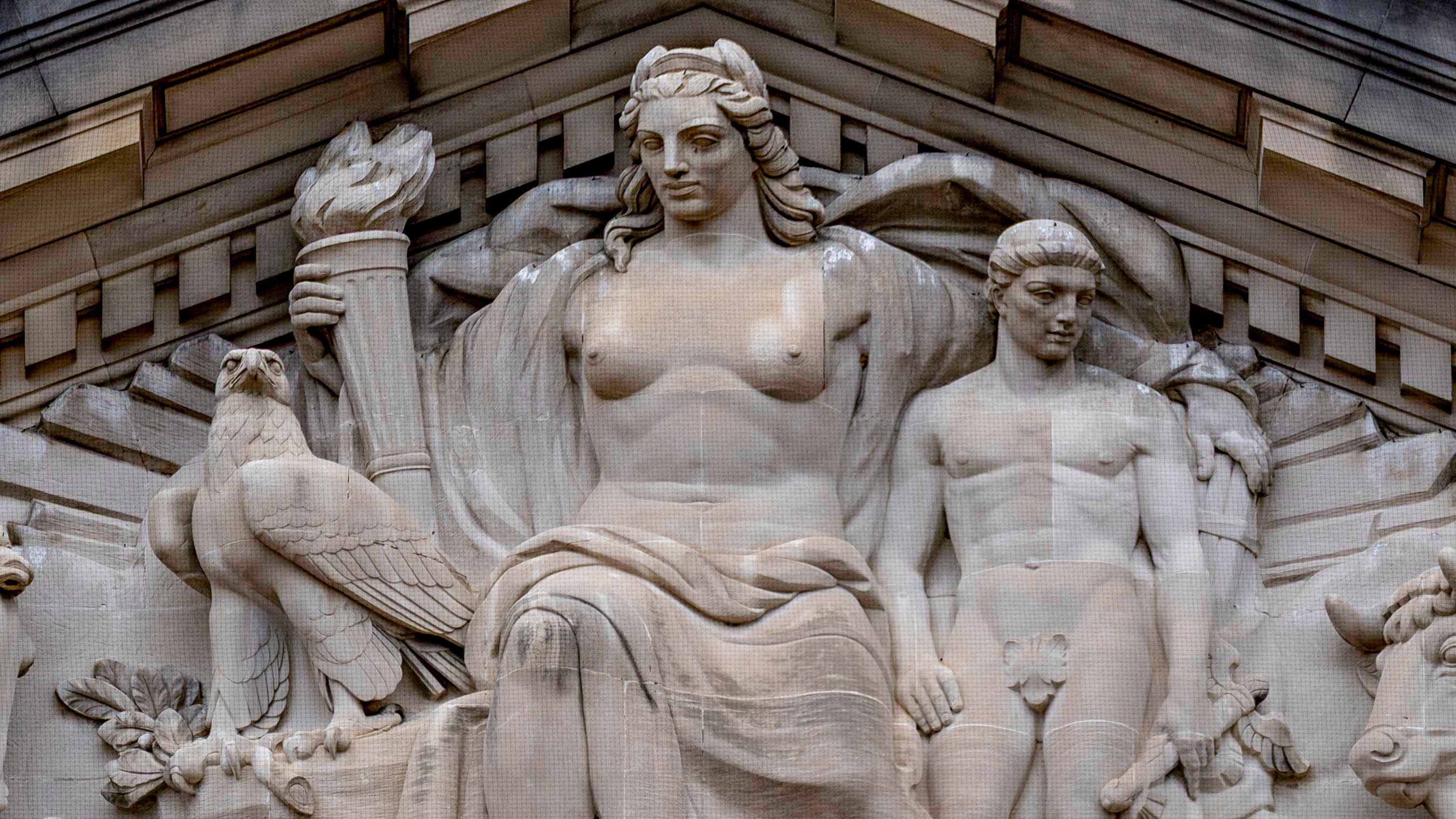
The pediment over the building where America drew its first peacetime draft numbers, where mothers' sons were selected for death, is crowned with a scene from the throne room of Zeus, down to an eagle and a naked boy. The National Archives’ official explanations reveal no clues, as the men who carved it never officially explained why. An investigation of classical sources may explain it for them.


Stand on Constitution Avenue at 13th Street and look up. You may have to crane your neck or cross the street, but above the six Doric columns of what is now the Andrew W. Mellon Auditorium — the government called it the Departmental Auditorium when FDR dedicated it on February 25, 1935 — a limestone pediment runs eighty-six and a half feet wide.1 At its apex sits a colossal hermaphroditic figure on a throne-like seat: bare-breasted, heavy-armed, a torch raised in one hand, stone rays fanning out behind the seat like a sunburst. At the central figure’s right hand stands an eagle. At the figure’s left hand stands a naked boy, and the enthroned figure’s arm rests on his shoulder. Off to the sides: on the left, a naked soldier on what appears to be a horse; on the right, a naked woman on a bull; reclining naked figures in the corners with books and tools.

The National Archive’s description calls the seated figure ‘Columbia,’ the eagle an ‘emblem’ of the United States, and the naked boy “national defense.” I’ve spent several years testing that description against three kinds of evidence: the stone itself, which I photographed on January 5, 2021; the paper trail the builders left, which turned out to be thinner and stranger than I expected; and the classical corpus — the original Greek and Latin sources for what the research has uncovered.

Words are Fungible, Limestone Not So Much
Every element on the pediment is described in a single line in a document that the architect’s office submitted to the Commission of Fine Arts on December 3, 1934, when Arthur Brown Jr. submitted photographs of the sculptor’s models. The commission’s complete minutes are available on the Web Archive — 448 meetings, 1910 to 1959 — and here is the entire official description of the central design, verbatim:
“Walter pediment. Connecting Wing. Representing Columbia flanked by elements, right national defence, left national resources. (Male and female figures to be about evenly divided in number)”2
Twenty-six words. That’s it.
It names no attribute, explains no form, and accounts for none of the choices a sculptor spent two years making. The sculptor was Edgar Walter of San Francisco, Beaux-Arts trained in Paris, and George Gurney’s Sculpture and the Federal Triangle — the standard history, built from the Treasury and commission archives — attempts to explain what Walter and Brown meant by it all:
“Neither the architect nor the sculptor apparently ever saw fit to elaborate on the interrelated symbolism of all the figures or the reasons for the choice of the subject matter for this pediment.”3
Gurney added that Brown “appears to have been content to leave the interpretation to the observer.” Your tax dollars at work.
One of the project’s own sculptors, Edmond Amateis, said the quiet part out loud: an allegorical figure “may represent almost anything depending on the point of view” — his example was a woman scattering seeds, who becomes Fecundity for a sociologist, Knowledge for an educator, and a farm girl for a farmer.4

Obfuscation is a feature, not a bug. The visual forms were planned — supposedly argued over for years, submitted, criticized, resubmitted, carved at colossal scale in Indiana limestone. It’s curious that an entire category of art has optional meaning, while its forms are fixed.

The explanation — “the figure is Columbia, an American goddess” — is flummery. Columbia means nothing. English periodical writers coined the name in the 1730s as a supposed poetic label for the colonies; Phillis Wheatley personified her in a 1775 poem to Washington.5 No cult, no myth, no iconography of her own. A made-up goddess has no parts to lend. Every carved element on that pediment is borrowed from well-documented pagan deities who have been well-represented for three thousand years — which means the figures have meaning.

The Meaning
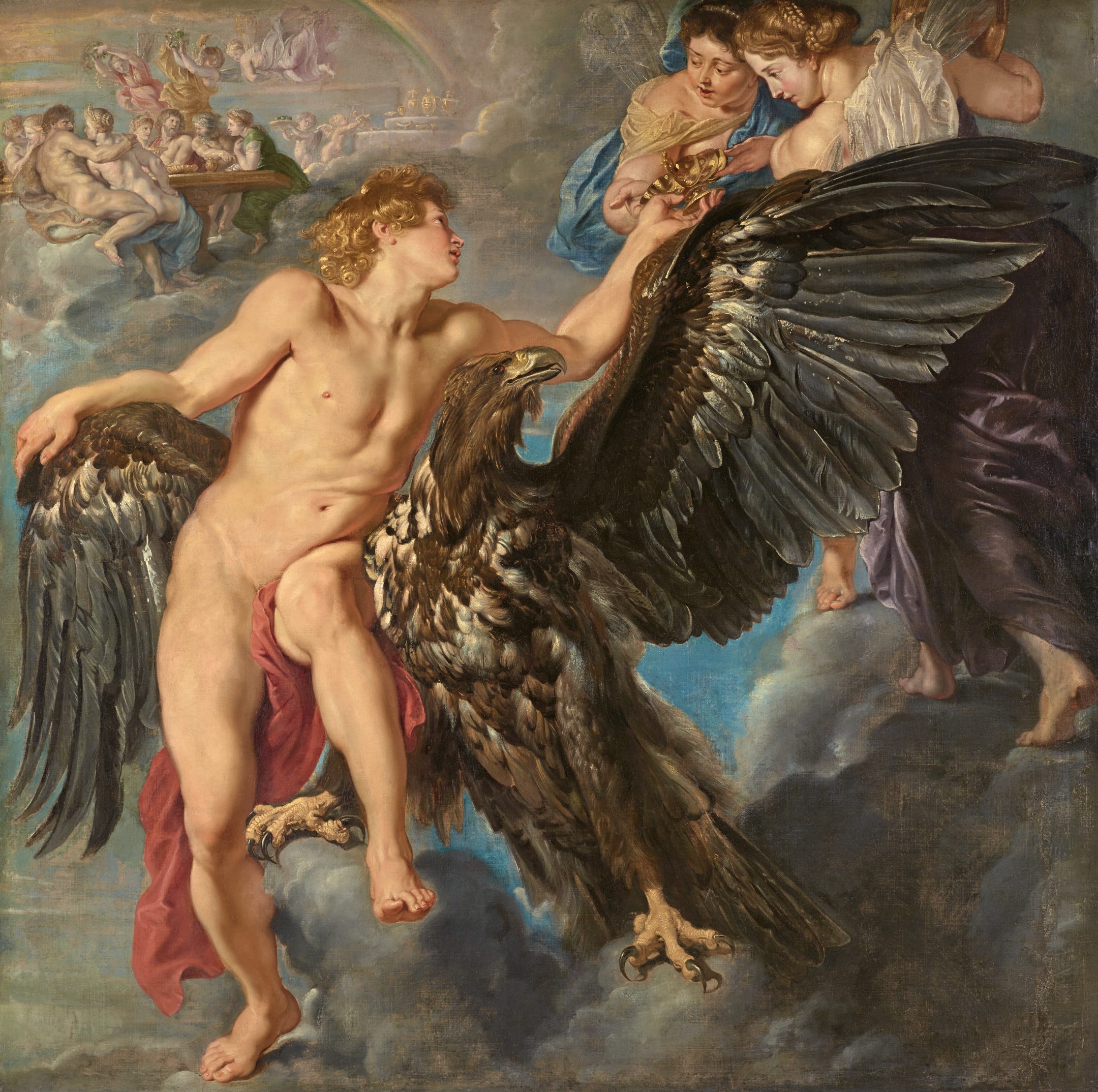
The throne arrangement. An enthroned figure with an eagle stationed at the right hand and a beautiful naked boy attendant at the left is not a generic composition. It is the arrangement — the schema of Zeus enthroned at Olympia — that Beaux-Arts instructors taught their students to draw from casts and copies of Greek and Roman examples for training. American sculptors adopted it openly and early: Horatio Greenough carved George Washington bare-chested on the Pheidian Zeus model in 1841, and Congress put it on display. Walter reproduced the schema, with the sovereign’s sexes adjusted and the scepter swapped for a torch.

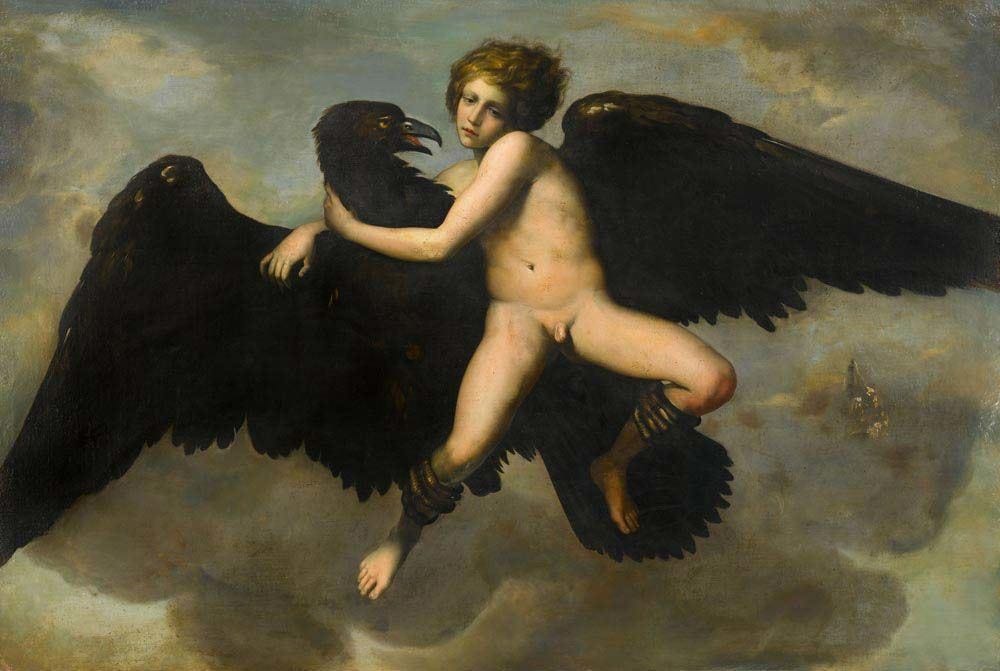
The eagle at the right hand. The witnesses are the Latin poets whose lines the classically schooled men of 1935 had studied. Vergil, describing the abduction of a Trojan boy. Ganymede, woven into a prize cloak:
“...and woven there, the royal boy on leafy Ida wearies the swift stags with javelin and running, eager, like one panting — whom the swooping weapon-bearer of Jupiter snatched aloft from Ida in his hooked talons.” (Aeneid 5.252–255)6
intextusque puer frondosa regius Ida / veloces iaculo cervos cursuque fatigat, / acer, anhelanti similis, quem praepes ab Ida / sublimem pedibus rapuit Iovis armiger uncis

Iovis armiger — Jupiter’s weapon-bearer. That is the eagle’s Latin title, conferred inside the Ganymede abduction itself. Horace gives the eagle its explanation:
“Like the winged minister of the thunderbolt, to whom Jupiter, king of the gods, granted kingship over the wandering birds, having proved him faithful in the matter of blond Ganymede...” (Odes 4.4.1–4)7
Qualem ministrum fulminis alitem, / cui rex deorum regnum in avis vagas / permisit expertus fidelem / Iuppiter in Ganymede flavo...
In Horace, the eagle earns its throne-side office by successfully abducting a boy. The abduction is the credential. That is the same eagle standing at the right hand of the enthroned figure on Constitution Avenue. The eagle represents the kidnapping of children for the pleasure of the boss.8

The youth at the left hand is the beloved attendant — the position of Ganymede at the throne of Zeus, the ‘cupbearer’ taken “for his beauty’s sake,” as Homer puts it. And he holds something. For decades the recycled description read “sword”; the stone says otherwise, and so does the archive. Gurney, from the builders’ own records: Columbia’s “left arm rests on the shoulder of a standing nude (with fig leaf) youth who carries a rod with attached wings in his hand to imply that he is the herald of future generations.”9

A winged rod is a herald’s wand — the kerykeion, the staff of Hermes.

Homer tells us what that wand does. When Hermes sets out in Iliad 24, he takes up “his wand by which he charms the eyes of men, of those whom he chooses, and then he rouses others from their sleep.”10 The instrument that closes men’s eyes and chooses whom to wake, in the hand of a naked youth under the nation’s arm, labeled — by the gubmint’s explanation — “national defence.”

The torch, the rays, the flanks. The torch is the Liberty kit; the sunburst behind a throne is among the oldest divinizing devices in ruler-imagery, from Sol Invictus to the Great Seal’s glory. On the flanks: a nude soldier with shield and quiver on a horse, and a naked woman with a wheat sheaf riding on the back of a bull.
What Ganymede Meant — Let the Ancients Testify
What have we got? A sovereign enthroned between the abduction-credentialed eagle and a handsome naked youth in the beloved’s position, holding the eye-charming wand. The question the title asks turns on what the Ganymede material meant to the civilization that produced it. We do not have to guess. The sources say it flatly, and every line below is quoted from the critical editions.

Homer, the oldest witness, Iliad 20.230–235: Ganymede “became the most beautiful of mortal men. And the gods snatched him up to pour wine for Zeus, for his beauty’s sake.”11 The verb is ἀνηρείψαντο — snatched away. His father Tros, in the Homeric Hymn to Aphrodite, is left grieving because “he knew not whither the heaven-sent whirlwind had caught up his dear son.”12 Zeus pays the father off — with horses, “compensation for Ganymede” (Iliad 5.266). A boy seized for his beauty; a father paid off; the seizure remembered as grief. The oldest stratum of the myth is a kidnapping narrative with restitution.
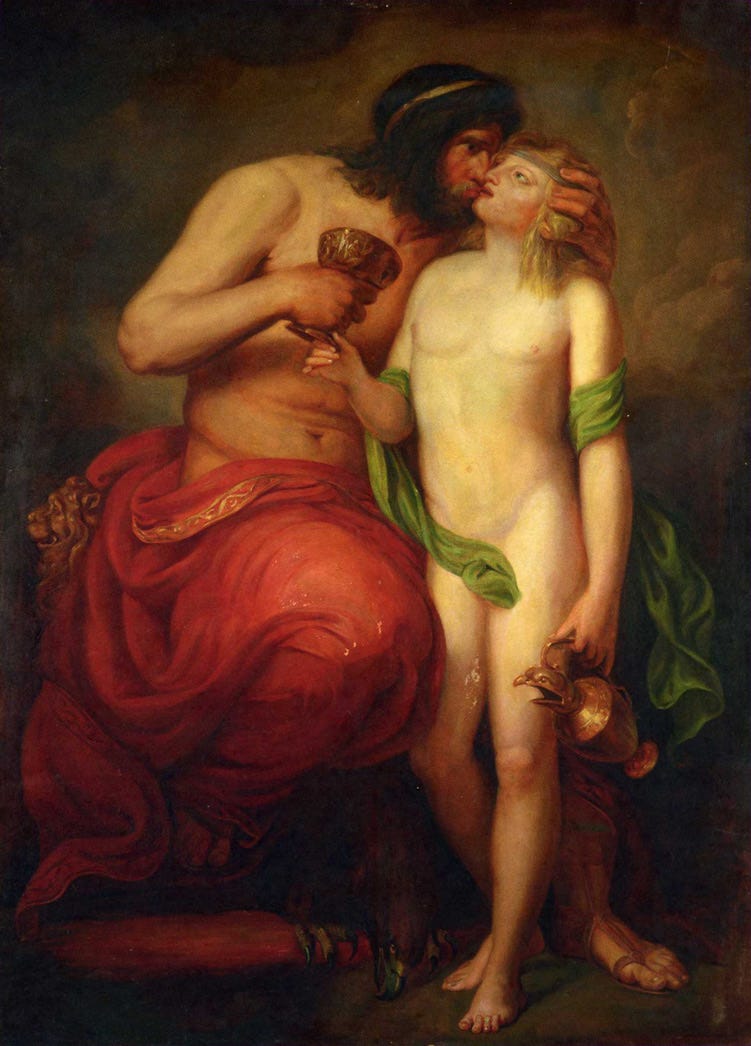
Now the Greeks’ own analysis of what the myth was for. Plato, Laws 636c — Athenian speaker to a Cretan, and I preserve his bluntness:
“We all accuse the Cretans of inventing the myth of Ganymede: they were so convinced that their laws came from Zeus that they attached this myth to him, so that they might harvest the fruits of this pleasure and say they were following the god’s example.”13
πάντες δὲ δὴ Κρητῶν τὸν περὶ Γανυμήδη μῦθον κατηγοροῦμεν ὡς λογοποιησάντων τούτων· ἐπειδὴ παρὰ Διὸς αὐτοῖς οἱ νόμοι πεπιστευμένοι ἦσαν γεγονέναι, τοῦτον τὸν μῦθον προστεθηκέναι κατὰ τοῦ Διός, ἵνα ἑπόμενοι δὴ τῷ θεῷ καρπῶνται καὶ ταύτην τὴν ἡδονήν.
That is a fourth-century-BCE philosopher stating that the Ganymede myth was manufactured as legal cover for institutionalized pederasty. Not my thesis — Plato’s accusation. Aristotle supplies the policy memo. Politics 1272a, on the Cretan lawgiver:
the lawgiver, “so that the women might not bear many children, instituted intercourse with the males.”14
ἵνα μὴ πολυτεκνῶσι, τὴν πρὸς τοὺς ἄρρενας ποιήσας ὁμιλίαν
Population control, by statute, and the institution had a liturgy. Ephorus of Cyme, preserved in Strabo’s Geography, describes the Cretan rite in procedural detail: a man of rank gave the boy’s family advance notice, then seized the boy off a prearranged street while the relatives staged a ritual pursuit; he kept the boy two months; and he released him with legally established gifts — military gear, an ox to be sacrificed to Zeus, and a drinking cup.15 The seized boy came home carrying the cupbearer’s own attribute, and the community called him kleinós — celebrated. On Crete, they said it was Minos, not Zeus, who took Ganymede — the abduction ascribed to the human king whose law the rite enacted. Myth, statute, and ceremony formed one machine, and the machine’s product was a sanctioned kidnapping.

The Romans inherited all of it and coarsened it. Ganymede’s Latin name, Catamitus, survives in English as catamite — the word itself is the myth’s residue in law and insult.16
Ganymede has been a popular subject for centuries. In As You Like It, Rosalind disguises herself as a boy and picks the alias herself: “I’ll have no worse a name than Jove’s own page, / And therefore look you call me Ganymede.”17 John Aubrey wrote of Francis Bacon, Lord Chancellor of England: “He was a παιδεραστής [a pederast]. His Ganimeds and favourites tooke bribes; but his lordship alwayes gave judgement secundum aequum et bonum [according to what is fair and good].”18 Simonds D’Ewes charged Bacon in language his 1845 editor refused to print; the editor cut the sentence and confessed the cut in a footnote: “language too gross for publication.”19 And in Giordano Bruno’s Expulsion of the Triumphant Beast (1584), a petitioner fears his message to Jove will be turned back at the chamber door by “some Venus or Cupid or Ganymede” — the kept boy as doorkeeper to the sovereign.20

Ovid fixed the eagle-abduction as the canonical image: Jupiter “deigned to change into no other bird than the one that can bear his thunderbolts” and snatched the Trojan boy.21 And when seventeenth-century astronomers needed names for the four moons Galileo found circling Jupiter, Kepler’s suggestion, published by Simon Marius, was programmatic: Io, Europa, Ganymede, Callisto — a matched set of the god’s takings, three women and a boy, orbiting their taker forever.22 Europa: the girl carried over the sea on the back of a bull.

The Rape of Europa
The Europa story, as Ovid tells it: Jupiter saw the Tyrian king’s daughter gathering flowers by the shore, set down the weight of his scepter, and became a bull — snow-white, mild-eyed, so tame that the girl garlanded his horns and climbed onto his back. Then the bull walked into the surf and swam, and Europa, trembling, looked back at the receding shore with one hand gripping a horn. He landed her on Crete and took her there. The poets did not soften it. Ovid’s Arachne weaves the scene into her tapestry of the gods’ crimes — caelestia crimina, his phrase — a bull you would take for real over waves you would take for real; and the Latin tradition’s word for the act is raptus: seizure, rape. Herodotus opens his entire Histories with men seizing women back and forth across the Aegean — Io, Europa, Medea, Helen — and in his rationalized telling, the men who stole Europa from Tyre were Cretans.23 Either way she lands on Crete. And from that union, the genealogists record, came Minos — the same Minos to whom the Cretans ascribed the abduction of Ganymede, the same king Aristotle names as the framer of Cretan law. One island, one royal house. The bull carries in the girl; the girl’s son carries off the boy; and under the law Aristotle records, the Cretans made the taking a custom. Her name outlived the act. The continent is named for the stolen bride.

Which returns us to the pediment’s right flank, where a woman rides on the back of a bull.
Under a Zeus-schema center, with the abduction-credentialed eagle at the throne and a naked youth in Ganymede’s slot, the sculptor put a naked woman on a bull. Every viewer raised on the classics — which in 1935 meant most educated elite viewers — walked past a pediment whose parts rhymed with the two most famous violent sexual abductions in the pagan canon: the boy Zeus took as an eagle, the girl Zeus took as a bull. The riddle is in the limestone.
The Silence, on the Record
The men who built this thing were asked, in effect, and declined. Brown wrote to his own associate that he had “been studying the form and scale of these pediments for nearly three years.”24 Three years on form and scale — and then, per Gurney, from the complete archive: no elaboration of the symbolism, ever, from either architect or sculptor; interpretation left “to the observer.” The Commission of Fine Arts, for its part, reviewed the models in December 1934 and found the compositions understudied and the figures too large; a commissioner’s letter that February still complained that there was “no photograph of the large central pediment.”25 Nobody in the record asks what the youth’s wand is. Nobody says Ganymede. Nobody says anything.

Beaux-Arts men treated iconography as a craftsman’s vocabulary too obvious to gloss, and Gurney’s chapters show the same professional silence across the whole Triangle. But whatever their motive, the silent men left us the forms. And the thought-terminating defense that usually steps in front of subversive art — “it’s allegory, not idolatry; the figures merely represent...” — deserves one hard look. It is, nearly verbatim, the defense the last pagans gave for their cult statues: we do not worship the stone; the image signifies the divine to those who can read it. The Christian answer, from the men who tore the temples down, was that a form trains the eye, whatever the experts say. You do not have to pick a side in that 3,000-year-old war to see what is at the top of the building.

The Temple Beneath
The ‘decorations’ on the buildings mean what their creators intended. So the last body of evidence is what the government did in the room under the carving. The hall’s documented history, from its own record:26
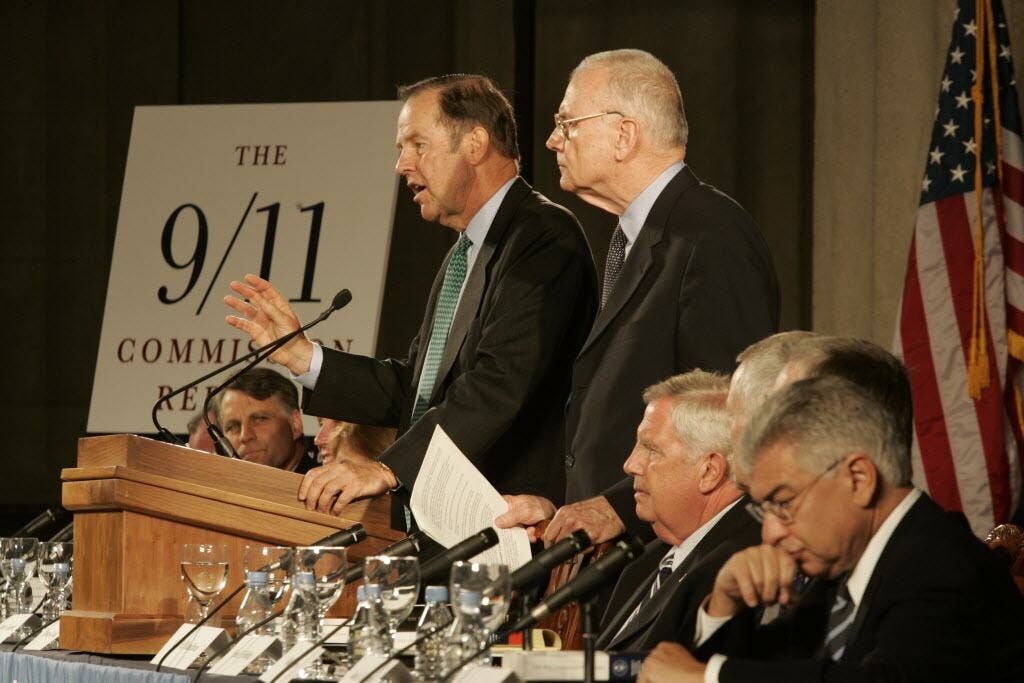
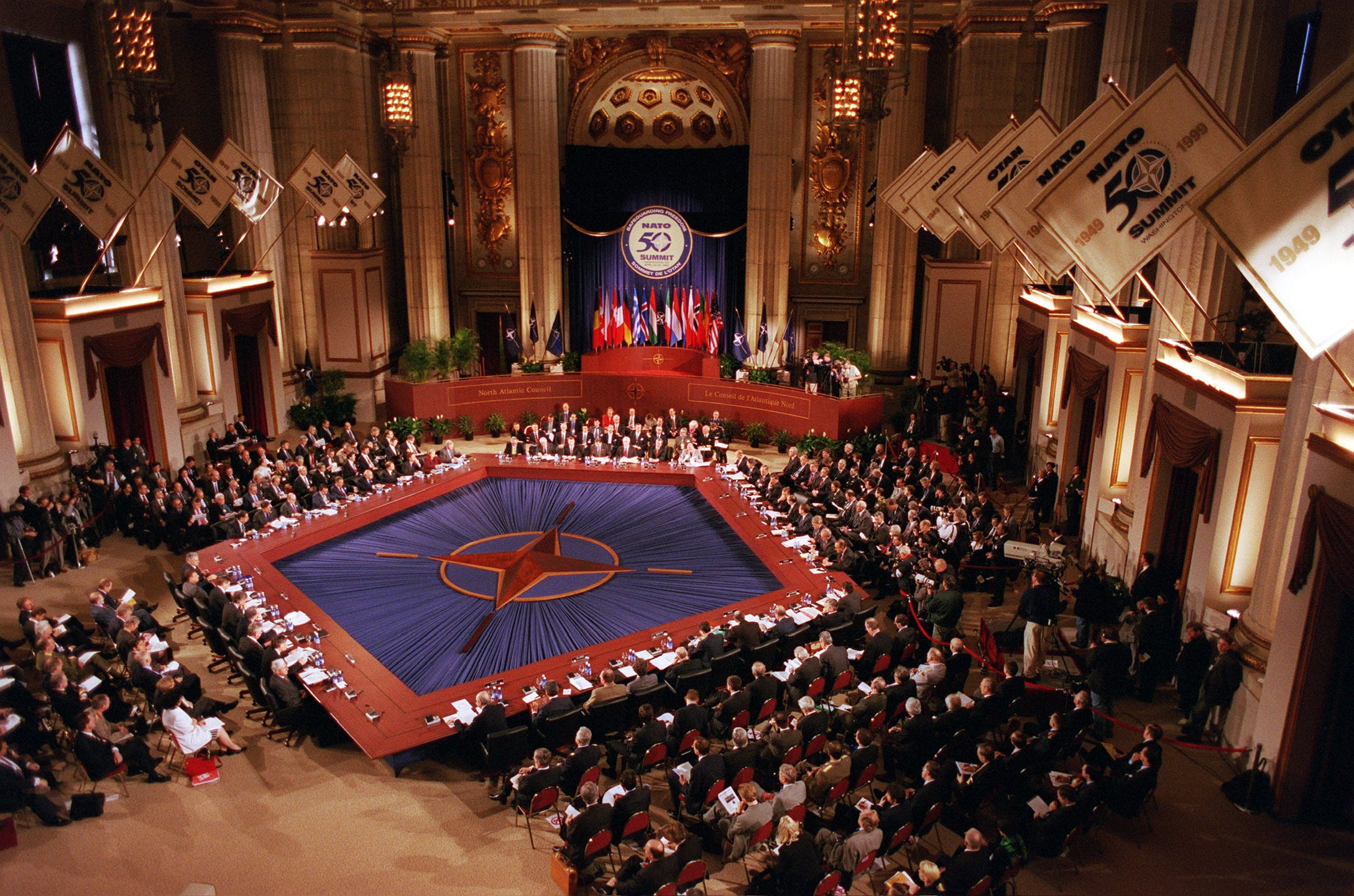
Its first event was its dedication, February 25, 1935 — with the pediment above still uncarved; Walter’s design wasn’t cut until 1936, and he signed the corner EDGAR WALTER SC. 1936 and was dead within two years. In 1940, Franklin Roosevelt stood on its stage and announced the re-institution of conscription, the draft. On October 29, 1940, Secretary of War Stimson, blindfolded, drew the first number of the first peacetime draft lottery in American history — in this hall. The mothers’ sons of 1941–45 were summoned, by lot, beneath a hermaphroditic ‘mother’-figure of the nation resting her arm on a nude youth the record calls the herald of future generations. On April 4, 1949, the North Atlantic Treaty was signed in the same room, creating NATO, under the same herald, and the sons of the next seventy years of alliance warfare were committed there in principle. NAFTA, 1994. The 9/11 Commission report, 2004. When the state stages the solemn committal of its young, it books this temple.

The state, given any hall in the capital, repeatedly chooses this one for exactly the acts the pediment’s oldest sources describe: the sovereign taking the young, with compensation paid in honor and ceremony to the households that surrendered them. A whirlwind the fathers could not trace; horses for Tros; a flag for the mother.

Verdict
So, did the federal government build a temple dedicated to kidnapping, rape, and pederasty in the 1930s?
Here is the evidence:
The government built its ceremonial hall in the visual language of the Olympian throne room, using the arrangement of Zeus, the eagle Jupiter made king of the birds for kidnapping a boy for his bed, a youth stationed in the abducted boy’s position holding the wand that charms men’s eyes, and flank imagery that rhymes — at the level of parts — with the canon’s two great abductions.
The myth-complex to which those stories belonged was, on the ancient record’s own testimony, a charter for sanctioned abduction and pederasty. Plato says the Cretans invented it as cover. Aristotle says the lawgiver institutionalized the practice. Ephorus describes the state-regulated kidnapping rite, down to the cup in the boy’s going-home gifts. “Dedicated to kidnapping, rape, and pederasty” comes close to paraphrasing what the classical sources say the Ganymede-Europa material was for — no forcing required.
The record contains no explanation beyond twenty-six words, no statement from Walter, no letter from Brown explaining a single form. Your tax dollars at work.
What do you think it means?
Two archive boxes could still move this verdict. The Arthur Brown Jr. Papers at Berkeley’s Bancroft Library (BANC MSS 81/142 c) hold the original photographs of Walter’s models and Brown’s correspondence with his Washington office — the place a fuller program would survive if it exists. And the Commission of Fine Arts’ project files in the National Archives hold the exhibits its minutes reference. The call numbers are right there, and if any reader wants to pull them, you have my full support — publish what you find, whichever way it cuts.
The stones, meanwhile, say what they have said since 1936. Above the door where America drew its sons’ numbers: a sovereign on Zeus’s throne, a bird that earned its post by taking a boy, and a beautiful youth under the sovereign’s hand, holding the wand that closes men’s eyes.
I wonder what goes on in the basement of that building?

Afterward: Naked Warrior and the King of the City
On the left side of the pediment is a naked warrior on horseback, and Mrs. Heritage History hypothesizes a connection to the logo of the Council on Foreign Relations’ magazine. The logo’s paper trail is short, and we have it from the editor himself. In 1922, Hamilton Fish Armstrong and editor Archibald Cary Coolidge wanted a permanent cover for Foreign Affairs; they had settled from the start on no illustrations or pictures, and Armstrong asked his sisters for sketches — “Margaret being particularly good at lettering, Helen at figures.” Margaret advised that “a colophon be the only ornamentation,” and her first proposal for it was the Pillars of Hercules — “the gateway between the eastern and western hemispheres,” the pillars the scholarship traces to the Tyrian god’s temples in the far west — with the old-form motto “Plus Oultre.” The editors passed on it, and on a Galileo device and a “Veritas: Lux” globe, and took the fourth sketch: “a horseman, with the motto ‘Ubique.’” Armstrong names no archetype for the horseman and no source for the motto, and the cover, he writes, “has remained unchanged ever since.” Ubique — “everywhere” — is also the motto of the Royal Artillery, granted by William IV in 1832 in place of all battle honours; whether the sisters took it from the gunners or from the dictionary, the memoir does not say.27

Melqart is Phoenician for “king of the city” — mlk, king, plus qrt, city. The city was Tyre. Greek writers called him the Tyrian Hercules; artists gave him the lion’s skin; Tyre’s shekels show him riding a hippocamp. “Baal” (bʿl, “lord, master”) belongs to the same language — both words are Phoenician, and baʿal is common to Hebrew and the other Canaanite tongues, which is why Kings uses the same word Tyre did. But within that language the two words come from two different word-families. Semitic speakers built their vocabulary on roots: sets of consonants, usually three, visible in every word of the family. From m-l-k (”rule”) come melek, “king,” and Melqart. From b-ʿ-l (”own, be master of”) come baʿal, “lord,” and the name of Jezebel’s own father — Ethbaal, with baal visible inside it. The two roots share no consonants; no “baal” appears anywhere in “Melqart,” just as no “lord” appears in “king.” But the Tyrians used “Baal” as Melqart’s title. In the 2nd century BCE, two brothers from Tyre dedicated a pair of marble pillars in Malta — the Cippi of Melqart (KAI 47). Their Phoenician dedication opens: lʾdnn lmlqrt bʿl ṣr — “To our lord Melqart, Baal of Tyre.” Their Greek version of the same dedication reads Ἡρακλεῖ ἀρχηγέτει — “to Heracles the founder.”28 Two limits on what the pillars prove. First and Second Kings call Ahab’s god by the bare title “Baal” throughout the Ahab-to-Jehu narrative (1 Kings 16:31 through 2 Kings 10:28) — a title applied to many gods. The brothers carved their dedication in the 2nd century BCE, roughly seven hundred years after Ahab, and their four lines thank the god for hearing their voice. The pillars prove the title Baal is conferred on Melqart. The identification of Ahab’s Baal as Melqart remains an inference, and the inference stands on three documented facts: Jezebel married in from the royal house of Tyre and Sidon — Kings calls her father king of the Sidonians, Menander lists him among Tyre’s kings; that father, Ethbaal, held Astarte’s priesthood at Tyre before he took the throne; and Tyrians addressed Melqart as “Baal of Tyre” on the Malta pillars. All three facts concern Tyre. The texts provide many clues, except for the god’s personal name; scholars supply it by inference.

In the biblical record, Ahab “took to wife Jezebel daughter of Ethbaal king of the Sidonians, and went and served Baal” (1 Kings 16:31).29 Josephus, quoting the Tyrian court historian Menander of Ephesus, identifies Ethbaal: “the priest of Astarte,” who killed his predecessor and took the throne of Tyre.30 The verse orders the events: the marriage, then the service of Baal. The record states the father’s priesthood and the daughter’s marriage.

In the Tyrian record, Menander, again through Josephus, reports of King Hiram of Tyre — Solomon’s contemporary in the standard synchronism — that he “pulled down the ancient temples and built the temple of Hercules and of Astarte, and first made the awakening (egersis) of Hercules in the month Peritius.”31 Menander’s king-list places Hiram in the tenth century BCE and Ethbaal, Jezebel’s father, roughly a century later. So the sequence on Tyre’s side: Hiram builds the temple of Hercules and Astarte and establishes the yearly waking of the god; a century later Jezebel marries Ahab, and Ahab serves Baal (1 Kings 16:31); within Ahab’s reign Elijah confronts Baal’s prophets on Carmel (1 Kings 18). By the time Elijah spoke, the Tyrians had woken their god once a year for roughly a hundred years.

Elijah's words. "Cry aloud: for he is a god; either he is talking, or he is pursuing, or he is in a journey, or peradventure [perhaps] he sleepeth, and must be awaked" (1 Kings 18:27).32 In the Greek Bible the final verb is ἐξαναστήσεται — "he will rise." If Ahab's Baal is the Tyrian god, the sleep-and-waking clause corresponds to a rite documented a century earlier: the egersis. The journey clause is the one commentators — Roland de Vaux first, in 1941 — assigned to the god's traveling cult.33
The drought. Josephus states that Menander’s annals record a rainless season (ἀνομβρία) in the years when Ithobalos reigned at Tyre, and dates it to Ahab.34 1 Kings 17–18 describes a drought under the same kings. Two records, one drought.
The end in Israel; the continuation at Tyre. “And Jehu made Baal vanish out of Israel” (2 Kings 10:28) — ἠφάνισεν, made unseen.35 At Tyre, the cult continued. Herodotus visited the temple in the fifth century BCE and describes two pillars, one of gold, one of emerald “shining by night”; the priests dated the temple’s founding with the city’s, 2,300 years before his visit.36 In about 174 BCE the high priest Jason sent three hundred silver drachmas from Jerusalem “for the sacrifice of Hercules” at Tyre; 2 Maccabees adds that the envoys carrying the money asked that it not be used for the sacrifice.37
The limit of the identification. The Bible states “Baal,” never “Melqart.” The identification rests on the Tyrian ancestry of Jezebel and on Tyre’s documented cult; some scholars argue for a different Baal. The name is inferred; the geography is documented.
Europa. Herodotus, in the opening chapters of the Histories, reports the Phoenician account: Greek raiders — “these would be Cretans” — landed at Tyre and seized the king’s daughter, Europa.38 The woman on the bull on this pediment’s right flank comes from an abduction story set at Tyre, Melqart’s city, carried out in Herodotus’s account by Cretans — the countrymen of Minos, the lawgiver in Aristotle’s statute and the abductor in the Cretan Ganymede variant. If the naked warrior is Melqart, both flank scenes trace to Phœnician Tyre. If the naked warrior is not Melqart, the Europa scene still traces there.

Open Items
My photograph shows the mount’s tail — a sigmoid curve. The question is what kind of tail: a horse’s fall of hair or a hippocamp’s fish coil? The carved stone, photographed from any angle, leaves that open. The decider is the sculptor’s own work at an earlier stage: the Arthur Brown Jr. Papers at Berkeley’s Bancroft Library (BANC MSS 81/142 c) hold photographs of Edgar Walter’s models for this pediment — the tail and the rider’s headdress before Ardolino’s carvers simplified anything — and Brown’s correspondence with his Washington office, the place a fuller program would survive, if one exists.
The government’s files. The Commission of Fine Arts project files in the National Archives (Record Group 66) hold the exhibits its minutes reference; the Public Buildings Service records (Record Group 121) hold the contracts and correspondence for the Federal Triangle sculpture program. Anything in either group that names the naked warrior settles the question this afterword leaves open.
The other rider. Armstrong's memoir settles who made the logo and leaves the horseman unnamed. If a name or a source for the figure exists, the places it might survive: Harold Pratt House, Chatham House, the Margaret Armstrong papers in the Miriam Irwin Collection, University of Cincinnati; the Council on Foreign Relations records at Princeton’s Mudd Library.
The official gubmint-published description of the pediment is twenty-six words.

In any case, Rhodes Roundtable associate Rudyard Kipling wrote a poem about Ubique that we can all ponder on.
There is a word you often see, pronounce it as you may “You bike,” “you bykwee,” “ubbikwe “—alludin’ to R.A. It serves ’Orse, Field, an’ Garrison as motto for a crest, An’ when you’ve found out all it means I’ll tell you ’alf the rest.
Ubique means the long-range Krupp be’ind the low-range ’ill— Ubique means you’ll pick it up an’, while you do, stand still. Ubique means you’ve caught the flash an’ timed it by the sound. Ubique means five gunners’ ’ash before you’ve loosed a round.
Ubique means Blue Fuse an’ make the ’ole to sink the trail. Ubique means stand up an’ take the Mauser’s ’alf-mile ’ail. Ubique means the crazy team not God nor man can ’old. Ubique means that ’orse’s scream which turns your innards cold!
Ubique means “Bank, ’Olborn, Bank—a penny all the way— The soothin’, jingle-bump-an’-clank from day to peaceful day. Ubique means “They’ve caught De Wet, an’ now we shan’t be long.” Ubique means “I much regret, the beggar’s goin’ strong!”
Ubique means the tearin’ drift where, breech-blocks jammed with mud, The khaki muzzles duck an’ lift across the khaki flood. Ubique means the dancing plain that changes rocks to Boers. Ubique means the mirage again an’ shellin’ all outdoors.
Ubique means “Entrain at once for Grootdefeatfontein”! Ubique means “Off-load your guns”—at midnight in the rain! Ubique means “More mounted men. Return all guns to store.” Ubique means the R. A. M. R. Infantillery Corps!
Ubique means that warnin’ grunt the perished linesman knows, When o’er ’is strung an’ sufferin’ front the shrapnel sprays ’is foes; An’ as their firin’ dies away the ’usky whisper runs From lips that ’ave n’t drunk all day: “The Guns! Thank Gawd, the Guns!”
Extreme, depressed, point-blank or short, end-first or any’ow, From Colesberg Kop to Quagga’s Poort—from Ninety-Nine till now— By what I’ve ’eard the others tell an’ I in spots ’ave seen, There’s nothin’ this side ’Eaven or ’Ell Ubique doesn’t mean!39
Bibliography
Ancient sources
Aristotle. Politics. Book 2, ch. 10 (1272a, Bekker pagination).
Apollodorus. Library. Book 3, ch. 1.
Herodotus. Histories. Book 1, ch. 2; Book 2, ch. 44 (the temple of Herakles at Tyre).
Homer. Iliad. Books 5, 20, and 24.
Homeric Hymn to Aphrodite (Hymn 5), lines 202–217. Translated by Hugh G. Evelyn-White. Loeb Classical Library. Cambridge, Mass.: Harvard University Press, 1914.
Horace. Carmina (Odes). Book 3, ode 27; Book 4, ode 4. Perseus Digital Library critical text (phi0893.phi001.perseus-lat2).
Josephus. Jewish Antiquities, Book 8, §§146, 324; Against Apion, Book 1, §§118–123. Both preserving Menander of Ephesus on the kings of Tyre.
Moschus. Europa.
Ovid. Metamorphoses. Book 2, lines 833–875; Book 6, lines 103–107; Book 10, lines 155–161.
Plato. Laws, Book 1, 636c–d; Phaedrus, 255c.
Plautus. Menaechmi, Act 1, scene 2.
Plutarch. De liberis educandis (On the Education of Children), 11F.
Septuagint. 3 Kingdoms (1 Kings) 16:31 and 18:27; 4 Kingdoms (2 Kings) 10:28; 2 Maccabees 4:18–20.
Strabo. Geography. Book 10, ch. 4, §§20–21 (Casaubon 483), preserving Ephorus of Cyme.
Vergil. Aeneid. Book 5, lines 250–257. Perseus Digital Library critical text (phi0690.phi003.perseus-lat2).
Early modern sources
Aubrey, John. ‘Brief Lives,’ chiefly of Contemporaries. Edited by Andrew Clark. 2 vols. Oxford: Clarendon Press, 1898. Vol. 1 (Francis Bacon).
Bruno, Giordano. The Expulsion of the Triumphant Beast (1584). Translated by Arthur D. Imerti. New Brunswick: Rutgers University Press, 1964.
D’Ewes, Sir Simonds. The Autobiography and Correspondence of Sir Simonds D’Ewes, Bart. Edited by James Orchard Halliwell. 2 vols. London: Richard Bentley, 1845. Vol. 1. The unexpurgated passage: British Library, Harley MS 646.
Shakespeare, William. As You Like It, Act 1, scene 3.
Archival and documentary sources
Cippi of Melqart. Bilingual Phoenician–Greek votive inscription, Malta, 2nd century BCE. KAI 47 = CIS I, 122/122 bis. Louvre, Paris, and National Museum of Archaeology, Malta.
Minutes of the U.S. Commission of Fine Arts. Meetings of December 3, 1934, and February 23, 1935. Digitized collection, U.S. Commission of Fine Arts records, via the Internet Archive.
Marius, Simon. Mundus Iovialis. Nuremberg, 1614.
New York Times. “Stimson Will Draw First Number in Draft Lottery at Noon Oct. 29,” October 22, 1940. “Dedication for Peace,” April 5, 1949.
Wheatley, Phillis. “To His Excellency George Washington.” 1775.
White House photo gallery. “President Donald Trump delivers remarks at the White House AI Summit at Andrew W. Mellon Auditorium,” July 23, 2025.
Modern scholarship and reference
Armstrong, Hamilton Fish. Peace and Counterpeace: From Wilson to Hitler. New York: Harper & Row, 1971. Chapter “The Making of Foreign Affairs,” 186–88.
de Vaux, Roland. “Les prophètes de Baal sur le Mont Carmel.” Bulletin du Musée de Beyrouth 5 (1941): 7–20.
Gurney, George. Sculpture and the Federal Triangle. Washington, D.C.: Smithsonian Institution Press, 1985.
Hamer, Mary, and Roger Ayers. “Ubique.” The Kipling Society Readers’ Guide, 2008.
Kagmatche, Samuel. “The God of Mount Carmel.” PhD diss., South African Theological Seminary, 2016.
Kipling, Rudyard. “Ubique.” In The Five Nations. London: Methuen, 1903.
Lima, Rodrigo Araújo de. “Herakles/Melqart: The Greek Façade of a Phoenician Deity.” Hélade 5, no. 2 (2019).
Oxford English Dictionary, s.v. “catamite.”
Rendsburg, Gary A. “The Mock of Baal in 1 Kings 18:27.” Catholic Biblical Quarterly 50 (1988): 414–17.
“Andrew W. Mellon Auditorium.” Wikipedia, with primary citations for the hall’s event history.
Thanks to the generosity of my readers, all my articles are available for free access. Independent journalism, however, requires time and investment. If you found value in this article or any others, please consider sharing or even becoming a paid subscriber, who benefits by joining the conversation in the comments. I want you to know that your support is always gratefully received and will never be forgotten. Please buy me a coffee or as many as you wish.

The Duke Report - Where to Start
My articles on SubStack are all free to read/listen to. If you load the Substack app on your phone, Substack will read the articles to you. (Convenient if you are driving).
Foundational Articles
Podcast (Audio & Video Content)
Palmerston’s Zoo Episode 01 - Solving the Paradox of Current World History (9 Episodes)
Oligarchic Control from the Renaissance to the Information Age
SoundCloud Book Podcasts
I’ve taken almost 200 foundational books for understanding how the world really works and posted them as audio podcasts on SoundCloud. If you load the app on your phone, you can listen to the AI robots discuss the books on your journeys across America.
Duke Report Books
Over 600 foundational books by journalists and academics that never made the New York Times Bestseller list, but somehow tell a history we never learned in school. LINK

Dimensions and construction: George Gurney, Sculpture and the Federal Triangle (Smithsonian Institution Press, 1985), Labor–ICC chapter and sculpture key: Columbia, by Edgar Walter (1877–1938), limestone, approx. 18′9″ × 86′6″, carved by the Edward Ardolino company, signed EDGAR WALTER SC. 1936. Dedication: February 25, 1935, the hall’s first event.
Minutes of the Commission of Fine Arts, meeting of December 3, 1934, item 4, "Pediment for the Department of Labor and I.C.C. Building" — Arthur Brown Jr.'s office (Fred Kramer) submitting model photographs with one-line programs for all five pediments. Complete digitized minutes: archive.org, U.S. Commission of Fine Arts collection.
Gurney, Sculpture and the Federal Triangle, p. 275 (executed description and the “never saw fit to elaborate” verdict, with his n. 50 citing the underlying Treasury and commission documents), pp. 273–74 (design history, figs. 175–176).
Amateis, quoted in Gurney, p. 275.
"Columbia" as 18th-century coinage from Columbus, personified by Phillis Wheatley, "To His Excellency George Washington" (1775).
Vergil, Aeneid 5.250–257, Perseus Digital Library critical text (phi0690.phi003.perseus-lat2). Translation mine.
Horace, Carmina 4.4.1–4, Perseus Digital Library critical text (phi0893.phi001.perseus-lat2). Translation mine.
Horace, Odes 4.4.1–4: “Like the winged bearer of the thunderbolt, to whom Jupiter, king of the gods, granted kingship over the wandering birds, having proved him faithful in the affair of golden-haired Ganymede” (”Qualem ministrum fulminis alitem, cui rex deorum regnum in avis vagas permisit expertus fidelem Iuppiter in Ganymede flavo”). Horace opens the ode with the eagle’s royal appointment and, in the same sentence, the service that proved him: the Ganymede abduction.
Gurney, Sculpture and the Federal Triangle, p. 275.
Homer, Iliad 24.343–345.
Homer, Iliad 20.230–235: κάλλεος εἵνεκα, “for his beauty’s sake”; the abductors plural (”the gods”), the eagle absent — Leochares (c. 340 BCE) and the Latin poets brought the eagle into the tradition.
Homeric Hymn to Aphrodite (Hymn 5), 202–217, trans. Evelyn-White.
Plato, Laws 1.636c–d. Cf. Phaedrus 255c.
Aristotle, Politics 2.10, 1272a (Bekker).
Ephorus of Cyme, in Strabo, Geography 10.4.20–21 (Casaubon 483): ἀφίεται δ’ ὁ παῖς δῶρα λαβὼν στολὴν πολεμικὴν καὶ βοῦν καὶ ποτήριον· ταῦτα μὲν τὰ κατὰ τὸν νόμον δῶρα — “the boy is released with gifts: a war-dress, an ox, and a drinking-cup; these are the gifts according to the law.” Cf. Plutarch, De liberis educandis 11F; Plato, Laws 636 and 836; the honorific κλεινός.
Plautus, Menaechmi 1.2.34; Latin Catamitus via Etruscan Catmite; OED s.v. “catamite.”
Shakespeare, As You Like It, 1.3.
John Aubrey, ‘Brief Lives,’ ed. Andrew Clark (Oxford: Clarendon Press, 1898), 1:71. Clark’s marginal apparatus sources the report to Anthony Weldon’s Court of King James. A contemporary accusation, recorded as such — Aubrey defends Bacon’s judicial record in the same sentence.
The Autobiography and Correspondence of Sir Simonds D’Ewes, ed. James Orchard Halliwell (London: Richard Bentley, 1845), 1:191–92, with the editor’s note, which also preserves the lampoon verse thrown into Bacon’s rooms. The unexpurgated wording survives in D’Ewes’s manuscript, British Library Harley MS 646. D’Ewes is the sole authority for the charge, as Halliwell’s note itself states.
Giordano Bruno, The Expulsion of the Triumphant Beast (1584), trans. Arthur D. Imerti (1964). Bruno’s dialogue also gives Ganymede the office of handing Jove “the three-forked lightning” and calls him “Jove’s page” — Shakespeare’s gloss, sixteen years early.
Ovid, Metamorphoses 10.155–161: nulla tamen alite verti / dignatur, nisi quae posset sua fulmina ferre — “he deigns to change into no bird but the one that can carry his thunderbolts.”
Simon Marius, Mundus Iovialis (1614), crediting Kepler’s suggestion for the names Io, Europa, Ganymede, Callisto.
The abduction: Ovid, Metamorphoses 2.833–875; the tapestry of the gods’ crimes (caelestia crimina), 6.103–131; Moschus, Europa; Horace, Odes 3.27 (Europa’s lament on Crete). Herodotus, Histories 1.2 (Cretans seize the king of Tyre’s daughter). Minos as son of Zeus and Europa: Apollodorus, Library 3.1.1. Minos as framer of Cretan law: Aristotle, Politics 2.10, 1271b; cf. Plato, Laws 624a.
Brown to Fred Kramer, quoted in a Commission of Fine Arts member's letter of February 11, 1935; CFA minutes, meeting of February 23, 1935.
CFA minutes, December 3, 1934 (composition and scale criticisms) and February 23, 1935 (member's letter on the second submission).
Hall history: New York Times, Oct. 22, 1940 ("Stimson Will Draw First Number in Draft Lottery at Noon Oct. 29"); New York Times, April 5, 1949 ("Dedication for Peace"); FDR's conscription announcement from the Auditorium stage, 1940; North Atlantic Treaty signing, April 4, 1949; NAFTA signing, 1994; 9/11 Commission report release, 2004; White House AI Summit, presidential remarks and executive-order signing in the hall, July 23, 2025 (White House photo gallery, official captions). Collected with further citations in "Andrew W. Mellon Auditorium," Wikipedia.
Hamilton Fish Armstrong, Peace and Counterpeace: From Wilson to Hitler (New York: Harper & Row, 1971), 186–88 (”The Making of Foreign Affairs”), Alexandria copy, read 2026-07-11. Direct quotations from those pages: the no-illustrations decision; “Margaret being particularly good at lettering, Helen at figures”; Margaret’s advice that “a colophon be the only ornamentation”; her Pillars of Hercules sketch with “Plus Oultre” (”more picturesque than the modern ‘Plus Ultra’” — their artist father had once won the point with the Geographical Society for a window); the Emanuel-of-Portugal sketch with Galileo’s motto; the “Veritas: Lux” globe; and “Another, showing a horseman, with the motto ‘Ubique,’ was the one we eventually agreed upon,” the cover “unchanged ever since.” On the pillars as the Tyrian god’s: Rodrigo Araújo de Lima, “Herakles/Melqart: The Greek Façade of a Phoenician Deity,” Hélade 5, no. 2 (2019), read 2026-07-11. Motto history: William IV, 1832–33; see the Kipling note. (This note is numbered 12 in this file because the numbering is frozen; it anchors first, and Substack assigns its own number on paste.)
Cippi of Melqart, KAI 47 (CIS I, 122/122 bis). Phoenician line 1: lʾdnn lmlqrt bʿl ṣr — “To our lord Melqart, Baal (Lord) of Tyre”; Greek: Ἡρακλεῖ ἀρχηγέτει — “to Heracles the founder.” Pair of marble votive cippi, Malta, 2nd century BCE; Jean-Jacques Barthélemy deciphered Phoenician from this inscription in 1758. Transliteration per the “Cippi of Melqart” article (Wikipedia).
1 Kings 16:31. Septuagint (3 Kingdoms 16:31): καὶ ἔλαβεν γυναῖκα τὴν Ἰεζάβελ θυγατέρα Ἰεθεβάαλ βασιλέως Σιδωνίων, καὶ ἐπορεύθη καὶ ἐδούλευσεν τῷ Βάαλ καὶ προσεκύνησεν αὐτῷ — “he took to wife Jezebel daughter of Iethebaal king of the Sidonians, and went and served Baal and worshipped him.”
Josephus, Against Apion 1.123, quoting Menander of Ephesus: Εἰθώβαλος ὁ τῆς Ἀστάρτης ἱερεύς — “Eithobalos the priest of Astarte,” who killed his predecessor Pheles and reigned thirty-two years.
Josephus, Jewish Antiquities 8.146, quoting Menander of Ephesus: καθελών τε τὰ ἀρχαῖα ἱερὰ καὶ ναὸν ᾠκοδόμησε τοῦ Ἡρακλέους καὶ τῆς Ἀστάρτης, πρῶτός τε τοῦ Ἡρακλέους ἔγερσιν ἐποιήσατο ἐν τῷ Περιτίῳ μηνί — “he pulled down the ancient temples and built the temple of Hercules and of Astarte, and first made the egersis of Hercules in the month Peritius.” Repeated near-verbatim at Against Apion 1.118–19. “Hercules” is the Greek name for the Tyrian god throughout. Hiram’s dating: the biblical building accounts (1 Kings 5–7) and Menander’s king-list as cited by Josephus.
1 Kings 18:27 (KJV wording). Septuagint (3 Kingdoms 18:27): μή ποτε καθεύδει αὐτός, καὶ ἐξαναστήσεται — “perhaps he sleeps, and will rise.” The “journey” clause appears in the Hebrew (וְכִי־דֶרֶךְ לוֹ); the Septuagint drops it.
Roland de Vaux, “Les prophètes de Baal sur le Mont Carmel,” Bulletin du Musée de Beyrouth 5 (1941), argued the Carmel Baal was Melqart and read the taunt’s journey and sleep against the god’s travels and egersis. Gary A. Rendsburg, “The Mock of Baal in 1 Kings 18:27,” Catholic Biblical Quarterly, surveys the taunt clause by clause.
Josephus, Jewish Antiquities 8.324: Menander recorded the ἀνομβρία — the rainless season — of Ahab’s day, Ithobalos reigning at Tyre in the same years.
2 Kings 10:28. Septuagint (4 Kingdoms 10:28): καὶ ἠφάνισεν Εἰοὺ τὸν Βάαλ ἐξ Ἰσραήλ.
Herodotus, Histories 2.44.
2 Maccabees 4:18–20: ἀργυρίου δραχμὰς τριακοσίους εἰς τὴν τοῦ Ἡρακλέους θυσίαν — three hundred silver drachmas "for the sacrifice of Hercules"; the text adds that the envoys carrying it asked that it not fund the sacrifice.
Herodotus, Histories 1.2. The Europa section above cites the same passage; separate note per the one-number-one-referent rule.
Kipling published the poem in The Five Nations (1903), among the sixteen “Service Songs” that close the volume; the Kipling Society’s editors, Mary Hamer and Roger Ayers, suggest he wrote it for that collection, ca. 1902–03. William IV granted the motto to the Royal Artillery in 1832 and in 1833 ordered it borne in place of all battle honours. Kipling’s one documented return to the poem: for the Sussex Edition he added the subscript “(Royal Artillery)” and notes on Blue-Fuse and R.A.M.R.
Lemme guess: YES?
Don't look up