



This podcast deep dive examines a Substack article by Peter Duke, published in The Duke Report™ on March 18, 2026, titled “Pharisees & Freemasons: They Told You What They Were Doing — A 2,000-Year-Old Hebrew Root Explains Both Institutions in Three Letters.” The bots walk listeners through Duke’s EpiWar™ (epistemological warfare) analysis, which identifies a shared architectural blueprint of institutional control operating across centuries — grounded in a single Hebrew root: pāraš.
Original Post:

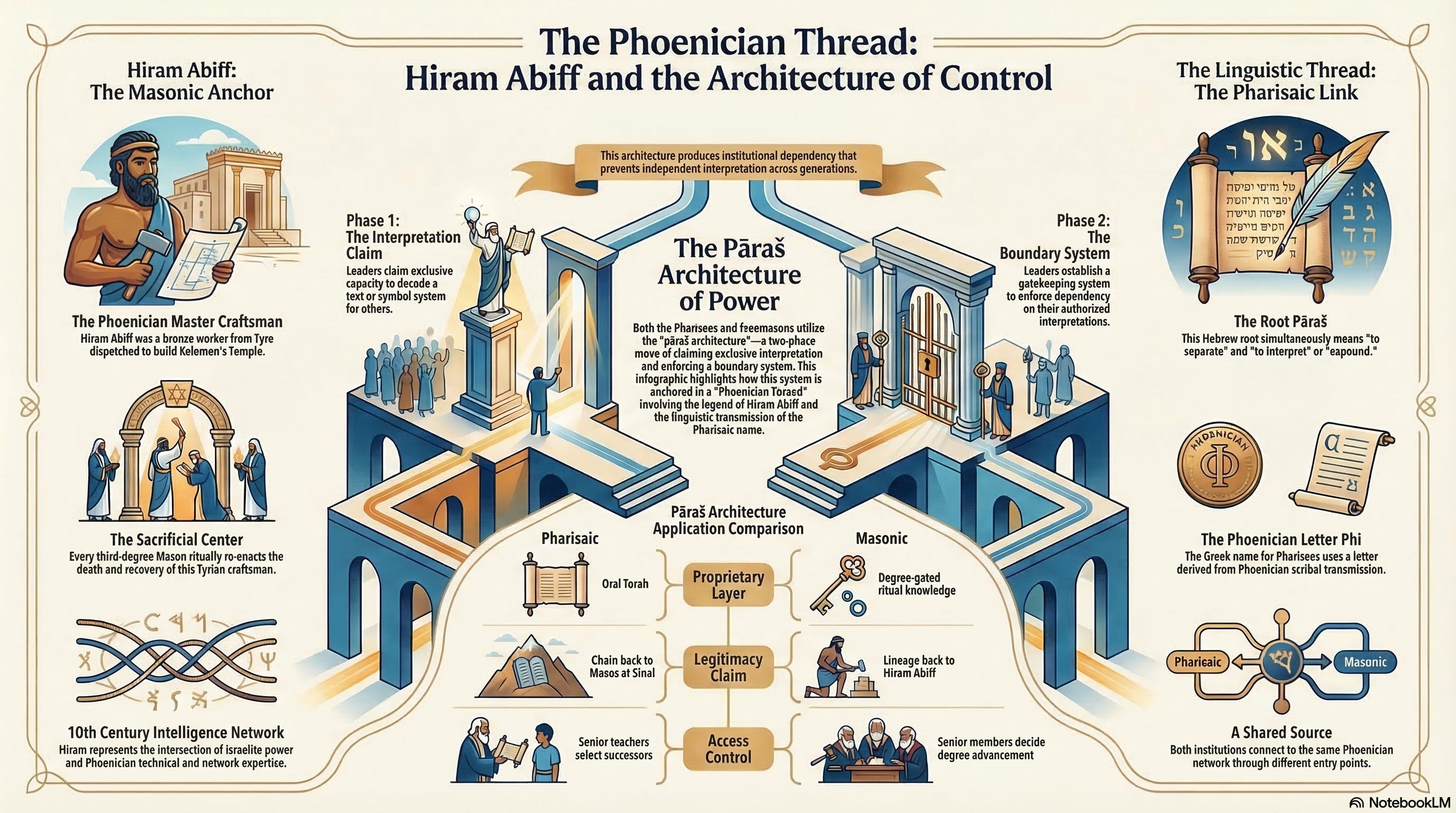
The root pāraš carries two definitions that Duke synthesizes into a unified organizational function. The first, pārû, means “to separate” or “to divide.” The second, pārûš, means “to expound,” “to specify,” or “to interpret.” Duke argues these two meanings form a deliberate two-phase loop — what he calls “the double move.” In phase one, a group claims exclusive authority to interpret a critical body of knowledge. In phase two, that same group constructs a strict boundary system to protect its interpretive monopoly from outside challenge. The interpretation justifies the boundary; the boundary ensures no one can contest the interpretation. The result is a closed, self-reinforcing system that produces permanent institutional dependency.
Duke applies a philosophical tool he calls Parmenides’ Razor — “what is, is” — to cut away self-mythology and conspiracy theory alike and observe institutional behavior on structural terms alone. The podcast hosts illustrate this through a tech-company analogy: ignore the CEO’s Congressional testimony about “connecting the world” and instead examine the platform’s algorithm, which physically fragments users into isolated echo chambers to maximize revenue. Judge the plumbing, not the marketing.
The Pharisees serve as Duke’s first case study. Their name derives from the Aramaic pĕrîšayyā, a direct derivation of pāraš — they literally called themselves “the separators and interpreters.” The written Torah (the five books of Moses) was public, read aloud in communal gatherings. The Pharisees claimed this public text was incomplete and introduced the Oral Torah — a hidden body of interpretation they said Moses received directly from God at Sinai, transmitted mouth-to-ear through an unbroken chain of custody documented in the Mishnah Avot. Because the written Torah’s commands were broad and daily life required granular detail (what constitutes “work” on the Sabbath?), ordinary Israelites were compelled to consult Pharisaic teachers for authorized rulings. The public held the text; the sect held the meaning. When Rome destroyed the Second Temple in 70 CE, the Sadducees — whose power base was the physical Temple — were eliminated. The Pharisees survived because their power base was an epistemological boundary, a portable “temple of interpretation” that required no building.
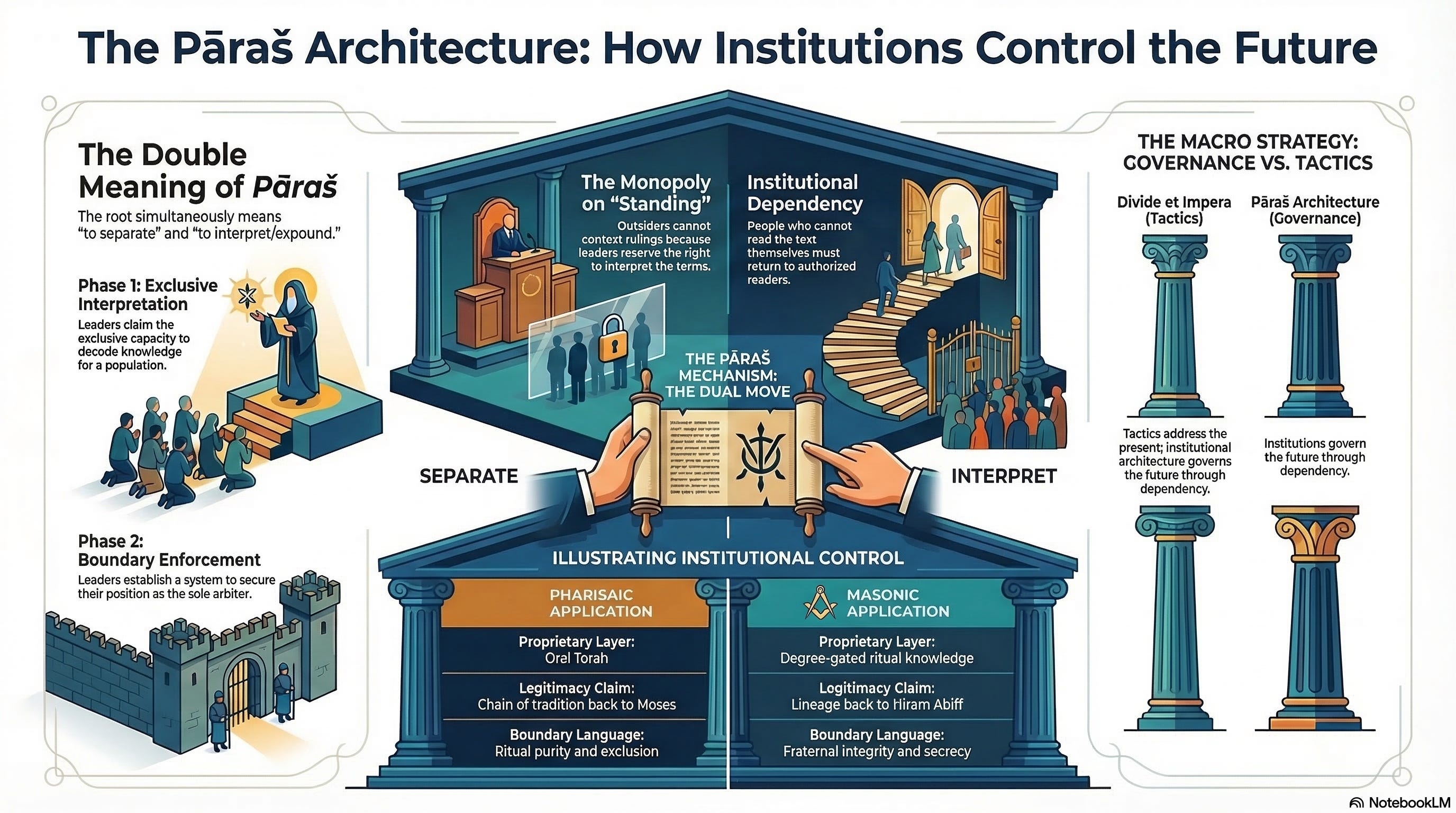
Duke’s second case study is the speculative Freemasons, who run the same double move through graded initiation. The Blue Lodge offers three foundational degrees; the Scottish Rite extends the compartmentalization up to a 32nd degree (with an honorary 33rd). Duke’s key evidence is a passage from Albert Pike’s Morals and Dogma, distributed only to Masons who had completed the 14th degree. Pike wrote that Blue Lodge initiates are “intentionally misled by false interpretations” and that “it is intended that he shall imagine he understands them.” Pike placed the admission of deception in plain sight — behind a massive boundary wall.
The podcast highlights Duke’s semiotic reading of the Masonic square and compass: the compass draws a circle (a boundary separating inside from outside), the square measures a standard (quality control determining who passes), and the letter G at the center — explained to lower initiates as “God and Geometry” — is revealed at higher degrees to represent the Hebrew letter Yod and esoteric concepts of generative principle and gnosis.
Duke traces both institutions to a shared Phoenician network of knowledge transfer. The Freemasons anchor their founding myth in Hiram Abiff, a Phoenician craftsman from Tyre. The Pharisees’ Aramaic name entered the Greek historical record through the letter Phi — a supplemental character Greek scribes created from the Phoenician alphabet to capture the aspirated Semitic consonant.
The podcast concludes with Duke’s five diagnostic markers of a pāraš organization: a proprietary interpretive layer, genealogical legitimacy claims, purity/quality language for boundary maintenance, penalty structures for unlicensed interpretation, and recursive self-authorization (insiders control who becomes an insider). The hosts then apply these markers to modern Big Tech, arguing that black-box algorithms function as a contemporary Oral Torah — interpreting users’ data while maintaining an impenetrable boundary over how the interpretation operates — thereby achieving divide et impera automatically through filter bubbles and echo chambers.
Thanks to the generosity of my readers, all my articles are available for free access. Independent journalism, however, requires time and investment. If you found value in this article or any others, please consider sharing or even becoming a paid subscriber, who benefits by joining the conversation in the comments. I want you to know that your support is always gratefully received and will never be forgotten. Please buy me a coffee or as many as you wish.

The Duke Report - Where to Start
My articles on SubStack are all free to read/listen to. If you load the Substack app on your phone, Substack will read the articles to you. (Convenient if you are driving).
Foundational Articles
Podcast (Audio & Video Content)
Palmerston’s Zoo Episode 01 - Solving the Paradox of Current World History (9 Episodes)
Oligarchic Control from the Renaissance to the Information Age
SoundCloud Book Podcasts
I’ve taken almost 200 foundational books for understanding how the world really works and posted them as audio podcasts on SoundCloud. If you load the app on your phone, you can listen to the AI robots discuss the books on your journeys across America.
Duke Report Books
Over 600 foundational books by journalists and academics that never made the New York Times Bestseller list, but somehow tell a history we never learned in school. LINK


