

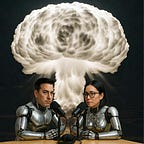

A two-bot deep dive walks through Ben Davidson’s book The Next End of the World: The Rebirth of Catastrophism, with support from the solar-weather textbook Weatherman’s Guide to the Sun. The Google bots cover their virtual asses and state at the top that they read these sources to unpack the argument, not to endorse it. They build the case over roughly 47 minutes, moving from frozen mammoths to a classified Pentagon expedition to the solar micronova that Davidson identifies as the trigger.
(00:00:00) From Casino to Metronome
Most people picture the end of the world as a stray asteroid, a super volcano waking on a random Tuesday, a chaotic cosmic casino where everyone hopes their number stays unrolled. The hosts find that randomness oddly comforting, since a person cannot plan for a lightning strike. Davidson’s sources dismantle that picture, and the hosts reframe the planet as a metronome running on a schedule, calling that move from random destruction to cyclical precision the central paradigm shift. They name uniformitarianism — the slow, drop-by-drop model of geology — as the framework the book pushes against, since that model leaves the anomalies unexplained.
(00:03:00) The Physical Evidence: Mammoths, Muck, and Stranded Oceans
The breadcrumbs of disaster come first. Flash-frozen mammoths in Siberia carry undigested food and even flower petals in their stomachs, which the hosts read as a temperature drop of perhaps a hundred degrees below zero within hours, fast enough to halt stomach acid mid-chew. A slow ice age cannot do that. They move to the muck: bone-filled surge deposits worldwide, mountains of splintered trees and mud shoved together, with a specific mention of the Pejark Marsh in Australia. Marine shells and oceanic boulders sit thousands of feet up on mountains in Wales and the Jura Mountains, which the catastrophist model reads as the ocean thrown over the mountain in a single event.
(00:06:00) Deep-Sea Canyons as Runoff Scars
Next come the Ganges Cone in the Bay of Bengal and similar features off South America’s east coast, underwater canyons that dwarf the Grand Canyon. Mainstream geology credits turbidity currents — underwater landslides of sand and silt — yet the hosts note that filmed turbidity currents churn slowly, deposit nearly as much as they carve, and work only in soft sediment. Davidson reads these canyons instead as runoff scars, the channels carved when the entire ocean rushed back off the continents and drained into the basins, like rivulets through a muddy driveway scaled to a planet.
(00:08:00) Mythological Corroboration
Cross-referencing the geology against global myth, the hosts approach ancient accounts as the careful observations of people who lacked telescopes yet knew the sky. The Buddhist Sermon of the Seven Suns describes the sun burning in distinct stages. Islamic teaching prophesies the sun rising in the wrong place under a black cloud. Peruvian myths describe the sun standing still for days; stories from the southern tip of South America echo the sun setting in the wrong place; Malaysian and Sumatran accounts describe a long night that felt unending; Zoroastrianism speaks of the sun unseen and spotted and the days shortening; Norse Ragnarok plunges the world into freezing dark as the earth sinks into a roaring ocean. The hosts stress the specificity: not vague flood stories, but consistent celestial mechanics. They compare the pattern to black boxes from a dozen separate crashes recording the same final words.
(00:11:40) The Magnetic Clock
From myth the hosts transition to measurable geophysics. They separate a magnetic reversal, which flips the poles for hundreds of thousands of years, from a magnetic excursion, a rapid flip and flip-back. Paleomagnetism preserves the record: iron particles in cooling magma at mid-ocean ridges lock in the field direction like millions of tiny compasses, so core samples read back as a tape recording of the magnetic field. During an excursion, those particles point wildly off and the field intensity drops, lowering the planet’s shield and letting space energy in.
(00:13:38) The Excursion Timeline and Severity Scale
Walking the excursions backward, the hosts cite the book’s severity scale out of ten. Gothenburg, 12,000 to 13,000 years ago, rates an 8 and aligns with the Younger Dryas, the North American megafauna extinctions, and the frozen Siberian mammoths. Lake Mungo, 24,000 to 28,000 years ago, rates a 4. Mono Lake, 33,000 to 37,000 years ago, rates a 5. Laschamp, 41,000 to 46,000 years ago, rates an 8 and marks the Neanderthal downfall. Toba, around 72,000 years ago, rates a 9, coinciding with volcanic activity and a genetic bottleneck that shrank humanity to a few thousand. The hosts read the spacing as a roughly 12,000-year cycle, with the last major event 12,000 years back, and conclude the clock has run down.
(00:15:28) The Signs Showing Now
Present measurement grounds the cycle. NASA, the European Space Agency, and the USGS all track a weakening field, down more than 10% in a century with the decay accelerating. The north magnetic pole races out of Canada across the Arctic toward Russia while the south pole leaves Antarctica for the Indian Ocean. The hosts explain the World Magnetic Model that GPS and aviation depend on, normally revised on a five-year schedule, and the unprecedented out-of-cycle emergency update forced when the pole accelerated past what the systems anticipated.
(00:17:29) The CIA Hat Trick
Why does a field with this much evidence sit at the fringe? The hosts pose that question, and the book answers with a three-part cover-up. In the 1940s, Major Maynard E. White led a Pentagon Arctic expedition that found five alternating layers of tropical and polar sediment, separated by roughly 10,000 to 12,000 years, showing the crust had shifted the poles to the tropics and back, with each shift taking about a single day. The Pentagon classified the findings; White’s son Ken later published them as World in Peril (1994).
(00:19:33) The Hapgood Distraction
The second move follows. Charles Hapgood, a figure in the OSS, held the classified data yet published a public theory of Earth crust displacement built on random pole positions and timelines that contradicted the paleomagnetic record, a straw man mainstream geologists could easily debunk. Because Hapgood became the public face of catastrophism, his defeat tainted the whole field. The hosts handle the Einstein foreword with care: Einstein, fascinated late in life by the physics of a crust shifting under slight centrifugal forces from polar ice, wrote the foreword, then died three years before Hapgood published the manipulated data. Carl Sagan and others finished dismantling the flawed version, and the field went dormant.
(00:22:18) Chan Thomas and the NSF
The third figure carries the most intrigue. Chan Thomas wrote The Adam and Eve Story in the 1960s, sold poorly, and faded out, until a 2013 FOIA request surfaced a 57-page sanitized copy inside a CIA file marked with the unusual classification code “K” for unknown origin. Thomas pinpointed the crust-mantle boundary that Hapgood missed, arguing the crust detaches while the planet keeps spinning. The hosts cite Douglas Vogt’s forensic accounting of CIA money channeled through the National Science Foundation, alongside a real 1980 Harvard Crimson exposé on CIA-funded programs at Columbia, as the means by which gatekeepers kept the debunked Hapgood version as the only one taught.
(00:24:00) Manipulated Dating
Flawed isotope dating scattered a single event across the timeline, and the hosts explain how. Carbon-14 forms when cosmic rays strike atmospheric nitrogen, and the method assumes a constant background level. A magnetic excursion or solar event floods the atmosphere with cosmic rays, spiking C-14, so bones saturated during the spike read as far older or younger than they are. The hosts cite an Australian crater readjusted from 300,000 to under 200,000 years and Tibetan ice caps moved from over 500,000 to under 20,000 years. Holding the background constant turns one synchronized global event into a scatter of unrelated accidents, hiding the metronome.
(00:26:52) Unlocking the Crust at the Low Velocity Zone
Mechanics come next. The rigid lithosphere sits on the molten mantle, and the Low Velocity Zone marks the boundary, where thermoelectric plasticity binds the crust to the spinning interior so the two move as one. They use a wet glass on a coaster: the water seal locks the glass to the coaster until a jolt or a heating breaks the seal and the glass slides free. Modern instruments already catch micro-slippage as length-of-day glitches, millisecond stutters in Earth’s rotation correlated with two phenomena: geomagnetic jerks from the core, like a pothole the car survives, and strong solar storms.
(00:29:28) The Electric Sun and Yelverton’s Olivine
Drawing on Weatherman’s Guide to the Sun, the hosts describe the sun as an electrical connection inside a global electric circuit, not just a heat lamp. They cite Billy Yelverton’s lab work: olivine, the most abundant crustal mineral, physically jumps and translocates when he charges the crystals and discharges the current, with no kinetic force applied. Scaled to a planet, an electromagnetic disruption from space travels the circuit down to the Low Velocity Zone, breaks the plasticity, and unlocks the roughly thirty-mile crust so it floats free on the spinning mantle.
(00:31:18) The Great Waves
An unlocked crust explains the oceans washing over mountains. The planet keeps spinning while the crust slides, and the oceans, carrying their own inertia, stay put and slosh over the continents at supersonic speed, like water yanked across a table in a wide bowl. This resolves the physics that defeated Hapgood: the model never stops the whole Earth, it only unlocks the thin shell.
(00:32:38) Three Clues and the Solar Micronova
Three clues defeated Thomas, and the hosts lay them out: impact craters and microtektite glass beads matching the magnetic-flip dates, the crustal shift itself, and rare short-lived nova isotopes — aluminum-26 and iron-60 — in the 12,000-year-old layers. Those transuranic isotopes decay fast, so they cannot date to the solar system’s birth and cannot have crossed deep space from a distant supernova, which means a recent, local source. A full supernova would vaporize everything from Mercury to Pluto, so the hosts introduce the solar micronova: on a luminosity scale, a supernova runs 10^43 to 10^50 ergs and destroys the star, while a micronova runs 10^33 to 10^35 ergs. They picture dynamite versus a firecracker inside a mailbox — violent, paint-stripping, yet the mailbox survives to erupt again.
(00:36:13) How the Sun Builds the Blast
Accumulation builds the blast. The sun sweeps up dust and gas as it travels the galaxy, and that material blankets the star, blocking its pressure vents, dimming it to red and then near-black while pressure builds underneath like a pressure cooker with the valve glued shut. It then sheds the blanket in a micronova, leaving the core intact. They cite Dr. Sofue at the University of Tokyo, who in 2020 found a lone star that wandered into a molecular cloud, accumulated surface material, and erupted, evidence that a star needs no binary partner to go nova.
(00:37:57) The Event Timeline at Earth
The hosts walk the sequence in three phases. Phase one, the flash: trapped light releases as visible, UV, and X-ray radiation that reaches Earth eight minutes later and sears the sun-facing side for minutes or seconds, matching the Buddhist Sermon of the Seven Suns. Phase two, the bombardment: protons and electrons arrive over four to twenty hours, supercharging the global electric circuit and delivering the jolt that penetrates to the Low Velocity Zone and unlocks the crust, the Yelverton experiment at planetary scale. Phase three, the shockwave: accelerated plasma induces planet-wide geomagnetic storms and can collapse the sun-facing field into an arc discharge from ionosphere to ground; then dust carrying aluminum-26 and iron-60 washes over the rotating Earth, depositing different concentrations on different longitudes and explaining the non-homogeneous isotope readings; then the heaviest agglomerated silicate chunks arrive as impactors. One event ties together the magnetic flip, the crustal shift, the isotopes, and the cratering.
(00:41:40) The Two-Step Freeze
A star explosion causing an ice age sounds like a paradox, and the hosts resolve it. First the flash and plasma wave vaporize ocean water into a saturated, sauna-hot atmosphere. Then the lingering solar dust shades the planet, the temperature plummets, and the suspended vapor freezes into an unprecedented global blizzard that buries the surface in days. The reflective ice locks in an albedo loop, less sunlight feeding more ice. An animal grazing in Siberia freezes fast enough that its stomach acids stop before the last meal decays.
(00:43:18) Why It Matters
The hosts call the model elegant for weaving disparate threads — muck on mountaintops, sudden ice ages, shifting poles, the 1940s Pentagon cores, manipulated carbon dating, rare isotopes, and the dark-sun myths — into one narrative that unifies sedimentology, paleomagnetism, astrophysics, and comparative mythology, fields that rarely share notes. They frame the takeaway as a shift in perspective: Earth as a dynamic, electrically connected participant in a cosmic system, with ancestors who carved real warnings into stone for descendants to read.
(00:45:17) The Universe Snitches on Itself
The hosts close on Davidson’s phrasing that the universe snitches on itself as the cycle nears its crescendo. They point to the shifting poles outrunning navigation models, the measurably weakening shield, and extreme weather as the present-day signs the ancients recorded. As a final provocation, they ask whether the sudden billionaire rush to build rockets and colonize Mars amounts to a lifeboat built before the metronome swings back. The episode ends at (00:46:51) with “keep looking up.”
Thanks to the generosity of my readers, all my articles are available for free access. Independent journalism, however, requires time and investment. If you found value in this article or any others, please consider sharing or even becoming a paid subscriber, who benefits by joining the conversation in the comments. I want you to know that your support is always gratefully received and will never be forgotten. Please buy me a coffee or as many as you wish.

The Duke Report - Where to Start
My articles on SubStack are all free to read/listen to. If you load the Substack app on your phone, Substack will read the articles to you. (Convenient if you are driving).
Foundational Articles
Podcast (Audio & Video Content)
Palmerston’s Zoo Episode 01 - Solving the Paradox of Current World History (9 Episodes)
Oligarchic Control from the Renaissance to the Information Age
SoundCloud Book Podcasts
I’ve taken almost 200 foundational books for understanding how the world really works and posted them as audio podcasts on SoundCloud. If you load the app on your phone, you can listen to the AI robots discuss the books on your journeys across America.
Duke Report Books
Over 600 foundational books by journalists and academics that never made the New York Times Bestseller list, but somehow tell a history we never learned in school. LINK


